Flower in the Crannied Wall
"Flower in the Crannied Wall" is a poem composed by Alfred Tennyson in 1863 beside the wishing well at Waggoners Wells. The poem takes a philosophical spin on flowers[1] and is one of multiple poems where Tennyson touches upon the topic of the relationship between God, nature, and human life.[2]
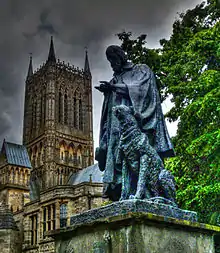
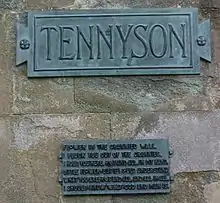
The Tennyson memorial statue was completed in 1903 by George Frederic Watts and unveiled in 1905[3] at Lincoln Cathedral, shows Tennyson holding a flower in his hand standing alongside a dog. Underneath, on the pedestal of the statue, lies a plaque of the poem. Since the statue was unveiled in 1905, there has been concerns over discoloration and disintegration. A commissioned firm specializing in bronze restoration then expressed that the statue appears similar to when it was first unveiled.[3]
Text
Flower in the crannied wall,
I pluck you out of the crannies,
I hold you here, root and all, in my hand,
Little flower—but if I could understand
What you are, root and all, and all in all,
I should know what God and man is.
Structure
In terms of stresses, the poem follows an accentual meter where there is a fixed number of stresses per line. The pattern for the number of stresses in this poem is 3-3-4-4-4-3.

Flow-er in the cran-nied wall,
I pluck you out of the cran-nies,
I hold you here, root and all, in my hand,
Little flow-er—but if I could un-der-stand
What you are, root and all, and all in all,
I should know what God and man is.
The poem also follows an ABCCAB rhyme scheme. There are also 2 instances of a feminine ending found in the second and last line.
Reception
In Literature
The phrase flower in the crannied wall is sometimes used in a metaphorical sense for the idea of seeking holistic and grander principles from constituent parts and their connections.[4]
References
- Campbell, William R. (1976). "A Note on the Flowers in "Pippa Passes"". Victorian Poetry. 14 (1): 59–63. ISSN 0042-5206.
- Tucker, Herbert F. (1983). "Tennyson and the Measure of Doom". PMLA. 98 (1): 8–20. doi:10.2307/462069. ISSN 0030-8129.
- "THE TENNYSON STATUE, LINCOLN". Tennyson Research Bulletin. 1 (4): 111–111. 1970. ISSN 0082-2841.
- Brandom, Robert (1981). "Leibniz and Degrees of Perception". Journal of the History of Philosophy. 19 (4): 447–479. doi:10.1353/hph.2008.0100.
 |
Wikisource has original text related to this article: |