Forsythia suspensa
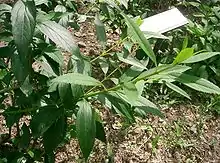
Forsythia suspensa, commonly known as weeping forsythia[3] or golden-bell,[4] is a species of flowering plant in the family Oleaceae, it is native to China.[2]
| Forsythia suspensa | |
|---|---|
 | |
Scientific classification  | |
| Kingdom: | Plantae |
| Clade: | Tracheophytes |
| Clade: | Angiosperms |
| Clade: | Eudicots |
| Clade: | Asterids |
| Order: | Lamiales |
| Family: | Oleaceae |
| Genus: | Forsythia |
| Species: | F. suspensa |
| Binomial name | |
| Forsythia suspensa | |
| Synonyms[2] | |
| |
Taxonomy
The Latinepithet of suspensa is derived from suspensus meaning suspended.[5] It was first described and published in Enum. Pl. Obs. Vol.1 on page 39 in 1804.[2]
Characteristics
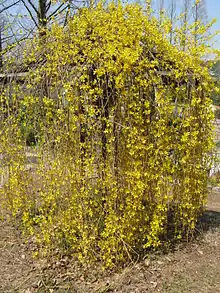
Forsythia suspensa is a large shrub. It can be grown as a weeping shrub on stream banks and can be identified by its pale flowers. Garden cultivars can be found. It is a spring flowering shrub, with yellow flowers. It is grown and prized for its toughness.[6] It is believed to be one of the parents of Forsythia × intermedia.
Uses
It is one of the 50 fundamental herbs used in traditional Chinese medicine.[7] It contains the lignans Pinoresinol[8] and phillyrin. The main active component isolated from Forsythia Fructus (the dried fruit of Forsythia suspensa) Forsythiaside A exhibits significant activities in treating various diseases, including inflammation, virus infection, neurodegeneration, oxidative stress, liver injury, and bacterial infection.[9]
References
- "Forsythia suspensa". Germplasm Resources Information Network (GRIN). Agricultural Research Service (ARS), United States Department of Agriculture (USDA). Retrieved 2008-02-06.
- "Forsythia suspensa (Thunb.) Vahl | Plants of the World Online | Kew Science". Plants of the World Online. Retrieved 11 September 2021.
- "Forsythia suspensa". Natural Resources Conservation Service PLANTS Database. USDA. Retrieved 19 January 2016.
- BSBI List 2007 (xls). Botanical Society of Britain and Ireland. Archived from the original (xls) on 2015-06-26. Retrieved 2014-10-17.
- Lewis, Charlton (1891). An Elementary Latin Dictionary. Oxford: Oxford University Press. ISBN 9780199102051.
- Royal Horticultural Society (Great Britain) (1992). The New Royal Horticultural Society Dictionary of Gardening. Macmillan Press. ISBN 978-1-56159-001-8.
- "Forsythia suspensa - Plants For A Future database report". Retrieved 2008-02-06.
- Davin, Laurence B.; Bedgar, Diana L.; Katayama, Takeshi; Lewis, Norman G. (1992). "On the stereoselective synthesis of (+)-pinoresinol in Forsythia suspensa from its achiral precursor, coniferyl alcohol". Phytochemistry. 31 (11): 3869–3874. doi:10.1016/S0031-9422(00)97544-7. PMID 11536515.
- Gong, L., Wang, C., Zhou, H., Ma, C., Zhang, Y., Peng, C., & Li, Y. (2021). "A review of pharmacological and pharmacokinetic properties of Forsythiaside A". Pharmacological Research, 169, 105690. PMID 34029711 doi:10.1016/j.phrs.2021.105690
External links
 Media related to Forsythia suspensa at Wikimedia Commons
 Data related to Forsythia suspensa at Wikispecies
- Forsythia - Forsythia suspensa, species information page - at Brickfields Country Park.
- Forsythia suspensa page