Ramsej
Ramsej or Ramshej Fort (Ramshej - Rama's bed)(Marathi: रामशेज किल्ला) is a small fort located 10 kilometres (6.2 mi) north-west of Nashik, in the Indian state of Maharashtra. It is believed that Lord Rama stayed in the fort for a short time when he travelled to Sri Lanka. The fort can be visited during the day, and is located on the busy Nashik-Vapi route.
| Ramshej Fort | |
|---|---|
| Nashik, Maharashtra, India | |
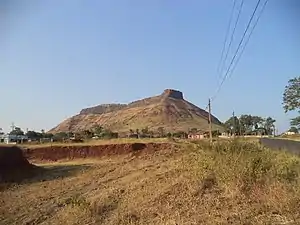 Ramshej fort from base village | |
  Ramshej Fort Ramshej Fort  Ramshej Fort Ramshej Fort (Maharashtra) | |
| Coordinates | 20.112195°N 73.767354°E |
| Type | Fort |
| Height | 3200 feet |
| Site information | |
| Owner | Govt. of India |
| Controlled by |  Maratha ( -1687) Maratha ( -1687).svg.png.webp) Moghul Empire(1687-1752) Maratha (1752-1818) Moghul Empire(1687-1752) Maratha (1752-1818) United Kingdom United Kingdom
 India (1947-) India (1947-) |
| Open to the public | Yes |
| Condition | Ruins |
| Site history | |
| Materials | Stone |
| Garrison information | |
| Past commanders | Suryaji Jadhav |
.svg.png.webp)
History
Ramsej Fort was used in the fight against the Mughal Empire that lasted for six and a half years.[1] The fort's first Killedar (Fort commander) was Suryaji Jadhav, but he was transferred after five and a half years and a new Killedar was soon appointed, as per the rotation policy of the Maratha Empire. In 1682 Aurangzeb sent Sahabuddin Khan to conquer the fort. Shahbuddin Khan, with his 40,000 man army and strong artillery, vowed to capture the fort within a few hours, but the 600 Maratha soldiers in the fort held their posts and pushed the forces back for many months with a fierce array of slingshots, lit haystacks, and huge stones - even though there were no cannons in the fort. Mughal artillery managed to break the fort walls in the evening. They assumed that the fort would be captured easily. However, all 600 Marathas on the fort worked for the full night to rebuild the entire broken section of the wall, much to the despair and awe of the Mughals.
The inability of the artillery to capture the fort made Aurangzeb very frustrated and uneasy. He raised a wooden platform to storm the fort. Marathas were amazing planners, and Shivaji and his son Sambhaji had a policy of keeping a healthy supply of ammunition in the fort, even though it had no cannons or guns. Ramsej was no exception and, even though it did not have cannons, the fort had sufficient ammunition. The Fort Commander came up with the idea to use amply-available animal skin and wood to make wooden cannons. Coupled with the ammunition already available in the fort, these wooden cannons inflicted heavy damage to the Mughal army. The retaliation from the Marathas was so strong that Aurangzeb left the command to Bahadurkhar Khan Kokaltash and fled to Junnar.
Bahadurkhan also tried to capture the fort by fooling Marathas into believing that the Mughals were preparing for a full-fledged frontal assault, while his real plan was to send 200 of his best troops from the rear side of the fort by climbing the steep cliff. The Maratha commander was aware of the fact and allowed these 200 soldiers to climb the rope. While they were climbing up the rope, he cut the rope and as a result 200 of the best Mughal soldiers fell and died in the valley. Bahadurkhan was distraught and found that Marathas were receiving secret supplies from the nearby forts. He carefully blocked all the paths to nearby Maratha forts. It created a dire shortage of food in the fort. Seeing the situation, Maratha King Sambhaji acted quickly by sending his sardars - Rupaji Bhosle and Manaji - with an 8,000 extra soldiers and more supplies.
They tried to break through the Mughal line but were unable to supply the fort. Sambhaji worried greatly that his fiercely loyal and brave warriors were fighting without food. However, the weather supported the Marathas and due to severe weather conditions, Bahadurkhan relaxed his encirclement for one day. This enabled Rupaji and Manaji to supply the fort with supplies enough for six more months. Bahadurkhan then tried to win the fort with the help of a 'mantrik' believing that the Marathas had ghosts under their control.
The Marathas again fooled him as the Mantrik was himself as a Maratha soldier in disguise who led the Mughal army to a deadly ambush of the Marathas. Bahadurkhan and Mughals fled the deadly ambush and several Mughals were killed in this surprise attack. Bahadurkhan was unable to siege the fort. Finally, he burnt the wooden platform and left the battle. Aurangzeb sent Kasim Khan Kirmani to lead the battle[2] and the Mughals conquered Ramshej Fort. Ramsej was one of the forts which surrendered to the British Army in 1818 after the fall of Trymbakgad fort.[3] Captain Briggs reported that there were eight guns, 9 small cannons called jamburasand 21 jingals on the fort.
Places to see
The Fort is located on a high tableland with escarpments on all sides. There are good steps on the eastern side of the fort which lead to the entrance gate. A temple of Lord Ram is at the entrance of the fort. There is a water cistern near the temple holding potable water.
On the eastern side of the fort is the main gate to the fort which is chiseled from the parent rock. There are many rock-cut water cisterns on the fort. The hidden entrance gate on the eastern side of the fort leads the path to Bhorgad fort which is about 3.21 km. (two miles) north-west of Ramsej
Track to fort goes from right side behind the village by keeping fort at the left side. it takes around 1 hour to climb the fort from this route.
Gallery
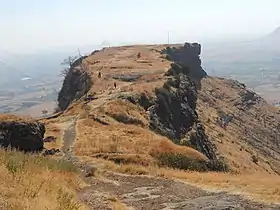 plateau on Fort
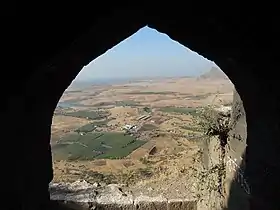 Outside view
 Sunshine on the fort
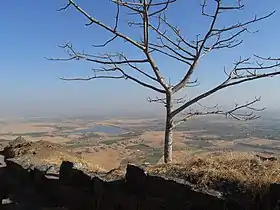 Tree stood alone on the fort
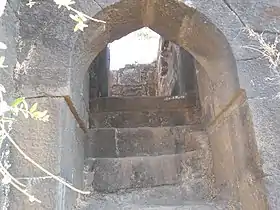 Staircase
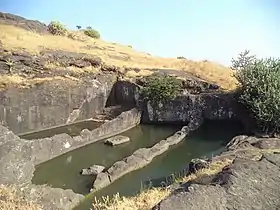 Rockcut water cistern
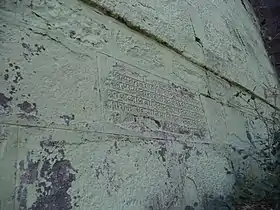 Inscriptions on the temple wall
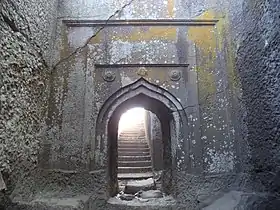 Main entrance gate