Foundational skills
Foundational skills comprise the skills of basic literacy and numeracy.[1] Someone who has acquired mastery of foundational skills can, therefore, read and write in at least one method of writing, and comprehend fundamental arithmetical operations like addition, subtraction, multiplication, and division. Mastery of foundational skills involves the instant, fluent, speedy execution of tasks—such as instantly comprehending a word that is perceived, fluently pronouncing a sentence that is read, and speedily computing a simple arithmetical operation (e.g., 2+2=4).
The global focus on foundational skills
Since the 1990s, major players in the international community have placed importance on ensuring the acquisition of foundational skills among children across the world. In 1990, for example, UNESCO's Jomtien Declaration emphasized that "literacy is a necessary skill in itself and the foundation of other life skills".[2] A decade later in 2000, the World Education Forum published the Dakar Framework for Action, which made a commitment to "[improve] all aspects of the quality of education and [ensure] excellence of all, so that recognized and measurable learning outcomes are achieved by all, especially in literacy, numeracy and essential life skills".[3] And finally in 2020, the World Bank, through its Education Strategy, stated that the organization's "overarching goal is not just schooling, but learning", and that "lifelong learning" depends on the achievement of foundational literacy and numeracy.[4] There are several reasons why these organizations have placed such a strong focus on foundational skills:
The cumulative nature of learning
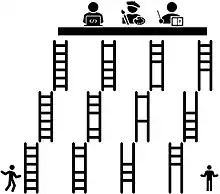
Acquisition of foundational skills receives widespread attention because human learning is a cumulative process. This is a result of how working memory and long-term memory interact. Working memory has a very limited capacity for actively processing new knowledge, but this capacity expands greatly when building on knowledge that has previously been incorporated into long-term memory.[5][6] A foundation of prior knowledge in long-term memory enables children to use their working memory to build new knowledge on top of this foundation. In other words, mastery of foundational skills is critical to unlocking children's ability to access more complex content.[7]
A useful metaphor to consider is to think of foundational skills as rungs on a ladder that leads to important outcomes later in life, such as higher education and gainful employment.[8] For the ladder to function effectively, it must have enough rungs in place to enable someone to climb it safely and make progress on their learning journey. Here and there, a missing rung or two will not compromise progress overall. However, large gaps will prevent upward movement completely. As the critical lower rungs on the ladder, foundational skills enable further education. Without a firm grasp on these skills, children will struggle to understand concepts that are more complex, and are unlikely to progress to higher-order learning.[1] In a similar vein, foundational skills have been likened to the foundations of a skyscraper, without which further learning cannot take place:
"[Failing to prioritize the development of foundational skills over other learning objectives] is a bit of an invitation to build a skyscraper not from the foundation up, but by placing windows, doors, and roof mid-air, in defiance of gravity."
— Girindre Beeharry, Bill & Melinda Gates Foundation [9]
The learning crisis
The fact that a lack of foundational skills hinders future learning is evidenced by vast amounts of data on the global learning crisis—the reality that while the majority of children around the world attend school, a large proportion of them are not learning. For example, a World Bank study found that "53 percent of children in low- and middle-income countries cannot read and understand a simple story by the end of primary school."[10] Additionally, across seven low- and middle-income countries that participated in PISA for Development, only 12 percent of children who were tested met minimum proficiency levels for math, and just 23 percent for reading.[11]
There are a multitude of reasons why children in education systems around the world are not learning, such as curricula being too fast-paced relative to students' actual learning pace, misalignment between what examinations test for and what curricula aim to teach children, and teachers being too under-skilled and under-supported to provide high quality teaching in the classroom.[12] However, the outcome is the same: children fail to conceptually and procedurally master foundational skills, which impedes future learning progress and causes them to fall behind. This is especially true of children who fall within the bottom tercile of their class in terms of current learning levels (i.e., children who are the farthest behind their peers).[13]
Consequences of a lack of foundational skills
Children failing to acquire foundational skills has several negative implications on their lives. Firstly, children's learning levels are massively predictive of the number of years of schooling they will complete, indicating that low learners are more likely to drop out of school entirely than their peers.[14] A recent mixed methods study finds both a strong quantitative association between low learning and later dropout in Kenya, and were able to trace back the underlying reason for dropout to low learning through interviews with parents and students.[15] The rationale for this is fairly straightforward. When children and/or parents realize how little a child is actually learning in school, the opportunity cost of sending that child to school reaches a point where it is no longer an attractive option. In some cases, children may exercise agency in the decision of whether or not to remain in school, while in other cases, parents may make this decision.[16]
This is problematic for several reasons. Firstly, qualitative research also shows that low learning, due to a lack of mastery of foundational skills, exacerbates proximate causes of school dropouts, such as early marriage (for girls) and entering the workforce (for boys).[16] Additionally, low learning, whether it is due to dropping out or a prolonged pause in education in early years, has been shown to result in lower future lifetime income among children.[17]
Universal, early, conceptual and procedural mastery of foundational skills
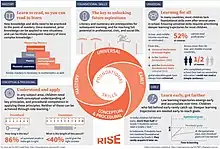
Given the importance of foundational skills in enabling children to learn in the future, education systems, education researchers have emphasized the need to cultivate universal, early, conceptual and procedural mastery of foundational skills (UECPMFS).[7] The rationale for each of these components is as follows:
'Universal'
- Global education goals have always been universal.
- This includes the Universal Declaration of Human Rights in 1948; the World Declaration on Education for All in 1990 (also referred to as the Jomtien Declaration); the Millennium Development Goals that specified universal access to primary schooling as a target; and the Sustainable Development Goal for education (SDG 4) that aims for every child in the world to gain at least minimum proficiency in basic skills by 2030.
- Most children lack foundational skills.
- Despite these universal declarations, most children lack foundational skills in many countries, even after spending many years in school. In fact, the World Bank's learning poverty measure shows that 80% of 10-year-olds in low-income countries are not able to read and understand a simple text.[10]
- Increasing access to schooling alone will not ensure learning.
- Achieving the goal of learning for all will require understanding not only the learning levels and trajectories of children who are enrolled, but of all children. The latter requires models that can simulate counterfactual scenarios of learning among those not currently enrolled to get to the full picture of cohort learning. What limited data is available on such counterfactuals suggests that more schooling alone would leave many without basic skills, and would have little to no effect on the percentage of children reaching the minimum proficiency levels stipulated in the SDGs.[18]
- Most learning measures focus on students, not cohorts.
- Many learning assessments focus only on children who are in school, rather than measure the learning of an entire cohort of children both in and out of school. As a result, these learning assessments depict progress on student learning for children that are enrolled, but they do not indicate progress on cohort-wide learning. This means that current measures are likely overestimating the state of learning among children.
'Early'
Evidence from learning profiles shows that learning gaps emerge early—and when children fall behind early, they rarely catch up. For example, an evaluation of textbook provision in rural Kenya concluded that only top-performing students saw test score gains from the availability of additional textbooks, while the intervention had no impact on lower performing students.[19] This is because an overambitious curriculum had left children so far behind they had not mastered English-language literacy, so they did not benefit from English textbooks. Similarly, an evaluation of the effect of primary school scholarships in rural Cambodia found that poverty targeted scholarships increased enrolment and attainment but had no effect on learning. Children were already so far behind that increased enrolment had no impact on the learning achieved.[20]
'Conceptual and procedural'
Children must gain conceptual knowledge (i.e., understanding the principles within a particular domain such as literacy or numeracy), as well as procedural knowledge (i.e., being able to fluently complete tasks in the domain), neither of which can be achieved through rote learning. Conceptual knowledge is an understanding of the principles and interrelationships within a particular domain, whereas procedural knowledge is an ability to use sequences of actions to complete tasks in a domain.
'Mastery'
For student learning to be meaningful and practicable, it needs to develop to a certain level of mastery. Without such mastery, any new learning attained will not be sufficiently consolidated for a child (or adult) to use effectively and flexibly, whether as a basis for more advanced learning or for responding to one's environment in daily life. A foundation of prior knowledge in long-term memory enables children to use their working memory to build new knowledge on top of this foundation. In an education system, if a teacher asks a student to complete a learning task for which they lack sufficient prior knowledge, then either:
- They will fail to complete the task;
- They will complete the task superficially, but will remember the new content inaccurately because they lack the prior knowledge needed to construct accurate mental representations of the new content;[21] or
- They will complete the task superficially, but will not remember any of the new content because their working memory was fully occupied with strategies for completing the task, leaving no room for thinking about the meaning of the new content.[22]
See also
References
- Kilburn, Lillie. “What Do We Mean By 'Foundational Skills'?” RISE Programme, 3 Dec. 2020, http://riseprogramme.org/blog/what-do-we-mean-foundational-skills
- "World Declaration on Education for All and Framework for Action to Meet Learning Needs". UNESCO. 1990. World Conference on Education. https://www.right-to-education.org/sites/right-to-education.org/files/resource-attachments/UNESCO_World_Declaration_For_All_1990_En.pdf
- "The Dakar Framework for Action". UNESCO. World Education Forum. 2000. https://sustainabledevelopment.un.org/content/documents/1681Dakar%20Framework%20for%20Action.pdf
- "Learning for All Investing in People’s Knowledge and Skills to Promote Development". World Bank Group. 2020.https://pubdocs.worldbank.org/en/418511491235420712/Education-Strategy-4-12-2011.pdf
- Abadzi, H. 2020. Skills to Stay: Memory functions in 21st-century education. Cambridge Partnership for Education Insight. Cambridge University Press. http://services.cambridge.org/files/8215/9860/7008/Abadzi_CambridgeER_Memory_Functions_WEB.pdf
- National Academies of Sciences, Engineering, and Medicine. 2018. How People Learn II: Learners, Contexts, and Cultures. National Academies Press. https://doi.org/10.17226/24783
- Belafi, C., Hwa, Y., and Kaffenberger, M. 2020. Building on Solid Foundations: Prioritising Universal, Early, Conceptual and Procedural Mastery of Foundational Skills. RISE Insight Series. 2020/021. https://doi.org/10.35489/BSG-RISE-RI_2020/021
- Abadzi, Helen. “In Order to Rise High, We Must Dig Low.” RISE Programme, 2 Dec. 2020, http://riseprogramme.org/blog/in-order-to-rise-high-we-must-dig-low
- "The Pathways to Progress on SDG 4: A Symposium". Center For Global Development, 2021. https://www.cgdev.org/reader/pathway-progress-sdg4-symposium?page=0 report
- "Learning Poverty." World Bank, 15 Oct. 2019, http://worldbank.org/en/topic/education/brief/learning-poverty
- Kaffenberger, Michelle. "What Have We Learned about the Learning Crisis?" RISE Programme, http://riseprogramme.org/blog/learned_about_learning_crisis
- Atuhurra, J. and Kaffenberger, M. 2020. System (In)Coherence: Quantifying the Alignment of Primary Education Curriculum Standards, Examinations, and Instruction in Two East African Countries. RISE Working Paper Series. 20/057. https://doi.org/10.35489/BSG-RISE-WP_2020/057
- Muralidharan, Karthik, Abhijeet Singh, and Alejandro J. Ganimian. 2019. "Disrupting Education? Experimental Evidence on Technology-Aided Instruction in India." American Economic Review, 109 (4): 1426-60.https://econweb.ucsd.edu/~kamurali/papers/Published%20Articles/Disrupting_education_AER.pdf
- Singh, Abhijeet. “RISE Annual Conference 2019”. Test Scores and Educational Opportunities: Panel Evidence from Five Countries. RISE, 20 June 2019, http://riseprogramme.org/events/rise-annual-conference-2019
- Zuilkowski, Stephanie Simmons & Jukes, Matthew C.H. & Dubeck, Margaret M., 2016. “I failed, no matter how hard I tried”: A mixed-methods study of the role of achievement in primary school dropout in rural Kenya," International Journal of Educational Development, Elsevier, vol. 50(C), pages 100-107. https://www.poverty-action.org/sites/default/files/publications/Zuilkowski%20Jukes%20Dubeck%202016.pdf
- Kaffenberger, M., Sobol, D. and Spindelman, D. 2021. The Role of Low Learning in Driving Dropout: A Longitudinal Mixed Methods Study in Four Countries. RISE Working Paper Series. 21/070. https://doi.org/10.35489/BSG-RISE-WP_2021/070
- Andrabi, T., Daniels, B., Das, J. 2020. Human Capital Accumulation and Disasters: Evidence from the Pakistan Earthquake of 2005. RISE Working Paper Series. 20/039. https://doi.org/10.35489/BSG-RISE-WP_2020/039
- Kaffenberger, M. and Pritchett, L. 2020. Failing to Plan? Estimating the Impact of Achieving Schooling Goals on Cohort Learning. RISE Working Paper Series. 20/038. https://doi.org/10.35489/BSG-RISE-WP_2020/038
- Glewwe, Paul, Michael Kremer, and Sylvie Moulin. 2009. "Many Children Left Behind? Textbooks and Test Scores in Kenya." American Economic Journal: Applied Economics, 1 (1): 112-35. https://www.aeaweb.org/articles?id=10.1257/app.1.1.112
- Barrera-Osorio, Felipe and de Barros, Andreas and Filmer, Deon, Long-Term Impacts of Alternative Approaches to Increase Schooling: Evidence from a Scholarship Program in Cambodia (August 23, 2018). World Bank Policy Research Working Paper No. 8566, Available at SSRN: https://ssrn.com/abstract=3238409
- Kirschner, P. A., Sweller, J., and Clark, R. E. 2006. Why Minimal Guidance During Instruction Does Not Work: An Analysis of the Failure of Constructivist, Discovery, Problem-Based, Experiential, and Inquiry-Based Teaching. Educational Psychologist, 41(2), 75–86. https://doi.org/10.1207/s15326985ep4102_1
- Sweller, J. 2010. Element Interactivity and Intrinsic, Extraneous, and Germane Cognitive Load. Educational Psychology Review, 22(2), 123–138. https://doi.org/10.1007/s10648-010-9128-5