Franciszek Honiok
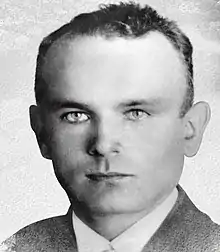
Franciszek Honiok (1896 – 31 August 1939) is famous for having been the first victim of World War II, on 31 August 1939.[1][2]
Franciszek Honiok | |
|---|---|
 | |
| Born | 1896 |
| Died | August 31, 1939 Katowice, Śląskie, Poland |
| Cause of death | Lethal Injection, Shot multiple times |
He was the unfortunate victim of the Gleiwitz incident, that was a part of Operation Himmler, a multi-part false flag operation contrived by German SS Reichsführer, Heinrich Himmler and his deputy, Schutzstaffel (SS)-Obergruppenführer Reinhard Heydrich as a pretext to aid German Führer Adolf Hitler's plan to invade Poland.[3]
Background
A self-described Silesian (German: Oberschlesier, Silesian: Ślōnzŏk), Franciszek was living as a 43-year old unmarried Catholic farmer and agricultural equipment salesman. Born in Upper Silesia (a border region spanning present day Poland and the Czech Republic) in 1896, he had fought on the Polish side during the 1921 Silesian Uprisings that followed World War I. After a brief spell living in Poland, he returned to Germany in 1925, where he was forced to fight deportation back to Poland—a case he successfully pursued all the way to the League of Nations in Geneva. Though his firebrand days may have been over by 1939, Honiok was still well known in his German home village of Hohenlieben (modern day, Lubie) — about 10 miles north of Gleiwitz (modern day, Gliwice) —as a staunch advocate of the Polish cause.[4]
Arrest
Franciszek had been arrested by the SS in the village of Pohlom on August 30, and was ruthlessly selected as the person who would provide the proof of Polish aggression against Germany. He appears to have been selected because of his involvement in a number of local revolts against German rule in Silesia. According to his surviving family in Poland, Honiok identified strongly with Silesia and Poland. He underwent a brief incarceration at the police barracks in Beuthen.
Heydrich connection
According to the 1945 Nuremberg trials declaration by Alfred Naujocks,[5] the SS-Sturmbannfuhrer (Major) who was in charge of the operation for Heydrich, at a meeting in Berlin, Heydrich told him how a body, dressed in Polish uniform, was to be left on the Gleiwitz radio station steps to prove the Polish connection. The top secret operation was given a codeword: Großmutter gestorben, ("Grandmother died"), to be used by Heydrich to indicate to Naujocks via telephone that the operation was to commence.
Death
Franciszek was dazed with drugs before the raid. He was dragged semi-unconscious into the radio station, where he was shot in the head during the evening of 31 August. Naujocks added that Honiok had been referred to as a piece of Konserve, or "canned meat", which could be prepared in advance and used to suggest Polish involvement in the attack.
The location of Franciszek's body is unknown, and no memorial exists in his memory.
References
- Lightbody, Bradley (31 July 2004). The Second World War: Ambitions to Nemesis (2004 ed.). Routledge. p. 304. ISBN 9781134592722.
- Graham, Bob. "World War II's first victim". The Telegraph. Telegraph Media Group. Archived from the original on 14 March 2012. Retrieved 29 December 2018.
- "The Learning Network". The New York Times.
- Moorhouse, Roger. "The Man Who Started World War II". History Net. World War II magazine. Retrieved 29 December 2018.
- "Connecticut Digital Archive | Connect. Preserve. Share".