Frank Dikötter
Frank Dikötter (/diːˈkʌtər/; Chinese: 馮客; pinyin: Féng Kè) is a Dutch historian who specialises in modern China. Dikötter has been Chair Professor of Humanities at the University of Hong Kong since 2006. Before relocating to Hong Kong, he was Professor of the Modern History of China at the School of Oriental and African Studies at the University of London.
Frank Dikötter | |
|---|---|
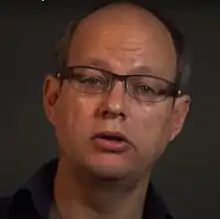 Dikötter in 2013 | |
| Born | 30 November 1961[1] Stein, Limburg, Netherlands |
| Nationality | Dutch |
| Alma mater | University of Geneva School of Oriental and African Studies, University of London |
| Occupation |
|
Notable work | Mao's Great Famine |
| Awards | 2011: Samuel Johnson Prize |
| Website | frankdikotter |
Work
Dikötter is the author of The People's Trilogy,[2] three books that document the impact of Communist-led China on the lives of ordinary people on the basis of new archival material.[3] The first volume, titled Mao's Great Famine, won the 2011 Samuel Johnson Prize (now called the Baillie Gifford Prize) for nonfiction,[4] Britain's most prestigious book award for non-fiction, in 2010.[5] The second installment, The Tragedy of Liberation: A History of the Chinese Revolution, 1945–1957, was shortlisted for the Orwell Prize in 2014,[6] losing out to This Boy by Alan Johnson.[7] The Cultural Revolution: A People's History, 1962–1976, concludes the trilogy and was shortlisted for the PEN International Hessell-Tiltman Prize in 2017.[8]
In Patient Zero (2003) and Narcotic Culture (2004), Dikötter posits that the impact of the prohibition of opium on the Chinese people led to greater harm than the effects of the drug itself. These works have been poorly received by academics, with Chinese historian Kathleen L. Lodwick saying that "Narcotic Culture appears to be one of the revisionist histories of which there have been several lately that have aimed at convincing us that imperialism wasn't all that bad, or at least that we should not blame the imperialists, in this case the opium traders who made vast fortunes from the trade, for the social problems they created. Closer attention to accuracy in the bibliography would have caught some errors, which appear more than once and so are not simply typos."[9]
In 2010, Pankaj Mishra described Dikötter's work as "boldly and engagingly revisionist",[10] leading to a public dispute between the two.[11] Adam Cathcart, lecturer of Chinese history at University of Leeds, has pointed out Dikötter's problematic use of sources.[12][13] Mao's biographer Philip Short wrote that "Dikötter's errors are strangely consistent. They all serve to strengthen his case against Mao and his fellow leaders." In reference to Dikötter's errors and misleading comments, Short said the main problem with Dikötter's book is that it does not offer credible explanation of why Mao and his colleagues acted as they did. Short posited that Dikötter's book "set out to make the case for the prosecution, rather than providing balanced accounts of the periods they describe."[14]
Awards
- 2011: Samuel Johnson Prize for Mao's Great Famine
- 2017: honorary doctorate from Leiden University
List of works
- 1992: The Discourse of Race in Modern China – digital edition
- 1995: Sex, Culture and Modernity in China: Medical Science and the Construction of Sexual Identities in the Early Republican Period
- 1997: The Construction of Racial Identities in China and Japan
- 1998: Imperfect Conceptions: Medical Knowledge, Birth Defects and Eugenics in China
- 2002: Crime, Punishment and the Prison in Modern China
- 2003: Patient Zero: China and the Myth of the Opium Plague – digital edition
- 2004: Narcotic Culture: A History of Drugs in China
- 2007: Exotic Commodities: Modern Objects and Everyday Life in China
- 2008: The Age of Openness: China Before Mao
- 2010: Mao's Great Famine: The History of China's Most Devastating Catastrophe, 1958–1962
- 2013: The Tragedy of Liberation: A History of the Chinese Revolution, 1945–1957
- 2016: The Cultural Revolution: A People's History, 1962–1976
- 2019: How to Be a Dictator: The Cult of Personality in the Twentieth Century
See also
References
- "Home". Web.mac.com. Archived from the original on 20 May 2012. Retrieved 21 November 2021.
- "Home". Frank Dikötter. Archived from the original on 11 November 2021. Retrieved 21 November 2021.
- McHugh, Fionnuala (23 June 2016). "What drives Frank Dikötter, chronicler of China's insanity?". South China Morning Post. Archived from the original on 26 June 2016. Retrieved 21 November 2021.
- "The Samuel Johnson Prize 2011". The Baillie Gifford Prize for Non-Fiction. Retrieved 21 November 2021.
- Lea, Richard (30 November 2015). "Goodbye Samuel Johnson, hello Baillie Gifford: top non-fiction prize gets new sponsor – and new name". The Guardian. ISSN 0261-3077. Retrieved 21 November 2021.
- "The Dark Beginnings of Communist China". HKU Bulletin. Vol. 15 no. 2. University of Hong Kong. Retrieved 21 November 2021.
... The Tragedy of Liberation: A History of the Chinese Revolution 1945–1957, a new book by Chair Professor of Humanities Frank Dikötter which has recently been shortlisted for the Orwell Prize ... .
- "2014 Book Prize Winner". The Orwell Prize. Orwell Foundation. Retrieved 21 November 2021.
- Cowdrey, Katherine (7 June 2017). "'Satisfying' PEN Hessell-Tiltman Prize shortlist revealed". The Bookseller. Retrieved 21 November 2021.
- Lodwick, Kathleen L. (Spring 2005). "Narcotic Culture: A History of Drugs in China (review)". China Review International. 12 (1): 74–76. doi:10.1353/cri.2005.0147. ISSN 1527-9367.
- Mishra, Pankaj (20 December 2010). "Staying Power: Mao and the Maoists". The New Yorker. Retrieved 21 November 2021.
- Dikötter, Frank; Mishra, Pankaj (15 November 2011). "Interview: Frank Dikötter, Author of 'Mao's Great Famine' [Updated]". Asia Society. Asia Society Policy Institute. Retrieved 21 November 2021.
- Cathcart, Adam (8 January 2019). "Mistranslating Mao in Chengdu, 1958". Adam Catchart. Retrieved 31 October 2021.
- Cathcart, Adam (17 March 2021). "Quantifying Civilian Casualties in the Northeast during the Chinese Civil War". Sino-NK. Retrieved 31 October 2021.
- Short, Philip (2017). Mao: The Man Who Made China. London: I.B.Tauris. ISBN 9781784534639.
External links
Authority control  | |
|---|---|
| General | |
| National libraries | |
| Other | |