Friedhelm Hummel
Friedhelm Hummel (born 1969 in Laichingen, Germany) is a German neuroscientist and neurologist. As a full professor he hold the Defitech Chair of Clinical Neuroengineering at École Polytechnique Fédérale de Lausanne, the head of the Hummel Laboratory at EPFL's School of Life Sciences.[1][2] He also is an associate professor of clinical neuroscience at the University of Geneva.[3]
Professor Friedhelm Hummel | |
|---|---|
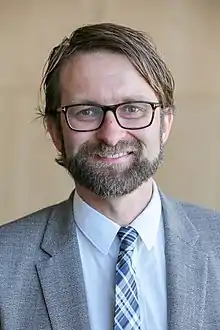 Friedhelm Hummel in 2016 | |
| Born | 1969 (age 51–52) Laichingen, Germany |
| Citizenship | Germany |
| Known for | Neurorehabilitation |
| Awards | Felgenhauer Symposiums Prize Prize of the German Society of Neurotraumatology and Clinical Neurorehabilitation Dr. Martini Prize |
| Academic background | |
| Education | Medicine |
| Alma mater | University of Tübingen University of Bordeaux |
| Thesis | Elastische Veränderungen durch semantische klassische Konditionierung und ihre elektrokortikalen Korrelate: eine Studie langsamer Potentiale (2000) |
| Academic work | |
| Discipline | Neuroscience |
| Sub-discipline | Neurorehabilitation |
| Institutions | EPFL (École Polytechnique Fédérale de Lausanne) |
| Main interests | Stroke recovery Motor control Neuroplasticity Non-invasive brain stimulation Structural and functional neuroimaging |
| Website | https://www.epfl.ch/labs/hummel-lab/ |
Career
Hummel studied medicine at University of Tübingen and at Bordeaux Segalen University and graduated in 1998. He then joined the Department of Neurology at University of Tübingen as a medical resident and researcher.[4] He earned his medical doctor in 2000 for his work on Plastische Veränderungen durch semantische klassische Konditionierung und ihre elektrokortikalen Korrelate: eine Studie langsamer Potentiale (Plastic changes through semantic classical conditioning and their electrocortical correlates: a study of slow potentials).[5]
In 2003, he joined the NINDS at the National Institutes of Health in Bethesda supported by a Feodor Lynen grant from the Alexander von Humboldt Foundation.[6][7] In 2005, he returned as researcher and medical resident to the Department of Neurology at Tübingen,[8] before starting in 2006 at the University Medical Center Hamburg-Eppendorf in the same function.[9] In 2006, he became the head of the Brain Imaging and Neurostimulation (BINS) Laboratory at Hamburg, followed by senior physician in 2007,[10][11] co-chairman at the Centre for Sleep Medicine in 2008, senior neurologist in 2013, and vice-director of the Department of neurology in 2013.[12][13]
Since 2016 he holds the Defitech Chair of Clinical Neuroengineering as full professor, is the director of the Centre for Neuroprosthetics and the Brain Mind Institute, both at EPFL,[1][2] and is associate professor of clinical neuroscience at the University of Geneva.[3]
Research
Hummel's research is in systems and translational neuroscience. His focus is on neuroplasticity, neuronal control of sensorimotor function, motor skill acquisition and learning, and healthy aging. He is interested in stroke in the acute and chronic phase, neurofibromatosis and extrapyramidal movement disorders like dystonia,[14] particularly functional reorganization and recovery after focal brain lesions by using multimodal systems neurosciences approaches including neuroimaging, brain stimulation and psychophysical and clinical evaluations.[7][15][16]
He investigates the fundamental mechanism of healthy aging and functional regeneration after focal brain lesions, such as after stroke or traumatic brain injury. He is also interested in clinical rehabilitation through modulation, such as by non-invasive brain stimulation.[6][17]
His research was featured in news outlets such as NZZ,[18] Le Nouvelliste, Physics World,[19] Der Spiegel,[20] and Focus.[21]
Distinctions
Hummel is the recipient of the 2015 Felgenhauer Symposiums Prize of the German Neurological Society and the Felgenhauer Foundation;[22] the 2013 prize of the German Society of Neurotraumatology and Clinical Neurorehabilitation;[23] the 2010 Dr. Martini Prize;[24] the 2005 Susanne Klein-Vogelbach Prize;[25] 2005 Fellows Award for Research Excellence by the National Institutes of Health; and the 2003 Feodor Lynen Research Fellowship Award by the Alexander von Humboldt Foundation.[23]
He is a member of the German Neurological Society,[26] the Society for Neuroscience, and the Society for the Neural Control of Movement.[27]
Selected works
- Nitsche, Michael A.; Cohen, Leonardo G.; Wassermann, Eric M.; Priori, Alberto; Lang, Nicolas; Antal, Andrea; Paulus, Walter; Hummel, Friedhelm; Boggio, Paulo S.; Fregni, Felipe; Pascual-Leone, Alvaro (July 2008). "Transcranial direct current stimulation: State of the art 2008". Brain Stimulation. 1 (3): 206–223. doi:10.1016/j.brs.2008.06.004. ISSN 1935-861X. PMID 20633386. S2CID 16352598.
- Lefaucheur, Jean-Pascal; André-Obadia, Nathalie; Antal, Andrea; Ayache, Samar S.; Baeken, Chris; Benninger, David H.; Cantello, Roberto M.; Cincotta, Massimo; de Carvalho, Mamede; De Ridder, Dirk; Devanne, Hervé (November 2014). "Evidence-based guidelines on the therapeutic use of repetitive transcranial magnetic stimulation (rTMS)". Clinical Neurophysiology. 125 (11): 2150–2206. doi:10.1016/j.clinph.2014.05.021. ISSN 1388-2457. PMID 25034472. S2CID 206798663.
- Gandiga, Prateek C.; Hummel, Friedhelm C.; Cohen, Leonardo G. (April 2006). "Transcranial DC stimulation (tDCS): A tool for double-blind sham-controlled clinical studies in brain stimulation". Clinical Neurophysiology. 117 (4): 845–850. doi:10.1016/j.clinph.2005.12.003. ISSN 1388-2457. PMID 16427357. S2CID 25934876.
- Hummel, F. (2005-01-05). "Effects of non-invasive cortical stimulation on skilled motor function in chronic stroke". Brain. 128 (3): 490–499. doi:10.1093/brain/awh369. ISSN 1460-2156. PMID 15634731.
- Hummel, Friedhelm C; Cohen, Leonardo G (August 2006). "Non-invasive brain stimulation: a new strategy to improve neurorehabilitation after stroke?". The Lancet Neurology. 5 (8): 708–712. doi:10.1016/s1474-4422(06)70525-7. ISSN 1474-4422. PMID 16857577. S2CID 9509765.
- Pulvermüller, Friedemann; Härle, Markus; Hummel, Friedhelm (2001-08-01). "Walking or Talking?: Behavioral and Neurophysiological Correlates of Action Verb Processing". Brain and Language. 78 (2): 143–168. doi:10.1006/brln.2000.2390. ISSN 0093-934X. PMID 11500067. S2CID 40912475.
- Sauseng, Paul; Klimesch, Wolfgang; Heise, Kirstin F.; Gruber, Walter R.; Holz, Elisa; Karim, Ahmed A.; Glennon, Mark; Gerloff, Christian; Birbaumer, Niels; Hummel, Friedhelm C. (2009). "Brain Oscillatory Substrates of Visual Short-Term Memory Capacity". Current Biology. 19 (21): 1846–1852. doi:10.1016/j.cub.2009.08.062. PMID 19913428. S2CID 13999952.
- Fridman, E. A.; Hanakawa, T.; Chung, M.; Hummel, F.; Leiguarda, R. C.; Cohen, L. G. (2004). "Reorganization of the human ipsilesional premotor cortex after stroke". Brain. 127 (4): 747–758. doi:10.1093/brain/awh082. PMID 14749291.
- Antal, A.; et al. (2017). "Low intensity transcranial electric stimulation: Safety, ethical, legal regulatory and application guidelines". Clinical Neurophysiology. 128 (9): 1774–1809. doi:10.1016/j.clinph.2017.06.001. PMC 5985830. PMID 28709880.
- Sauseng, P.; Hoppe, J.; Klimesch, W.; Gerloff, C.; Hummel, F. C. (2007). "Dissociation of sustained attention from central executive functions: Local activity and interregional connectivity in the theta range". European Journal of Neuroscience. 25 (2): 587–593. doi:10.1111/j.1460-9568.2006.05286.x. PMID 17284201. S2CID 3487768.
- Duque, Julie; Hummel, Friedhelm; Celnik, Pablo; Murase, Nagako; Mazzocchio, Riccardo; Cohen, Leonardo G. (2005). "Transcallosal inhibition in chronic subcortical stroke". NeuroImage. 28 (4): 940–946. doi:10.1016/j.neuroimage.2005.06.033. PMID 16084737. S2CID 39285099.
References
- "Hummel Lab". www.epfl.ch. Retrieved 2021-04-14.
- "Brexit: closer cooperation with the UK cannot replace participation in Horizon 2020 | ETH-Board". www.ethrat.ch. Retrieved 2021-04-15.
- "Friedhelm Hummel | Campus Biotech". www.campusbiotech.ch. Retrieved 2021-04-15.
- Rau, Cornelia; Plewnia, Christian; Hummel, Friedhelm; Gerloff, Christian (2003-10-01). "Event-related desynchronization and excitability of the ipsilateral motor cortex during simple self-paced finger movements". Clinical Neurophysiology. 114 (10): 1819–1826. doi:10.1016/S1388-2457(03)00174-3. ISSN 1388-2457. PMID 14499743. S2CID 39272563.
- Hummel, Friedhelm C. (2000). Plastische Veränderungen durch semantische klassische Konditionierung und ihre elektrokortikalen Korrelate eine Studie langsamer Potentiale. Tübingen.
- Fridman, E. A. (2004-01-14). "Reorganization of the human ipsilesional premotor cortex after stroke". Brain. 127 (4): 747–758. doi:10.1093/brain/awh082. ISSN 1460-2156. PMID 14749291.
- Hummel, F. (2005-01-05). "Effects of non-invasive cortical stimulation on skilled motor function in chronic stroke". Brain. 128 (3): 490–499. doi:10.1093/brain/awh369. ISSN 1460-2156. PMID 15634731.
- Gandiga, Prateek C.; Hummel, Friedhelm C.; Cohen, Leonardo G. (April 2006). "Transcranial DC stimulation (tDCS): A tool for double-blind sham-controlled clinical studies in brain stimulation". Clinical Neurophysiology. 117 (4): 845–850. doi:10.1016/j.clinph.2005.12.003. PMID 16427357. S2CID 25934876.
- Heise, K.-F; Gerloff, C; Hummel, F (September 2007). "Nicht invasive kortikale Stimulation als adjuvante Therapie zur Unterstützung der funktionellen Erholung nach Schlaganfall". Physioscience (in German). 3 (3): 99–108. doi:10.1055/s-2007-963363. ISSN 1860-3092.
- Nitsche, Michael A.; Cohen, Leonardo G.; Wassermann, Eric M.; Priori, Alberto; Lang, Nicolas; Antal, Andrea; Paulus, Walter; Hummel, Friedhelm; Boggio, Paulo S.; Fregni, Felipe; Pascual-Leone, Alvaro (July 2008). "Transcranial direct current stimulation: State of the art 2008". Brain Stimulation. 1 (3): 206–223. doi:10.1016/j.brs.2008.06.004. PMID 20633386. S2CID 16352598.
- Sauseng, Paul; Klimesch, Wolfgang; Heise, Kirstin F.; Gruber, Walter R.; Holz, Elisa; Karim, Ahmed A.; Glennon, Mark; Gerloff, Christian; Birbaumer, Niels; Hummel, Friedhelm C. (2009-11-17). "Brain Oscillatory Substrates of Visual Short-Term Memory Capacity". Current Biology. 19 (21): 1846–1852. doi:10.1016/j.cub.2009.08.062. ISSN 0960-9822. PMID 19913428. S2CID 13999952.
- Hummel, Friedhelm Christoph; Gerloff, Christian (2011). "Zukunft der Neuromodulation". Handfunktionsstörungen in der Neurologie. Retrieved 2021-04-15.
- Lefaucheur, Jean-Pascal; André-Obadia, Nathalie; Antal, Andrea; Ayache, Samar S.; Baeken, Chris; Benninger, David H.; Cantello, Roberto M.; Cincotta, Massimo; de Carvalho, Mamede; De Ridder, Dirk; Devanne, Hervé (November 2014). "Evidence-based guidelines on the therapeutic use of repetitive transcranial magnetic stimulation (rTMS)". Clinical Neurophysiology. 125 (11): 2150–2206. doi:10.1016/j.clinph.2014.05.021. PMID 25034472. S2CID 206798663.
- Hummel, Friedhelm C; Cohen, Leonardo G (August 2006). "Non-invasive brain stimulation: a new strategy to improve neurorehabilitation after stroke?". The Lancet Neurology. 5 (8): 708–712. doi:10.1016/S1474-4422(06)70525-7. PMID 16857577. S2CID 9509765.
- Sauseng, Paul; Klimesch, Wolfgang; Heise, Kirstin F.; Gruber, Walter R.; Holz, Elisa; Karim, Ahmed A.; Glennon, Mark; Gerloff, Christian; Birbaumer, Niels; Hummel, Friedhelm C. (November 2009). "Brain Oscillatory Substrates of Visual Short-Term Memory Capacity". Current Biology. 19 (21): 1846–1852. doi:10.1016/j.cub.2009.08.062. PMID 19913428. S2CID 13999952.
- Duque, Julie; Hummel, Friedhelm; Celnik, Pablo; Murase, Nagako; Mazzocchio, Riccardo; Cohen, Leonardo G. (2005-12-01). "Transcallosal inhibition in chronic subcortical stroke". NeuroImage. 28 (4): 940–946. doi:10.1016/j.neuroimage.2005.06.033. ISSN 1053-8119. PMID 16084737. S2CID 39285099.
- Sauseng, P.; Hoppe, J.; Klimesch, W.; Gerloff, C.; Hummel, F. C. (2007). "Dissociation of sustained attention from central executive functions: local activity and interregional connectivity in the theta range". European Journal of Neuroscience. 25 (2): 587–593. doi:10.1111/j.1460-9568.2006.05286.x. ISSN 1460-9568. PMID 17284201. S2CID 3487768.
- Geiser, Eveline (2021-07-15). "Wo Ärzte abwarten müssen, kann künstliche Intelligenz eine Prognose stellen". Neue Zürcher Zeitung. Retrieved 2021-09-01.
- "Mapping the brain's neural connections can predict recovery after stroke". Physics World. 2021-07-13. Retrieved 2021-09-01.
- SPIEGEL, Susanne Schäfer, DER (23 April 2015). "Warum ein Schlag auf den Musikknochen so weh tut". Der Spiegel (in German). Retrieved 2021-09-01.
- Online, FOCUS. "Stimulation von Hirnarealen". FOCUS Online (in German). Retrieved 2021-09-01.
- "Awards (2014 - 2015)". hahn-institute.de. Retrieved 2021-04-15.
- "Third congress on NeuroRehabilitation and Neural Repair" (PDF). NeuroRehabilitation and Neural Repair. Retrieved 2021-04-15.
- "Dr. Martini-Preis | Dr.-Martini-Stiftung". 2016-10-23. Archived from the original on 2016-10-23. Retrieved 2021-04-15.
- "SKV-Preis". FBL FUNCTIONAL KINETICS (in German). Retrieved 2021-04-15.
- "Preise und Ehrungen der DGN auf dem Kongress 2015 - Deutsche Gesellschaft für Neurologie e. V." Deutsche Gesellschaft für Neurologie (in German). Retrieved 2021-04-15.
- "29th NCM Annual Meeting" (PDF). Neural Control of Movement Society. Retrieved 2021-04-15.
External links
- Friedhelm Hummel publications indexed by Google Scholar
- Website of the Hummel Laboratory
