Frog (horse anatomy)
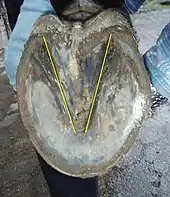
The frog is a part of a horse hoof, located on the underside, which should touch the ground if the horse is standing on soft footing. The frog is triangular in shape, and extends midway from the heels toward the toe, covering around 25% of the bottom of the hoof.[1]
Functions
The frog is an important part of the horse's circulatory system—it pumps blood up the horse's leg each time the frog makes contact with the ground. The blood flows down the horse's leg into the digital cushion, a fibrous part of the inner hoof located just above the frog which contains a network of blood vessels. The horse's weight then compresses the frog on the ground, squeezing the blood out of the digital cushion, and pushing it back up the horse's legs.
When a horse has certain types of lameness, the farrier may use the frog for support, using specialized shoes that help keep correct pressure on the frog so that less force is transmitted to the wall and sole of the foot or to the navicular bone, coffin bone, and deep digital flexor tendon. The frog may also decrease in size if it does not receive constant pressure, which can occur if the heels of the horse become contracted.
Digit remnants
A 2018 study on horse foot morphology has suggested that the frog is actually composed of remnants of digits II and IV. This showcases that horses are not truly monodactyl and posits a more complex formation of the horse foot than simple side toe reduction.[2]
See also
References
- King, Christine; Mansmann, Richard (1997). Equine Lameness. Equine Research. ISBN 9780935842128.
- Solounias, Nikos; Danowitz, Melinda; Stachtiaris, Elizabeth; Khurana, Abhilasha; Araim, Marwan; Sayegh, Marc; Natale, Jessica (2018). "The evolution and anatomy of the horse manus with an emphasis on digit reduction". Royal Society Open Science. 5 (1): 171782. doi:10.1098/rsos.171782. PMC 5792948. PMID 29410871.