Gliese 1061
Gliese 1061 is a red dwarf star located approximately 12 light-years (3.7 parsecs) from Earth in the southern constellation of Horologium. Even though it is a relatively nearby star, it has an apparent visual magnitude of about 13,[2] so it can only be seen with at least a moderately-sized telescope.
| Observation data Epoch J2000 Equinox J2000 | |
|---|---|
| Constellation | Horologium |
| Right ascension | 03h 35m 59.69s[1] |
| Declination | −44° 30′ 45.3″[1] |
| Apparent magnitude (V) | 13.03[2] |
| Characteristics | |
| Spectral type | M5.5 V[2] |
| Apparent magnitude (J) | 7.52 ± 0.02[3] |
| U−B color index | 1.52[3] |
| B−V color index | 1.90[3] |
| Astrometry | |
| Radial velocity (Rv) | −8 km/s |
| Proper motion (μ) | RA: 750.01[4] mas/yr Dec.: -349.98[5] mas/yr |
| Parallax (π) | 272.1615 ± 0.0316[6] mas |
| Distance | 11.984 ± 0.001 ly (3.6743 ± 0.0004 pc) |
| Absolute magnitude (MV) | 15.26[4] |
| Details | |
| Mass | 0.113[5] M☉ |
| Radius | 0.156±0.005 − 0.19[7] R☉ |
| Luminosity (bolometric) | 0.0017±0.0001 − 0.003[7] L☉ |
| Luminosity (visual, LV) | 0.00007[nb 1] L☉ |
| Temperature | 2953±98 − 2999±41[7] K |
| Metallicity [Fe/H] | −0.09±0.09[8] dex |
| Rotational velocity (v sin i) | ≤ 5[9] km/s |
| Age | >7.0±0.5[7] Gyr |
| Other designations | |
| Database references | |
| SIMBAD | data |
The proper motion of Gliese 1061 has been known since 1974, but it was estimated to be further away: approximately 25 light-years (7.7 parsecs) distant based upon an estimated parallax of 0.130″. The RECONS accurately determined its distance in 1997. At that time, it was the 20th-nearest star system to the Sun. The discovery team noted that many more stars like this are likely to be discovered nearby.[2]
This star is a tiny, dim, red dwarf, close to the lower mass limit. It has an estimated mass of about 11.3% of the Sun and is only about 0.2% as luminous.[5][7] The star displays no significant infrared excess due to circumstellar dust.[10]
Planetary system
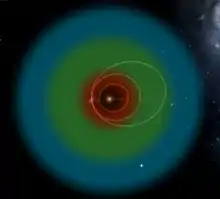
On August 13, 2019, a planetary system was announced orbiting the star Gliese 1061 by the Red Dots project of detecting terrestrial planets around nearby red dwarf stars.[7] The planet Gliese 1061 d orbits in the conservative circumstellar habitable zone of its star and the planet Gliese 1061 c orbits in the inner edge of the habitable zone.[7] Gliese 1061 is a non-variable star that does not suffer flares, so there is a greater probability that the exoplanets still conserve their atmosphere if they had one.[11]
| Companion (in order from star) |
Mass | Semimajor axis (AU) |
Orbital period (days) |
Eccentricity | Inclination | Radius |
|---|---|---|---|---|---|---|
| b | 1.38+0.16 −0.15 M🜨 |
0.021 ± 0.001 | 3.204 ± 0.001 | < 0.31 | — | — |
| c | 1.75 ± 0.23 M🜨 | 0.035 ± 0.001 | 6.689 ± 0.005 | < 0.29 | — | — |
| d | 1.68+0.25 −0.24 M🜨 |
0.054 ± 0.001 | 13.031+0.025 −0.032 |
< 0.53 | — | — |
Gliese 1061 c
| Discovery[7] | |
|---|---|
| Discovered by | Dreizler et al. 2019[7] |
| Discovery date | 13 August 2019 |
| Doppler spectroscopy | |
| Orbital characteristics | |
| 0.035 ± 0.001 au | |
| Eccentricity | < 0.29 |
| 6.689 ± 0.005 d | |
| 88+95 −85° | |
| JD 2458300.2+1.9 −1.5 | |
| Semi-amplitude | 2.48+0.28 −0.29 m/s |
| Physical characteristics | |
| Mass | >1.75 ± 0.23 |
Gliese 1061 c (also known as GJ 1061 c) is a potentially habitable exoplanet orbiting within the limits of the optimistic defined habitable zone of its red dwarf parent star.[12][13][7]
Gliese 1061 c is 75% more massive than the Earth.
The planet receives 35% more stellar flux than Earth and has an equilibrium temperature of 275 K (2 °C; 35 °F).[14] The average temperature on the surface would be warmer, 34 °C (307 K; 93 °F), provided the atmosphere is of similar composition to the Earth's.
Gliese 1061 c orbits its parent star very closely, every 6.7 days at a distance of just 0.035 au, so it is probably gravitationally locked and in synchronous rotation with its star.
Gliese 1061 d
| Discovery[7] | |
|---|---|
| Discovered by | Dreizler et al. 2019[7] |
| Discovery date | 13 August 2019 |
| Doppler spectroscopy | |
| Orbital characteristics | |
| 0.052 ± 0.001 au | |
| Eccentricity | <0.54 |
| 13.031 d[15] | |
| 157+88 −71° | |
| Semi-amplitude | 1.86±0.25 m/s |
| Physical characteristics | |
| Mass | >1.68+0.25 −0.24 |
Gliese 1061 d (also known as GJ 1061 d) is a potentially habitable exoplanet largely orbiting within the limits of the conservative defined habitable zone of its parent red dwarf star.[12][16][7]
The exoplanet is 68% more massive than the Earth.
The planet receives about 40% less stellar flux than Earth and has an estimated equilibrium temperature of 218 K (−55 °C; −67 °F).[12][7] The average temperature on the surface would be colder than Earth's and at around 250 K (−23 °C; −10 °F), provided the atmosphere is similar to that of Earth.
Gliese 1061 d orbits its star every 13 days, and due to its close-in semi-major axis, it is likely that the exoplanet is tidally locked.[15] However, if the planet's orbit is confirmed to be highly eccentric then this eccentricity could be desynchronising it, enabling the existence of non-synchronised states of equilibrium in its rotation, relative to which side of the planet is facing the star, and thereby it will experience a day/night cycle.[17]
Notes
- Taking the absolute visual magnitude of Gliese 1061, , and the absolute visual magnitude of the Sun, , the visual luminosity of Gliese 1061 can therefore be calculated:



References
- Cutri, R. M.; et al. (June 2003). "2MASS All-Sky Catalog of Point Sources". VizieR On-line Data Catalog: II/246. Bibcode:2003yCat.2246....0C.
- Henry, Todd J.; et al. (1997). "The solar neighborhood IV: discovery of the twentieth nearest star". The Astronomical Journal. 114: 388–395. Bibcode:1997AJ....114..388H. doi:10.1086/118482.
- "LHS 1565". SIMBAD. Centre de données astronomiques de Strasbourg. Retrieved 2008-12-11.
- Scholz, R.-D.; et al. (2000). "New high-proper motion survey in the Southern sky". Astronomy and Astrophysics. 353: 958–969. Bibcode:2000A&A...353..958S.
- "The One Hundred Nearest Star Systems". RECONS. 2008-01-01. Retrieved 2008-12-11.
- Brown, A. G. A.; et al. (Gaia collaboration) (2021). "Gaia Early Data Release 3: Summary of the contents and survey properties". Astronomy & Astrophysics. 649: A1. arXiv:2012.01533. Bibcode:2021A&A...649A...1G. doi:10.1051/0004-6361/202039657. S2CID 227254300. Gaia EDR3 record for this source at VizieR.
- Dreizler, S.; Jeffers, S. V.; Rodríguez, E.; Zechmeister, M.; Barnes, J.R.; Haswell, C.A.; Coleman, G. A. L.; Lalitha, S.; Hidalgo Soto, D.; Strachan, J.B.P.; Hambsch, F-J.; López-González, M. J.; Morales, N.; Rodríguez López, C.; Berdiñas, Z. M.; Ribas, I.; Pallé, E.; Reiners, Ansgar; Anglada-Escudé, G. (2019-08-13). "Red Dots: A temperate 1.5 Earth-mass planet in a compact multi-terrestrial planet system around GJ1061". Monthly Notices of the Royal Astronomical Society. arXiv:1908.04717. doi:10.1093/mnras/staa248. S2CID 199551874.
- Neves, V.; et al. (August 2014). "Metallicity of M dwarfs. IV. A high-precision [Fe/H] and Teff technique from high-resolution optical spectra for M dwarfs". Astronomy & Astrophysics. 568: 22. arXiv:1406.6127. Bibcode:2014A&A...568A.121N. doi:10.1051/0004-6361/201424139. S2CID 118619790. A121.
- Barnes, J. R.; et al. (April 2014). "Precision radial velocities of 15 M5-M9 dwarfs". Monthly Notices of the Royal Astronomical Society. 439 (3): 3094–3113. arXiv:1401.5350. Bibcode:2014MNRAS.439.3094B. doi:10.1093/mnras/stu172. S2CID 16005221.
- Avenhaus, H.; et al. (December 2012). "The nearby population of M-dwarfs with WISE: a search for warm circumstellar dust". Astronomy & Astrophysics. 548: 15. arXiv:1209.0678. Bibcode:2012A&A...548A.105A. doi:10.1051/0004-6361/201219783. S2CID 56397054. A105.
- Starr, Michelle. "Three Rocky Exoplanets Have Been Found Orbiting a Star Just 12 Light-Years Away". ScienceAlert. Retrieved 2020-10-07.
- "The Habitable Exoplanets Catalog - Planetary Habitability Laboratory @ UPR Arecibo". phl.upr.edu. Retrieved 2020-03-31.
- "Exoplanet-catalog". Exoplanet Exploration: Planets Beyond our Solar System. Retrieved 2020-03-31.
- "Trio of Super-Earths Found Orbiting Red Dwarf Gliese 1061 | Astronomy | Sci-News.com". Breaking Science News | Sci-News.com. Retrieved 2020-03-31.
- "Exoplanet-catalog". Exoplanet Exploration: Planets Beyond our Solar System. Retrieved 2020-10-07.
- "GJ 1061 d". exoplanetarchive.ipac.caltech.edu. Retrieved 2020-10-07.
- Auclair-Desrotour, P.; et al. (2019). "Final spin states of eccentric ocean planets". Astronomy & Astrophysics. EDP Sciences. 629: A132. doi:10.1051/0004-6361/201935905. ISSN 0004-6361.
While the semidiurnal tide drives the body towards the spin-orbit synchronous rotation, eccentricity tides tend to desynchronise it, and thereby enable the existence of non-synchronised states of equilibrium.
External links
| Stars |
| ||||||||
|---|---|---|---|---|---|---|---|---|---|
| |||||||||
| Star clusters |
| ||||||||
| Galaxies |
| ||||||||
| |||||||||
 Category Category | |||||||||