Gaius Appuleius Diocles
Gaius Appuleius Diocles (104 – after 146 AD) was a Roman charioteer who became one of the most celebrated athletes in ancient history. He has been described as the highest-paid athlete of all time.[1]
| Gaius Appuleius Diocles | |
|---|---|
 | |
| Nickname | The Lamecus |
| Born | 104 AD Lamecum, Roman Empire (now Lamego, Portugal) |
| Died | after 146 AD Praeneste, Roman Empire (now Palestrina, Italy) |
| Nationality | Roman |
| Career wins | 1,462 |
Biography
Early life
Gaius Appuleius Diocles was born in approximately 104 A.D in Lamecum, in the Roman province of Lusitania (now Lamego, Portugal). His father owned a small transport business, and the family was comparatively well off. Diocles is believed to have started racing at the age of 18 in Ilerda (modern-day Lleida, in Catalonia, Spain). This first notable victory outside his native land brought him international fame and encouraged him to go to Rome.
Career in Rome
Diocles began his racing career in Rome in 122 A.D. with the racing stable known as the Whites, although he did not win a race until two years later.[2] He became known as "the Lamecus" and brought fame and renown to his native city of Lamecum. Within the city, a statue was erected on top of a fountain near a garden known today as Jardim do Campo, located in the center of town. Another monument dedicated to Diocles is located in Neumagen, Germany.[3]
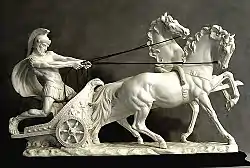
He most commonly raced four-horse chariots or quadrigae.[2] Diocles is also notable for owning an extremely rare ducenarius, a horse that had won at least 200 races. Records show that he won 1,462 of the 4,257 four-horse races he competed in, and was placed in an additional 1,438 races (mostly finishing in second place). The "Champion of Charioteers" is one of the best-documented ancient athletes, due to his popularity and success at the Circus Maximus.[4] Being the best in the field also seems to have allowed Diocles to perfect his showmanship. Many of his victories saw him race from behind, crossing the finish line at the last possible moment. This drama played to his widespread acclaim with fans. Any race with Diocles quickly became the featured event of the day. This naturally helped Diocles earn even more money.
He had an unusually long career for a charioteer, racing for 24 years and representing three of the four most famous chariot racing stables (factiones) in Rome, which were known by the racing colours worn by their charioteers (Reds, Whites, Blues, and Greens). He began with the Whites at the age of 18; after six years, he switched to the Greens for three years, and then raced 15 years for the Reds before retiring at the age of 42.[3] After retirement, he eventually died in the small town of Praeneste.
Winnings
His winnings reportedly totalled 35,863,120 sesterces, over a working life of 24 years. From this, he would have been paid an unknown sum by his management team, or his owners; his status as slave or free is not certain, nor is the likely amount of his total share. Golden believes that his winnings would have been thought "significant" in Rome.[5]
See also
Sources
- Golden, Mark (2004). Sport in the Ancient World from A to Z. New York: Routledge. ISBN 0-415-24881-7.
- Charioteers and Racing Factions
- The Origins and Evolution of the Lusitano Horse
References
- Struck, Peter T. (2 August 2010). "Greatest of All Time |". Lapham's Quarterly. Archived from the original on 22 December 2020. Retrieved 16 January 2017.
- Scanlon, Thomas Francis (2014). Sport in the Greek and Roman Worlds: Greek athletic identities and Roman sports and spectacle. Oxford: Oxford University Press. p. 300. ISBN 9780198703778.
- "Charioteers and Racing Factions". www.vroma.org.
- David Stone Potter (1999). Life, Death, and Entertainment in the Roman Empire. University of Michigan Press. pp. 296–. ISBN 978-0-472-08568-2.
- Golden 2004, p. 164.
