Galeazzo Sanseverino
Galeazzo da Sanseverino (French: Galéas de Saint-Séverin') (c. 1460 – 24 February 1525) was an Italian-French condottiere and Grand Écuyer de France. He was the fourth son of Roberto Sanseverino d'Aragona, first count of Caiazzo (1418-1487), the son of Elisa Sforza, sister of Francesco Sforza, Duke of Milan.
On the other hand the Duke of Milan
called and gave the general cane
to Maria Galeazo, and captain
did it of his people on the saddle,
who riding then from hand to hand,
with the banner in the wind of the snake,
honor and glory of Lombardy,
with many great gentlemen in company.— Gerolamo Senese, La venuta del Re Carlo con la rotta del Taro (1496-1497), in Guerre d'Italia in ottava rima, vol. 2, Ferrara, Edizioni Panini, 1989, cap. 4.8, p. 122
Galeazzo da Sanseverino | |
|---|---|
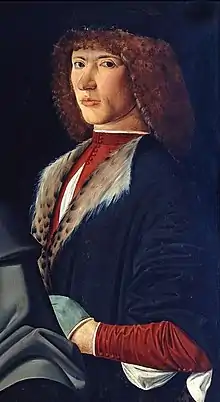 Galeazzo Sanseverino in Portrait of Luca Pacioli, c. 1495 | |
| Born | 12 June 1458 Naples |
| Died | February 24, 1525 Battle of Pavia |
| Allegiance | Duchy of Milan, kingdom of France |
| Years of service | 1495–1525 |
| Rank | Grand écuyer de France |
| Unit | cavalry |
| Commands held | Milanese army (1495–1500); French cavalry (1509–1525) |
| Battles/wars | Battle of Fornoue (1495) Battle of Agnadel (1509) Battle of Pavia (1525) |
| Awards | knight of the Order of Saint Michael |
| Spouse(s) |
|
Life
He was the third son of Roberto Sanseverino,1st Count of Caiazzo, and Giovanna da Correggio. He was educated by masters of arms and the scholar Pietro del Monte and was a friend of Leonardo da Vinci, who frequented his home in Milan.

Starting from 1483, Galeazzo and his brother Gianfrancesco entered the service of the Duke of Bari, then Duke of Milan, Ludovico il Moro, after in June they had deserted the Venetian conduct to which instead had remained faithful his father Roberto, bitter enemy of the Moro.[1] Later they would also be followed by the other two brothers, Gaspare and Antonio Maria. Galeazzo in particular immediately became the favorite of Ludovico, who certainly had to recognize his excellent qualities, so much so that in 1489 he married his daughter Bianca Giovanna and as long as he lived in Milan he kept his own court in the castleand,[2] always in the same years, he was given the castle of Mirabello.
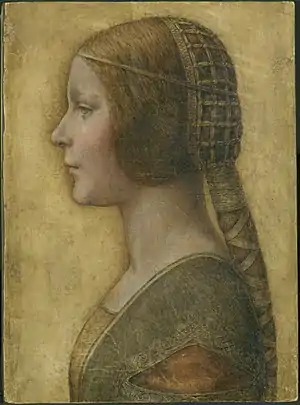
Bianca Giovanna was at the time of the wedding a girl of just seven years and therefore the marriage was purely nominal, becoming effective only in 1496, when the girl turned fourteen. With the marriage he was invested with the possessions of the counties of Bobbio, Castel San Giovanni, Val Tidone and Voghera.
Covered with benefits and often in charge of very delicate missions by the Moro, who trusted him blindly, Galeazzo also received the task of bringing to Milan from Ferrara the young wife of his lord, Beatrice d'Este, when in 1491, after ten years of engagement, Ludovico finally decided to take her as his wife. Also in this case Galeazzo knew with his affability and his natural charm to earn the favor of the new duchess, becoming his most faithful servant in perpetuity. Not infrequently, moreover, Ludovico commissioned him to entertain his young wife and to accompany her on cheerful outings as well as in matters of greater importance, such as Beatrice's diplomatic mission to Venice.[3]
As proof of the very close relations existing between the three, consider that Beatrice and Ludovico used to eat meals with the sole company of his son-in-law Galeazzo, at least when he was in Milan and not engaged in directing the armies on behalf of his father-in-law.[4]
It seems to me that this Messer Galeazzo is Duke of Milan because he can do what he wants and has what he knows how to ask and desire.
Through his marriage to Bianca Giovanna, Galeazzo was practically "adopted" within the Sforza family and therefore had the right to bear the surname "Sfortia Vicecomes", as he often used to sign himself in his missives. Precisely this fact generated confusion among historians, many of whom led to confusion with the court poet Galeazzo Visconti, all the more so that the latter also had a brother named Gaspare. However, the references in the letters to a rich collection of falcons and to the days of leisure spent in the company of the two sisters of Este, Beatrice and Isabella, leave any doubt about the real identity of Galeazzo, in addition to the fact that Ludovico Sforza would certainly not have entrusted certain missions of fundamental importance to a court poet, but rather to his trusted and dear son-in-law.[6]
He was made a knight of the Orderof St. Michael in 1494 during his visit to Lyon. Unbeatable champion of the rides, he was a perfect courtier, loved by women not only for his charm, elegance and well-groomed physique, but also for his culture and way of speaking, he was an esteemed friend of Pacioli, he knew Latin, French and German.
Baldassare Castiglione also in his book Il Cortegiano cites Galeazzo Sanseverino as an example of a perfect nobleman, and it is also said that Michelangelo was inspired by him when he sculpted his famous David.[3]
On July 6, 1495, he took part – again as captain general of the Sforza armies – in the epochal battle of Fornovo against the French who had invaded the Italian peninsula and was the only one who together with his brothers with the cavalrymen pursued the fugitives beyond the Taro river in an attempt to prevent them from continuing the march towards Lombardy, while the rest of the soldiers of the Holy League gave themselves to the looting of the camp French.
On November 23, 1496, a few months after the transductio ad maritum, the young Bianca Giovanna died of a "stomach disease", or according to some for poisoning perpetrated by a certain Francesca Dal Verme, a woman who fiercely hated the Moro for personal reasons. Galeazzo was deeply saddened by it and remained locked up for many days in certain damp rooms of the castle of Milan that harmed his health, already debilitated by a recent illness.[7]
Some courtiers of Ludovico, namely the castellan Bernardino da Corte, the first secretary Bartolomeo Calco and the Archbishop of Milan, very worried about his approval, then went to visit him and found him "so shocked and dejected [...] full of tears and sobs so that he could hardly express the words of pain". A few days later they returned together with the bishop of Piacenza to convince Galeazzo to join his father-in-law Ludovico in Pavia, who in those days had to go to Parma to welcome the emperor Maximilian,since he had the desire to have his son-in-law with him in order to comfort each other, but Galeazzo refused saying that he was not able to leave the room for the greatness of his pain, and that if Ludovico had ordered it then he would have gone to him "with the tongue on the ground". However, Bernardino da Corte managed to persuade him to leave the room to move to the healthiest country residence in Abbiategrasso so that he would not get sick.[7]
In 1498 he married again with Elisabetta Costanza del Carretto, called Madama la Grande, daughter of the Marquis del Finale, who was at the time a child and with whom he had no children. Galeazzo fell prisoner of the French, together with his lord Ludovico Sforza, after the battle of Novara (1500), where, hit by a stone, he was wounded in the face, but unlike Sforza, behind the mediation of his brother Cardinal Federico and after the payment of a ransom paid by his brothers, he was released only a few months after his capture. He lost the counties and lordships of Bobbio, Castel San Giovanni, Val Tidone and Voghera reassigned by the French.
After these nefarious events he went to Innsbruck to the court of Emperor Maximilian I, here the chronicles tell him sad melancholic little considered and always dressed in black, then he went to Nuremberg, where thanks to his mutual friend Willibald Pirckheimer he befriended Albrecht Dürer, who portrayed him in black dress in 1503.
Thanks to the intervention of his brothers and Cardinal Federico Sanseverino, in 1504 he reconciled with Louis XII of Franceand followed him to Naples, receiving the rank of councilor of state, chamberlain of the king and grand écuyer de France. In 1505 Galeazzo was given the castle of Mehun-sur-Yèvre. His numerous attempts to mediate with King Louis XII the release of his friend and father-in-law Ludovico Sforza, who died a prisoner in Loches in 1508, were in vain. In Leonardo's last years spent in Amboise, Galeazzo Sanseverino was still close to his old friend with whom he shared pleasant memories of the Milanese time.
In 1516 the King of France granted him again Bobbio and all the fiefs, and with a second diploma he was also created Marquis of Bobbio. The marquisate of Bobbio was formed by the counties of Bobbio and Voghera, by the Malaspinian lordships of Oltrepò and Varzi and by the county of Tortona (together with the Bishopric).[8] The restitution took place following the new expulsion of the Dal Verme counts, but did not regain the lordships of Castel San Giovanni and Val Tidone, already assigned by the French in 1504 to the Pallavicino,becoming the Piacenza territory and later passing to the Farnese.
_05_cavalli.jpg.webp)
In 1517 Galeazzo won a lawsuit against his enemy Jacques de Trivulce, Marshal of France, regaining his properties in Milan which Trivulce had confiscated. He accompanied Francis I of France on his encounter with Henry VIII of England at Calais in 1520. He was made count of Martigues in 1522. In the service of France, Galeazzo campaigned in the Italian Wars from 1509 until his death. He died in 1525 during the famous Battle of Pavia, while attempting to defend King Francis I from capture, where the French cavalry was decimated by a force of 1,500 Basque arquebusiers. The day after the battle, his body was taken by his people to the Certosa di Pavia and, buried there, his tomb was never found.
King Francis I, still a prisoner at the Charterthus, mourned his dear friend who will never forget, later no Italian will ever hold the office of Grand Ecuyer of the king. Willibald Pirckheimer at the end of 1525 in a letter to Albrecht Dürer recalls Galeazzo Sanseverino, a close friend in common and mourns his death. His widow, Elisabetta Costanza del Carretto, retired to Piacenza, where she died in her palace on 3 January 1564.[9]
Crescenzi claimed that Galeazzo had a daughter named Anna, but this according to other historians is to be excluded, as Galeazzo did not leave succession and his fiefs returned to the Dal Verme. His half-brother Giulio, in an attempt to recover them, filed a lawsuit against them, but without success.[9]
Honours
| Knight of the Order of St. Michael | |
| — 1494 |
In mass culture
- Literature
Galeazzo appears as a character in several novels:
- The Duchess of Milan, by Michael Ennis (1992);
- The Swans of Leonardo, by Karen Essex (2006);
- La misura dell'uomo, by Marco Malvaldi (2018);
- My name is Bianca, by Massimo Gregori Grgic (2020).
- Television
In the 2021 Anglo-Italian television miniseries Leonardo, Galeazzo is played by Italian actor Antonio De Matteo.
References
-
Condottieridiventura.it
. - Francesco Malaguzzi Valeri. La corte di Ludovico il Moro, la vita privata e l'arte a Milano nella seconda metà del Quattrocento.
- Julia Cartwright. Beatrice d'Este duchessa di Milano.
- Alessandro Luzio; Rodolfo Renier. Delle relazioni di Isabella d'Este Gonzaga con Ludovico e Beatrice Sforza.
- Francesco Malaguzzi Valeri, La corte di Lodovico il Moro: la vita privata e l'arte a Milano nella seconda metà del Quattrocento, vol. 1, Milano, Hoepli, 1913, p. 464.
- Julia Cartwright (1945). Beatrice d'Este duchessa di Milano (2 ed.). Edizioni Cenobio. p. 77.
- Società Storica Lombarda (1874). Archivio storico lombardo. 39. p. 242.
- Ristretto di storia patria ad uso de' piacentini. 1831.
- Deputazione di storia patria per le province parmensi (1964). Fonti e studi: Ser. 2. 4. p. 63.
- Richard Clayton, Translation of Tenhove's Memoirs of the House of Medici, The Monthly Review, 1798, p. 253.
- L'Histoire de la Republique de Venise, vol. 33 of Histoire universelle: depuis le commencement du monde jusqu'a present, Arkstée & Merkus, 1771, 292f.
- Antoine Varillas, Histoire de Charles VIII, 1691.
- Paul L. Jacob, Histoire du XVI siècle en France, 1834.