Gaussberg
Gaussberg (or Mount Gauss) is an extinct volcanic cone, 370 metres (1,214 ft) high, fronting on Davis Sea immediately west of the Posadowsky Glacier in Kaiser Wilhelm II Land in Antarctica.[1] It is ice-free and conical in nature, having formed subglacially in an intraplate environment about 55,000 years ago. The current edifice is thought to be the remains of a once-larger mountain that has been reduced by glacial and subaerial erosion.[2]
| Gaussberg | |
|---|---|
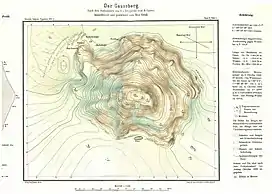 German map of 1921 | |
| Highest point | |
| Elevation | 370 m (1,210 ft)[1] |
| Listing | List of volcanoes in Antarctica |
| Coordinates | 66°48′S 089°11′E[1] |
| Geography | |
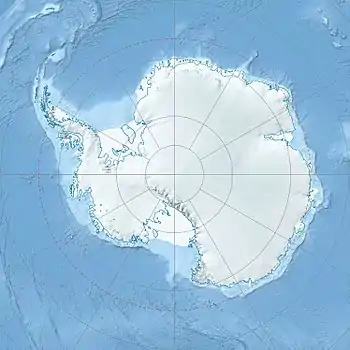  Gaussberg | |
| Geology | |
| Mountain type | Volcanic cone |
Discovered in February 1902 by the German Antarctic Expedition under Erich von Drygalski, who named it after his expedition ship, which was in turn named in honour of Carl Friedrich Gauss.[1]
See also
References
- "Gaussberg". Geographic Names Information System. United States Geological Survey. Retrieved 2009-05-03.
- "Gaussberg". Global Volcanism Program. Smithsonian Institution. Retrieved 2021-06-24.
Further reading
- LeMasurier, W. E. (1990). Thomson, J. W. (ed.). Volcanoes of the Antarctic Plate and Southern Oceans. American Geophysical Union. ISBN 0-87590-172-7.
This article is issued from Wikipedia. The text is licensed under Creative Commons - Attribution - Sharealike. Additional terms may apply for the media files.