Gavriil Skorodumov
Gavriil Ivanovich Skorodumov (Russian: Гавриил Иванович Скородумов; 12 March 1755 – 12 July 1792)[2] was a Russian engraver, draftsman, and painter, best known for his stipple prints. He was regarded as the first Russian-born artist to gain international acclaim.[3]
Gavriil Skorodumov | |
|---|---|
| Гавриил Иванович Скородумов | |
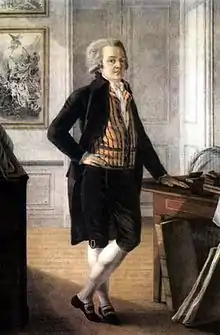 Self-Portrait, c. or after 1785, watercolor, Russian Museum, Saint Petersburg | |
| Born | March 12, 1755 |
| Died | July 12, 1792 (aged 37) |
| Education | Member Academy of Arts (1785)[1] |
| Alma mater | Imperial Academy of Arts (1773)[1] |
| Known for | |
| Awards |  [1] [1] |
Biography
He was born into a family of hereditary craftsmen. In 1764, he was admitted to the Imperial Academy of Arts, where he studied painting and engraving with Grigoriy Srebrenitsky, Johann Stenglin and Anton Losenko. In 1772, he graduated with a large gold medal for his engraving, "Lot with His Daughters", after a painting by Louis-Jean-François Lagrenée. The medal came with a grant for travelling abroad.
The following year, he and Mikhail Belsky, another grant recipient, went to London together. He studied in the workshop of the famous engraver, Francesco Bartolozzi, where he learned engraving techniques that were not in use in Russia (stippling and the "crayon manner"). Before he had finished his studies, he was already taking orders from local publishers, reproducing works by Joshua Reynolds and Benjamin West. He established his fame with 24 engravings based on works by Angelica Kaufman, an especially fashionable artist.
Although he was supposed to leave England in 1776, he continued to put off his return to Russia for as long as possible. He finally yielded in 1782, when he heard that Empress Catherine admired his work and would "give him a thousand two hundred rubles and a thousand for the trip, if only he promised not to be lazy".[4] Upon his arrival in St. Petersburg, she named him Court Engraver and caretaker of engravings at the Hermitage Museum, with a salary of 1,200 Rubles, an apartment worth 600 Rubles, and his own personal printer.
Things did not go as well as planned, however. Within a few months of his arrival, the Empress was apparently tired of his constant complaints and hinted that he was free to leave if he wished. In 1783, she noted that nobody had seen any of his works. In the Spring of 1784, she suspended his salary until he had something to show for it.[4] Nobody knows for certain why his productivity declined, although drinking has been suggested as a likely cause. In 1789, Ivan Krylov published a satire in his magazine, Почта духов, in which one of the characters, an artist named Trudolyubov (Hardworking), laments that he misses England, was better paid there, and is so depressed that he became a drunkard.[5]
During the last few years of his life, he managed to produce some engravings and portrait miniatures. In 1791, he began work on an album, with twelve scenes of St. Petersburg, that was never completed. On the day of his death, he was the guest of a merchant named Strunnikov. After dinner, he laid down on some damp grass to take a nap. By evening, he had become deranged, and was dead before morning, aged only thirty-seven.[6]
Works
 A Sultana, after Philippe Jacques de Loutherbourg, 1777[7]
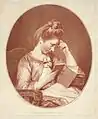 Reflections on Clarissa Harlowe, after Joshua Reynolds, 1775
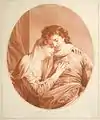 Romeo Parting with Juliet, after Benjamin West, 1775
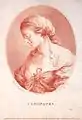 Cleopatra, after Angelica Kauffman, 1776
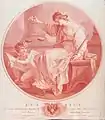 Justice, after Angelica Kauffman, 1777
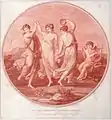 Dance of the Graces, after Angelica Kauffman, 1778
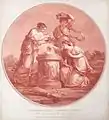 Sacrifice to Ceres, after Angelica Kauffman, 1778
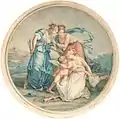 Cupid Trying to Get Back His Arrows, after Angelica Kauffman, 1777
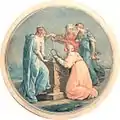 Sacrifice to Cupid, after Angelica Kauffman, 1778
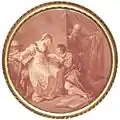 Abelard and Eloise Surprised by Fulbert, after Angelica Kauffman, 1778
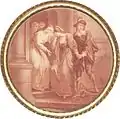 The Parting of Abelard and Eloise, after Angelica Kauffman, 1780
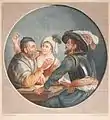 Gamblers, after Dirck van Baburen, 1778
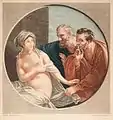 Susanna and the Elders, after Guido Reni, 1779
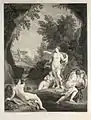 Diana and Actaeon, after Carlo Maratta, 1781
References
- Directory of the Imperial Academy of Arts 1915, p. 439.
- Komelova 1996, p. 823; Bénézit 2006, p. 882.
- Gabriel Scorodomoff. Fine Arts Museums of San Francisco. Retrieved 11 February 2016.
- Письма Екатерины II к Гримму… (Letters from Catherine to Grimm), Русского Исторического Общества, 1878
- "Почта духов", СПб, 1789, pp. 123, 124.
- D. A. Rovinsky, Подробный словарь русских граверов (Detailed Dictionary of Russian Engravers) СПб, 1895
- A Sultana. Victoria & Albert Museum. Retrieved 11 February 2016.
Further reading
- General studies
- Komelova, G. N. (1974). "Русский гравёр Гавриил Иванович Скородумов. 1755–1792". Труды Государственного Эрмитажа (in Russian). Leningrad: Aurora. 15: 36–57.
- Mishina, E. A. (2003). Гаврила Скородумов [Gabriel Skorodoomoff] (catalogue raisonné) (in Russian). Saint Petersburg: Ars. ISBN 5-900351-44-0.
- Additional studies
- Alexander, David (1992). "Kauffman and the Print Market in Eighteenth-Century England". In Roworth, Wendy Wassyng (ed.). Angelica Kauffman: A Continental Artist in Georgian England. London: Reaktion Books. pp. 141–178. ISBN 0-948462-41-8. OCLC 1145778286 – via the Internet Archive.
- Cross, Anthony Glenn (1980). "By the Banks of the Thames": Russians in Eighteenth-Century Britain. Newtonville, Mass.: Oriental Research Partners. ISBN 0-89250-085-9. OCLC 1148189047 – via the Internet Archive.
- Reference books
- Bénézit, Emmanuel (2006) [first published in French in 1911–1923]. Benezit Dictionary of Artists. 12. Paris: Gründ. pp. 882. ISBN 2-7000-3082-6 – via the Internet Archive.
- Komelova, Galina (1996). "Skorodumov, Gavriil (Ivanovich)". In Turner, Jane (ed.). The Dictionary of Art. 28. New York: Grove's Dictionaries. p. 823. ISBN 1-884446-00-0. OCLC 1033666104 – via the Internet Archive.
- Kondakov, S. N. (1915). Юбилейный справочник Императорской Академии художеств. 1764-1914 (in Russian). 2. R. Golike and A. Vilborg. p. 439.
External links
 Media related to Gavriil Skorodumov at Wikimedia Commons