Gender quota
A gender quota is a tool used by countries and parties to increase women's representation in legislature.[1] Women are largely underrepresented in parliaments and account for a 25.8% average in parliaments globally.[2] As of November 2021, gender quotas have been adopted in 132 countries.[3]
Categorizing Quota Systems
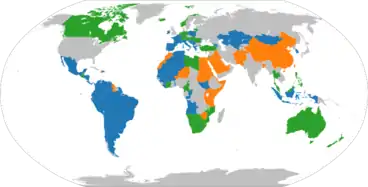
Developed by Drude Dahlerup, the definition of quotas contains two dimensions. The first examines what stage political recruitment process the quota targets. They can aim to increase the number of women who have considered running for office, the number of women candidates running, or women holding office.[5] The second factor considers their enforcement, as quotas can either be required by law or voluntary, in which parties can choose to implement them.[6] Based on these variations, there are three main types of gender quotas utilized around the world: aspirant quotas, candidate quotas, and reserved seats.[5]
| Aspirant Stage | Candidate Stage | Elected Stage | |
|---|---|---|---|
| Legal quotas | Primaries | Candidate quotas | Reserved seats |
| Voluntary party quotas | Aspirant quotas (short list) | Candidate quotas | Reserved seats |
Aspirant Quotas
Considered the least used form of quota, aspirant quotas ensure that some women are nominated for candidacy by a political party, increasing the number of women moving from being eligible to run to being an aspirant. Aspirant quotas are adopted voluntarily on a party-by-party basis in single-member district systems.[5] Examples of these policies include all-women shortlists in the United Kingdom and primaries.[7][5]
Aspirant quotas are used so little because they are seen as having low effectiveness. One criticism is it targets the beginning of political recruitment, which doesn't guarantee an increase in women legislators. According to Professor Richard Matland, another difficulty of these policies is the local-central struggle for power over candidate selection. Aspirant quotas tend to be implemented by central parties to meet their demands, which can intrude on local party strength.[5]
Candidate Quotas
Found in countries utilizing proportional representation, candidate quotas target the transition from aspirant to candidate by requiring parties to include a certain minimum percentage of women in their candidate lists.[7] Candidate quotas are either statutory or voluntary. Legislated candidate quotas require all parties to abide by the rule and are commonly found in Latin America, such as the Argentine quota law. However, with voluntary party quotas commonly found in Europe, it is up to individual parties to implement such guidelines.[5]
Reserved Seats
Reserved seats quotas guarantee the number of female legislators holding seats in legislature by setting aside a certain percentage of seats for women.[1] Within reserved seats policies, seats can either be allocated by direction elections or appointments. These policies are implemented in the Middle East, Africa, and Asia.[5]
Case Studies
Argentina
Prior to the establishment of a candidate quota in 1991, Argentina's Peronist party used internal party quotas to increase the number of women holding congressional seats. Because the party was so dominant, Argentina had one of the highest proportions of women in legislature in the world at the time.[8]
In 1991, Argentina passed Law 24.012, the first national gender quota law in the world. The Ley de Cupos ("Law of Quotas") stipulates that the closed lists of candidates that parties present must be have at least 30% women. It also requires that female candidates are placed in winnable spots on the list, which depended on the number of seats a party is renewing from the previous election.[8] In most contexts, this meant at least one woman candidate for every two men.[9] To ensure compliance, parties that do not present lists meeting these requirements are rejected.[8]
In November 2017, Argentina made changes to its Electoral Code of 2012.[10] By Law No. 27,412 Article 60, party lists were required to follow a zipper system, in which men and women alternated spots on the list.[11] Because of this mechanism, party lists are required to have parity (50% women) in their composition.[10]
As of November 1, 2021, there are 42.6% women in the Chamber of Deputies and 40.3% women in the Senate.[12]
Effectiveness
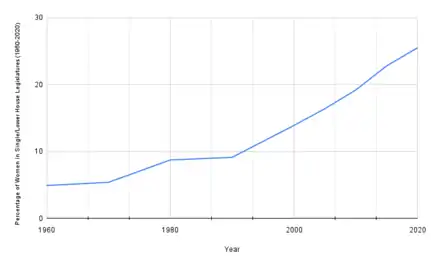
In a 2008 paper by Aili Tripp and Alice Kang, quotas were found to have a positive and statistically significant effect on the number of women in single or lower house legislatures. They also found that voluntary party quotas and reserved seats had a significant, positive effect on women's representation, while compulsory party quotas did not have a significant effect. Reserved quotas were more effective than voluntary party quotas.[13]
In 2015, Pamela Paxton and Melanie Hughes established that from 1990 to 2010, quotas became more effective over time in increasing women's representation. At the end of the period, quotas are twice as effective as at the beginning. They attribute this in part to a decrease over time in noncompliance and a rise in acceptance among elites. Like Tripp and Kang, Hughes and Paxton saw that reserved quotas were more effective than candidate quotas, finding them to be twice as effective.[15]
The effectiveness of quota policies is influenced by many factors, including the context of the country it is adopted in. Because of this, there is no 'perfect' universal quota for increasing women's representation.[16]
Placement Mandate
In proportional systems, the type of candidate list used by parties in elections can affect the number of women who are elected, whether or not there is a legislated candidate quota.[13] Closed lists tend to yield more effective results than open lists. This is because systems with closed lists can implement placement mandates, which require parties to place women in electable positions on the list. One example of this is a zipper system, which requires lists to alternate candidates between men and women. In open list elections, voters select individual candidates based on their preferences, so placement mandates aren't a possibility.[17]
Enforcement Mechanism
To ensure political parties comply with gender quotas, countries can implement enforcement mechanisms into law that specify what the consequences are for parties that evade the quota. These laws encourage compliance with the quota, therefore resulting in more women being elected.[17]
However, there is much variation in the level of the enforcement. In some countries, there is no penalty for refusing to comply with the quota. In other countries, parties are penalize for not abiding by the quota but can still run. Professor Leslie Schwindt-Bayer explains that this creates an issue because parties can claim to not have found enough qualified women and continue to run mostly male candidates. The most strict enforcement of quotas rejects the lists of political parties that do not abide by the quota, preventing them from running in elections.[17]
Criticism
While quotas can be a useful tool in increasing women's representation in legislatures, they are also controversial policies.[1]
Because some quotas require parties include a certain number of women be included on their lists, quotas can be viewed as undemocratic because voters aren't allowed to decide who is elected.
International Support
See also: World Conference on Women, 1995 § The Beijing Platform for Action
Consequences
Outside of increasing women's representation in legislature, quotas can have greater effects on the women candidates, their peers, and their constituents.
Mandate and Label Effects
In countries that have adopted quotas, the female legislators elected via the quota policy may feel obligated to represent women, as that was part of the reason they were elected.
Another impact of the perception that women who are elected because of the quota were elected just because of their gender is "quota women" are seen negatively by their peers as less qualified and independent.[18]
References
- "Gender Quotas | International IDEA". www.idea.int. Retrieved 2021-11-05.
- "Global and regional averages of women in national parliaments". Parline: the IPU’s Open Data Platform. Retrieved 2021-11-05.
- "| International IDEA". www.idea.int. Retrieved 2021-11-05.
- "| International IDEA". www.idea.int. Retrieved 2021-12-10.
- Dahlerup, Drude (2013-05-13). Women, Quotas and Politics. Routledge. ISBN 978-1-134-18652-5.
- "gender quotas". European Institute for Gender Equality. Retrieved 2021-11-05.
- "Quotas in politics". Epthinktank. 2012-10-04. Retrieved 2021-12-06.
- JONES, MARK P. (1998-02-01). "Gender Quotas, Electoral Laws, and the Election of Women: Lessons from the Argentine Provinces". Comparative Political Studies. 31 (1): 3–21. doi:10.1177/0010414098031001001. ISSN 0010-4140. S2CID 154644601.
- Bonder, Gloria; Nari, Marcela. "The 30 Percent Quota Law: A Turning Point for Women's Political Participation in Argentina" (PDF). United Nations.
- "| International IDEA". www.idea.int. Retrieved 2021-12-08.
- "Primera Sección Legislación y Avisos Oficiales" (PDF). Boletín Oficial de la República Argentina. December 15, 2017. Retrieved December 8, 2021.
- "Monthly ranking of women in national parliaments". Parline: the IPU’s Open Data Platform. Retrieved 2021-12-08.
- Tripp, Aili; Kang, Alice (March 2008). "The Global Impact of Quotas: On the Fast Track to Increased Female Legislative Representation". Comparative Political Studies. 41 (3): 338–361. doi:10.1177/0010414006297342. S2CID 15313816.
- "Women in Parliaments: World and Regional Averages (Statistical Archive)". archive.ipu.org. Retrieved 2021-12-07.
- PAXTON, PAMELA; HUGHES, MELANIE M. (2015). "The Increasing Effectiveness of National Gender Quotas, 1990-2010". Legislative Studies Quarterly. 40 (3): 331–362. doi:10.1111/lsq.12079. ISSN 0362-9805. JSTOR 43862533.
- "Do Quotas Actually Help Women in Politics?". Georgetown Institute of Women Peace and Security. Retrieved 2021-12-07.
- SCHWINDT-BAYER, LESLIE A. (2009). "Making Quotas Work: The Effect of Gender Quota Laws On the Election of Women". Legislative Studies Quarterly. 34 (1): 5–28. doi:10.3162/036298009787500330. ISSN 0362-9805. JSTOR 20680225.
- Franceschet, Susan; Piscopo, Jennifer M. (September 2008). "Gender Quotas and Women's Substantive Representation: Lessons from Argentina". Politics & Gender. 4 (3): 393–425. doi:10.1017/S1743923X08000342. ISSN 1743-9248. S2CID 67759059.