Genghis Khan (1950 film)
Genghis Khan (or Ang Buhay ni Genghis Khan) is a 1950 Filipino bioepic film directed by Manuel Conde, based on the life of Mongol ruler and emperor Genghis Khan.[1][2] It was the earliest film to depict the Khan's life.
| Genghis Khan | |
|---|---|
 | |
| Directed by | Manuel Conde |
| Starring |
|
| Narrated by | Tony Cruz (Original Version) James Agee (US version) |
| Distributed by | MC Productions |
Release date |
|
| Country | Philippines |
| Language | Tagalog/Filipino |
Genghis Khan is considered a classic, The film was given a technical achievement citation upon its debut at the 1952 Venice Film Festival. It also was shown at the 1952 Edinburgh Film Festival.[3]
Cast
- Manuel Conde as Genghis Khan
- Elvira Reyes as Lei Hu
- Inday Jalandoni as Börte
- Jose Villafranca
- Lou Salvador as Burchou
- Don Dano as Darmo Acosta
- Africa Dela Rosa
- Ric Bustamante
- Ely Nakpil
- Johnny Monteiro
- Andres Centenera
- Leon Lizares
Directional credit
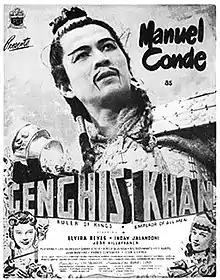
As seen in the original posters, Manuel Conde shares directional credit with Lou Salvador as a concession to the actor for agreeing to shave his head for his villain role as Burchou. Despite this, Conde had the full control in directing the film and Salvador didn't have a single directional input towards the film. New re-releases of the film now remove Salvador's directional credit and only bear Conde's name in the posters.[4][1]
Production
Genghis Khan was directed by Manuel Conde and was produced under his own studio Manuel Conde (MC) Productions. The film had a limited budget and equipment used for production was outdated even at that time. Due to cost-cutting measures, Conde used calesa horses which had smaller built compared to horses used in Western films.[5] Botong Francisco, who is better known for his murals, was also involved in Genghis Khan as its production designer.[6]
Release
Genghis Khan was released at the 1952 Venice Film Festival.
Reception
Genghis Khan was praised for its technical aspects although it was also found to be too graphic and violent by critics of that time.[5][6]Conde was praised for being "authentic" by devising small-built horses which was believed to be closer to the actual breed of horses used by Genghis Khan which is now extinct.[5]
See also
References
- "'Genghis Khan' lost, and found". Philippine Daily Inquirer. September 2, 2012. Retrieved November 28, 2013.
- "'Genghis Khan' shown in PH, formally opens national film archives". Philippine Daily Inquirer. September 30, 2012. Retrieved November 28, 2013.
- "Genghis Khan". Retrieved November 20, 2014.
- "Conde's Genghis Khan, Wayne's The Conqueror". Philippine Star. June 19, 2016. Retrieved May 29, 2018.
- Carballo, Bibsy (July 26, 2008). "Manuel Conde: A Filipino for Filipinos". The Philippine Star. Retrieved November 20, 2021.
- Cruz, Marinel (January 10, 2016). "Classic film 'Genghis Khan' made more accessible to movie buffs". Philippine Daily Inquirer. Retrieved November 20, 2021.