Genomoviridae
Genomoviridae is a family of single stranded DNA viruses. The genomes of this family are small (2.2–2.4 kilobases in length). The genomes are circular single-stranded DNA and encode rolling-circle replication initiation proteins (Rep) and unique capsid proteins. In Rep-based phylogenies, genomoviruses form a sister clade to plant viruses of the family Geminiviridae.[1][2] Ten genera are recognized in this family.[3][4]
| Genomoviridae | |
|---|---|
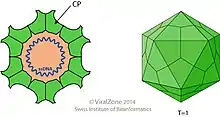 | |
Virus classification  | |
| (unranked): | Virus |
| Realm: | Monodnaviria |
| Kingdom: | Shotokuvirae |
| Phylum: | Cressdnaviricota |
| Class: | Repensiviricetes |
| Order: | Geplafuvirales |
| Family: | Genomoviridae |
The family name is an acronym derived from geminivirus-like, no movement protein.[1]
The genus name Gemycircularvirus stands for Gemini-like myco-infecting circular virus.[5][6] The type species of the genus Gemycircularvirus — Sclerotinia gemycircularvirus 1, reference strain Sclerotinia sclerotiorum hypovirulence associated DNA virus 1 (ssHADV-1), — was the first cultivated member of the family.[1] The other genomoviruses are uncultivated and have been discovered using metagenomics techniques.[2]
Taxonomy
The genera in this family are:[3]
- Gemycircularvirus
- Gemyduguivirus
- Gemygorvirus
- Gemykibivirus
- Gemykolovirus
- Gemykrogvirus
- Gemykroznavirus
- Gemytondvirus
- Gemytripvirus
- Gemyvongvirus
Virology

These viruses have circular single-stranded genomes of 2.1–2.2 kilobases in length. All but one genomovirids contain monopartite genomes, whereas the genome of Fusarium graminearum gemytripvirus 1 (genus Gemytripvirus) consists of three segments.[7] The monopartite genomes encode two proteins—a Rep (replicator) and a CP (capsid) protein. The Rep protein is most closely similar to the Rep protein of the Geminiviridae. In contrast, the CP protein has no known homologues.
References
- Krupovic M, Ghabrial SA, Jiang D, Varsani A (2016). "Genomoviridae: a new family of widespread single-stranded DNA viruses". Arch Virol. 161 (9): 2633–2643. doi:10.1007/s00705-016-2943-3. PMID 27343045.
- Varsani, Arvind; Krupovic, Mart (2017). "Sequence-based taxonomic framework for the classification of uncultured single-stranded DNA viruses of the family Genomoviridae". Virus Evolution. 3 (1): vew037. doi:10.1093/ve/vew037. PMC 5399927. PMID 28458911.
- "Virus Taxonomy: 2020 Release". International Committee on Taxonomy of Viruses (ICTV). March 2021. Retrieved 13 May 2021.
- Varsani, A; Krupovic, M (2021). "Family Genomoviridae: 2021 taxonomy update". Archives of Virology. 166 (10): 2911–2926. doi:10.1007/s00705-021-05183-y. PMID 34331585.
- Rosario K, Dayaram A, Marinov M, Ware J, Kraberger S, Stainton D, Breitbart M, Varsani A (2012). "Diverse circular ssDNA viruses discovered in dragonflies (Odonata: Epiprocta)". J Gen Virol. 93 (12): 2668–81. doi:10.1099/vir.0.045948-0. PMID 22915694.
- Yu X, Li B, Fu Y, Jiang D, Ghabrial SA, Li G, Peng Y, Xie J, Cheng J, Huang J, Yi X (2010). "A geminivirus-related DNA mycovirus that confers hypovirulence to a plant pathogenic fungus". Proc Natl Acad Sci USA. 107 (18): 8387–92. Bibcode:2010PNAS..107.8387Y. doi:10.1073/pnas.0913535107. PMC 2889581. PMID 20404139.
- Li, P; Wang, S; Zhang, L; Qiu, D; Zhou, X; Guo, L (2020). "A tripartite ssDNA mycovirus from a plant pathogenic fungus is infectious as cloned DNA and purified virions". Science Advances. 6 (14): eaay9634. Bibcode:2020SciA....6.9634L. doi:10.1126/sciadv.aay9634. PMC 7138691. PMID 32284975. S2CID 215746433.