George Graham (New Zealand politician)
George Graham (10 December 1812 – 14 February 1901) was a Scottish military engineer in the Corps of Royal Engineers and a Member of the New Zealand House of Representatives.
George Graham | |
|---|---|
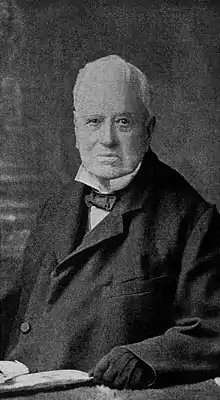 George Graham, c. 1900 | |
| Born | 10 December 1812 Frogmore, Berkshire, England[1] |
| Died | 14 February 1901 (aged 88) 42 Tisbury Road, Hove, Brighton, England[2] |
| Allegiance |  United Kingdom United Kingdom |
| Branch | Board of Ordnance |
| Rank | Clerk of Works |
| Unit | Corps of Royal Engineers |
| Campaigns | Flagstaff War (military works) Second Opium War |
| Spouse(s) | Jane Sargeant[3] |
| Children | William Australia Graham |
| Relations | George Samuel Graham (grandson) |
| Other work | Farmer Member of the New Zealand House of Representatives for Newton, 1861–69 Justice of the Peace for the Colony of New Zealand, 1861[4] |
Graham was born in 1812 at Frogmore in Berkshire,[5] England, and christened at St George's Chapel, Windsor Castle, that year. He belonged to Clan Graham, and his grandfather was an interpreter between the Scottish and English. He became clerk of works with the Board of Ordnance aged 19, and was assigned to the Royal Engineers for the next 25 years. He was posted to Ireland in 1835, to New South Wales in 1836, and to New Zealand in 1840.[6][5]
His work for the Royal Engineers involved public works, roads and military installations. The Flagstaff War in the Bay of Islands in 1845–1846 put a scare to the population of Auckland, and Graham supervised the enlargement of the Albert Barracks overlooking the town.[6][7] He later claimed that the fortification of the barracks was not necessary, but by doing so, it would prevent the subdivision of the hill and that the area could thus later become a park.[5] Indeed, Albert Park was formed in the 1880s.
Graham was then sent to China, where he suffered a nervous breakdown after witnessing a fellow soldier being buried alive. He resigned from the military and returned to New Zealand, where he took up farming in Mangere.[6][5]
He represented the Newton electorate from 1861 to 1869, when he resigned.[8] He was described by one newspaper as "a well-known Maori sympathiser".[9]
| New Zealand Parliament | ||||
| Years | Term | Electorate | Party | |
| 1861–1866 | 3rd | Newton | Independent | |
| 1866–1869 | 4th | Newton | Independent | |
Graham retired to Hove, Brighton, in England for the last years of his life. He died at home on 14 February 1901.[6] His son James Bannatyne Graham married Elizabeth Mary Josephine Sheehan, the sister of cabinet minister John Sheehan. Their son was George Samuel Graham.[10]
References
- Mr. George Graham. The Cyclopedia of New Zealand: Auckland Provincial District. Christchurch: The Cyclopedia Company Limited. 1902.
- "Deaths". The Auckland Star. 32 (44). 21 February 1901. p. 2.
- "Jane Sargeant Graham". Find a Grave. Retrieved 18 November 2021.
- "New Zealand Gazette". The New Zealander. 17 (1595). 31 July 1861. p. 6.
- "Death of Mr. Geo. Graham". The New Zealand Herald. 38 (11581). 20 February 1901. p. 5. Retrieved 26 January 2016.
- Scholefield, Guy, ed. (1940). A Dictionary of New Zealand Biography : A–L (PDF). I. Wellington: Department of Internal Affairs. p. 315. Retrieved 26 January 2016.
- "Albert Barracks Wall (University of Auckland Campus)". Register of Historic Places. Heritage New Zealand. Retrieved 26 January 2016.
- Wilson, James Oakley (1985) [First ed. published 1913]. New Zealand Parliamentary Record, 1840–1984 (4th ed.). Wellington: V.R. Ward, Govt. Printer. p. 200. OCLC 154283103.
- "News of the Day". Nelson Examiner. 24 February 1869.
- Graham, Edward Rahiri and Curnow, Jenifer. "Graham, George Samuel". Dictionary of New Zealand Biography. Ministry for Culture and Heritage. Retrieved 13 May 2012.CS1 maint: multiple names: authors list (link)