George Riley (abolitionist)
George Putnam Riley (1833–1905) was an African-American abolitionist in the United States. He was referred to as the "Fred Douglass of Oregon" by the Oregonian newspaper.[1]
Early life
George Putnam Riley (Geo P. Riley) was a native of Boston born on March 29, 1833. His grandfather was a participant in the Revolutionary War. Riley's father was engaged in the clothing trade in Boston. His mother, Elizabeth Riley, was an active abolitionist.[2] George moved to San Francisco at the age of 16 in the historic Gold Rush of 1949.[3] Several years later he moved to Oregon.[3]
Later life
In Portland he was employed by the federal customs department.[3]
In 1869, Riley and twelve other Black men and two white men, organized the Workingmen's Joint Stock Association (WJSA) in Portland, Oregon.[4] Riley was president of the WJSA. They bought property in Seattle (20 acres) and Tacoma on speculation.[4] The land was under litigation at the time of his death, where it had been under litigation for more than 20 years.[5]
In 1887 he moved to Tacoma, Washington.[3]
He died on October 2, 1905. Congressman F.W. Cushman attended his funeral.[6]
Politics
Riley was a republican, described as, "the ablest orator among the Republicans of Multnomah County."[7] He was a candidate for legislature, but did not win. In a "card" published in an Oregon newspaper Riley writes:
Portland, May 14, 1878 Editor Standard: -Noticing an article in your paper requesting me to reply to a question as to why I was not indorsed [sic] by the Republican Convention, or rather a clique who assume to be dictators of the party, I have only to remark that while they admit I have the ability, they discarded me on account of color. - Geo. Putnam Riley.[7]
Legacy
He had one daughter, Bonita Riley Wright.[8] She was a founding member of the Seattle NAACP in 1913.[9]
In 2004, a housing and commercial development group in Seattle was named in honor of George Riley Putnam. The company has taken its roots since 1983 as a result of the activities of African American businessmen followers of Riley.[10]
Speeches
1870, April 7, The Ratification Jubilee, Portland, Oregon.[11]
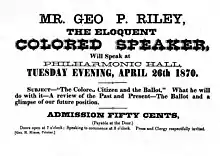
1870, April 26, "The Colored Citizen and the Ballot" Portland, Oregon.[12]
1871, February 7, "Toussaint L'Ouverture, the Hero of San Domingo" Salem, Oregon.[13]
References
- "Grant and Wilson". The Oregonian (Morning Oregonian). November 5, 1872. p. 3.
- "Riley, George Putnam (1833-1905) | The Black Past: Remembered and Reclaimed". blackpast.org. 2007-01-19. Retrieved 2018-12-07.
- "PIONEER COLORED MAN PASSES AWAY" (PDF). Tacoma Daily Ledger. October 5, 1905. Retrieved February 20, 2021.
- "Attack on Title". The Oregonian (Morning Oregonian). October 9, 1904. p. 6.
- "George P. Riley Dead". The Seattle Republican. 12. October 6, 1905.
- "Funeral of George P. Riley" (PDF). Tacoma Daily Ledger. October 4, 1905. Retrieved February 21, 2021.
- Riley, George Putnam (May 17, 1878). "Card". The state rights democrat.
- "George Augustus Wright, Seattle, ca. 1914". digitalcollections.lib.washington.edu. Retrieved 2021-02-21.
- "1913-1948". Seattle King County NAACP. Retrieved 2021-02-21.
- Cohen, Aubrey; Reporter, P.-I. (2007-12-28). "Housing group continues mission of pioneering black developer". seattlepi.com. Retrieved 2018-12-07.
- "The Ratification Jubilee". The Oregonian (Morning Oregonian). April 7, 1870. p. 3.
- "Broadside: Lecture by Mr. George P. Riley". www.oregonhistoryproject.org. Retrieved 2021-02-02.
- "Morning Oregonian". The Oregonian (Morning Oregonian). February 6, 1871. p. 2.
Sources
- Chandler, J. D. Hidden History of Portland, Oregon. Charleston, SC: History Press, 2013.
- Moreland, Kimberly Stowers. African Americans of Portland. Charleston, SC: Arcadia Publishing, 2013.