George Wishart of Drymme
George Wishart of Drymme was a Scottish landowner, lawyer, and a financial administrator for Mary, Queen of Scots.
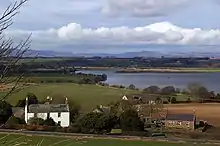
He was kinsman of John Wishart of Pitarrow. His lands were at "Drynne", "Drymmie" or Drymme, also known as "Drum", in Maryton parish near Montrose in Angus, Scotland.[1] A different property called Drymme or Drum was located nearby at Stracathro, close to the confluence of the North Esk and the Cruik Water, and this has sometimes been identified as the home of Wisharts.
In March 1562 John Wishart of Pitarrow became the comptroller of the exchequer and "collector-general of teinds", the collector of the tax for church incomes. He gave his kinsman George Wishart a job as a sub-collector of these royal incomes. An account made by George Wishart of his income (charge) and the expenditure (discharge) in 1565 is held by the National Records of Scotland.[2] From the teinds, the "thirds of benefices" contributed to the expenses of the queen's household.[3]
Another member of the family, John Wishart's older brother, Alexander Wishart of Cairnbeg in Fordoun, was involved as collector of the thirds of Coupar Angus Abbey, and chamberlain of Badenoch. George Wishart collected a few payments from neighbours, including Walter Wood of Balbegno north of Brechin for lands at Fettercairn, and from Ninian Guthrie of Kingennie near Dundee, as Sheriff of Angus.[4]
Some of the material in Wishart's account, especially regarding payments for the Royal Guard, Captain Anstruther, and the fortress island of Inchkeith, appears in other manuscript accounts and has been published.[5]
The historian Gordon Donaldson highlighted payments to household officers, including David Rizzio, who appears as "David Rischo, Italiane", and payments to the Kirk minister John Knox, as part of his stipend and also sums of money given to two of his servants, Margaret Fowlis and John Reid. Another payment for Knox was given to Robert Watson, a merchant in Edinburgh.[6][7] Wishart's account also records money allocated for keeping the Earl of Arran prisoner in Edinburgh Castle, and reveal that John Wishart played golf on Leith Links.
John Wishart of Pitarrow supported the Earl of Moray during the Chaseabout Raid and lost his job. No more is heard of George Wishart at the exchequer. The date of his death is unknown.
Marriage and children

George Wishart married Elizabeth Guthrie (d. 1583), the widow of James Mylne of Dundee. She was a grandmother of the Dundee merchant David Wedderburn.[8] Their daughter Eufame Wishart married Archibald Campbell of Clavers.[9] Elizabeth Guthrie's will mentions the farmstock at Drymme with the plough oxen, work horses, and the sheep they grazed beside the Montrose Basin.[10]
His son, also George Wishart, succeeded him as Laird of Drynnie or Drymme, before June 1605.[11] He married Elizabeth Erskine, a daughter of Robert Erskine (d. 1590) from the nearby House of Dun, and a granddaughter of the Reformer, John Erskine of Dun.[12] In 1609 George Wishart of Drymme and his son George, the feuar of Drymme, owed 2000 merks to a London-based tailor, Andrew Balfour.[13]
The younger George Wishart of Drymme presided over the trial of Jonet Irving in 1616, who was accused as a "notorious witch" of devising the poisoning of the heirs of the House of Dun for the benefit of the Erskine sisters.[14] It was alleged the sisters had journeyed over the Cairn O' Mounth to consult with Jonet Irving at the Muir Alehouse.[15]
References
- Alex. J. Warden, Angus or Forfarshire, The Land and its People, vol. 4 (Dundee, 1884), p. 312.
- Gordon Donaldson, Scotland's History: Approaches and Reflections (Scottish Academic Press, 1995), p. 63: NRS E30/11.
- Gordon Donaldson, Thirds of Benefices, 1561-1572 (SHS: Edinburgh, 1949).
- Gordon Donaldson, Thirds of Benefices, p. 174: Exchequer Rolls, XIX, p. 268.
- Gordon Donaldson, Thirds of Benefices (SHS, Edinburgh, 1949), pp. 172-181, and, 'Archearis of Soverane Ladyis Gaird' in Maitland Club Miscellany, vol. 1 part 1 (Edinburgh, 1833), pp. 33-5.
- Jane Davidson, John Knox (Yale, 2015), p. 222: Gordon Donaldson, Scotland's History: Approaches and Reflections (Scottish Academic Press, 1995), pp. 63-4.
- Charles Rogers cited George Wishart of Drymme's account for Rizzio's salary, apparently from a copy in the papers of George Chalmers in the Laing manuscripts at the University of Edinburgh, see History of the Chapel Royal of Scotland (London, 1882), p. lxiv: George Chalmers used Wishart's account for courtiers' salaries, see The Life of Mary, Queen of Scots, vol. 1 (Edinburgh, 1818), p. 75.
- A. H. Millar, Compt Buik of David Wedderburne (SHS: Edinburgh, 1898), p. 11.
- Alexander Wedderburn, Wedderburn Book (1898), p. 104.
- National Records of Scotland, Guthrie, Elizabeth, Will CC8/8/13, p.375.
- Patrick Chalmers, Registrum episcopatus Brechinensis (Edinburgh, 1856), p. 292 David Wishart, Genealogical History of the Wisharts of Pitarrow and Logie Wishart (Perth, 1914).
- Violet Jacob, The Lairds of Dun (London, 1931), p. 138.
- David Masson, Register of the Privy Council, 1610-1613, vol. 9 (Edinburgh, 1889), p. 52.
- David Masson, Register of the Privy Council of Scotland, 1613-1616, vol. 10 (Edinburgh, 1891), p. 584: Julian Goodare, 'Scottish Witchcraft in its European Context', Witchcraft and belief in Early Modern Scotland (Palgrave Macmillan, 2008), p. 47 fn. 50.
- Robert Chambers, Domestic Annals of Scotland, vol. 1 (Edinburgh, 1858), p. 448.