Geralt of Rivia
Geralt of Rivia (Polish: Geralt z Rivii) is a fictional character and the protagonist of The Witcher series of short stories and novels by Polish writer Andrzej Sapkowski. He is a magically enhanced monster-hunter known as a "witcher", who also possesses supernatural abilities due to his mutations. He has been described as a character embodying "the neo-liberal anti-politics" spirit of the Polish popular culture of the 1990s, following his debut in the books.[1]
| Geralt of Rivia | |
|---|---|
| The Witcher character | |
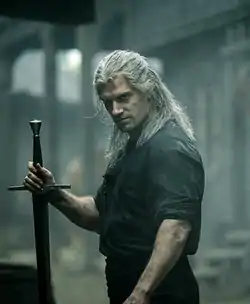 Henry Cavill as Geralt in the television series The Witcher (2019–present) | |
| First appearance |
|
| Last appearance |
|
| Created by | Andrzej Sapkowski |
| Adapted by | Lauren Schmidt Hissrich (The Witcher) |
| Portrayed by | Michał Żebrowski (The Hexer film and TV series) Henry Cavill (The Witcher TV series) |
| In-universe information | |
| Aliases | White Wolf Gwynbleidd Butcher of Blaviken Ravix of Fourhorn Butcher of White Orchard |
| Species | Human |
| Gender | Male |
| Occupation | Witcher |
| Family | Visenna (mother) |
| Significant others | Yennefer of Vengerberg (lover) Triss Merigold (lover) Fringilla Vigo (lover) |
| Children | Ciri (adopted daughter) |
Geralt of Rivia had an appearance in CD Projekt Red's video game trilogy (The Witcher, The Witcher 2: Assassins of Kings and The Witcher 3: Wild Hunt)
In it's televisions adaptations he was portrayed by Michał Żebrowski in The Hexer film and TV series, while Henry Cavill portrayed the character in Netflix The Witcher series.[2][3]
Fictional biography
Novels
Geralt is a witcher. Shortly after being born, Geralt's mother, Visenna, gave him away to undergo training and, eventually, become a witcher at Kaer Morhen – the stronghold of the witchers. Geralt survived mutations during the Trial of the Grasses, thanks to which he gained various witcher traits: high resistance to injury, poison and disease, and slowed aging, but also infertility. He resisted the "changes" brought on by the Trial of Grasses better than most, which encouraged his makers to perform even more dangerous experimental procedures on him, making him lose all body pigmentation. Because of his pale skin and white hair, he is also known in the Elder Speech as "Gwynbleidd" (close to the Welsh translation "Blaidd Gwyn"[4]), the White Wolf. From the arduous training of Witchers, he became a master swordfighter and learnt how to use the Signs, simple spells used by the witchers.
Despite his name, Geralt does not come from Rivia (although he learned how to mimic a Rivian accent and is later knighted for services to the queen of Rivia): young witchers were encouraged to make up surnames for themselves by master Vesemir, to make their names sound more trustworthy. He once claimed that his first choice was Geralt Roger Eric du Haute-Bellegarde, but this was dismissed by Vesemir as silly and pretentious.
After completing his witcher training, he received his Wolf medallion (the symbol of Kaer Morhen) and embarked into the world on his horse called Płotka (literally, "Roach" ; he gave the same name to every horse he owned) to become a monster slayer for hire.
I looked for the words "Witcher urgently needed". And then there'd be a sacred site, a dungeon, necropolis or ruins, forest ravine or grotto hidden in the mountains, full of bones and stinking carcasses. Some creatures which lived to kill, out of hunger, for pleasure, or invoked by some sick will. A manticore, wyvern, fogler, aeschna, ilyocoris, chimera, leshy, vampire, ghoul, graveir, were-wolf, giant scorpion, striga, black annis, kikimora, vypper... so many I've killed.
Even though Geralt did not believe in destiny, he unknowingly demanded the unborn child of princess Pavetta and her husband Duny as a reward for his services by invoking "the Law of Surprise". The child turned out to be a girl, Cirilla, commonly known as Ciri; since then the two are linked to each other. At first, Geralt did not take her because women cannot become witchers. However, fate caused Geralt and Ciri to cross their paths thrice, with him claiming her for a second time when he invokes the Law of Surprise on a traveling merchant he saves from monsters during a random encounter; and after the death of her grandmother, Queen Calanthe of Cintra, Geralt ends up taking the girl into his care, training and loving her as his own daughter.
Following the short stories, the novels unfold as Geralt is pulled into a whirlwind of events in his attempts to protect Ciri from those who would do her harm, becoming reluctantly embroiled in the political contentions of monarchs and emperors.[5][6]
Video games
| Geralt of Rivia | |
|---|---|
| First game | The Witcher (2007) |
| Last appearance | Soulcalibur VI (2018) |
| Adapted by | Artur Ganszyniec Sebastian Stępień Marcin Blacha |
| Voiced by | Polish: Jacek Rozenek Russian: Vsevolod Kuznetsov English: Doug Cockle Japanese: Kazuhiro Yamaji |
| In-universe information | |
| Aliases |
|
Geralt's adventures continue in a non-canonical version by CD Projekt Red's video game trilogy (The Witcher, The Witcher 2: Assassins of Kings and The Witcher 3: Wild Hunt), where he is still alive after being killed by a mob during an anti non-human riot at the end of the Witcher novel saga and his body was taken in a boat by his daughter Ciri to Avalon.
The third installment of the trilogy, like its predecessors, follows Geralt through his final adventures. Following the events of Witcher 2, Geralt has regained his memory of the past and prepares to embark on a new journey. In the Witcher 3, Geralt is on the hunt for the only person he considers kin, Ciri. Along his journey, Geralt must face the Wild Hunt in order to protect the people he cares about. In the new open world, Geralt has the opportunity to complete quests that are both part of the main story and side quests. He will also interact with old friends Dandelion and Vesemir along with potential lovers Triss Merigold and Yennefer.[7]
Sapkowski stated that the games are a work of art of their own and that they cannot be considered either an "alternative version", or a sequel, "because this can only be told by Geralt's creator. A certain Andrzej Sapkowski."[8]
TV adaptations
Hexer (2002)
In this television series, Gerald of Rivia is based loosely in the books series The Witcher, and is portrayed by Michał Żebrowski. The Polish series follows his life from his childhood, training and eventually transformation to a Witcher.[9][10]
Season 1
After fighting a kikimora in 1231, Gerald arrives to the town of Blaviken and meets Renfri, a cursed princess-turned-bandit who is being hunted by the wizard Stregobor, who thinks that she is evil for being born during the eclipse. Geralt meets Marilka who takes him to Stregobor and the latter attempts to convince him to kill Renfri, but the former refuses. Renfri also offers to Geralt a counter-proposal, but he refuses with an ultimatum: leave or die. After that Geralt meets Renfri again, and she tells him that she is leaving town. However when he wakes up the next day, Geralt finds out that she is not leaving and she won't stop until Stregobor is dead and he rushes to stop her. After killing her man, Renfri takes Marilka as hostage but Geralt convinced Renfri to release Marilka and fights Renfri. Gerald mortally wound Renfri and she tells Geralt that the girl in the forest is his destiny forever. Stregobor arrives and to take Renfri's body for autopsy, but Geralt refuses to let him do it. Afterwards Geralt is forced by the townspeople including Marilka to leave and never return urged by Stregobor.
In 1240, Geralt is seen drinking in a tavern who he meets Jasker, a mediocre bard. Geralt is hired to investigate mysterious grain thefts in Posada, where he is followed by Jaskier much to his dismay. They encounter and confront a Sylvan named Torque, who manages to knock them unconscious. They woke up in a mountain cave, where they meet Filavandrel, the elven king. He tells that they have been stealing to help their sick and starving populace, driven out from their lands by the humans. Geralt urges him to fight, and lead his people to better lands. Filavandrel spares their lives and let them go and decides to take Geralt words to heart.
In 1243, when Geralt learns of a rumor that another Witcher called Remus was hired but left with the Gold, he decides to go the kingdom of Temeria to pay off his debts leaving his horse, Roach, behind. Geralt arrives at the kingdom to find that the workers on the brink of the revolt, and confronts them. Later the courtier Ostrit, arrives with several guards, and forced Geralt to leave with several guards escorting. When the guards falls asleep, he meets Triss Merigold a sorceress who hires him to lift the curse of the monster. She shows Geralt the corpse of Remus, who she had hired to kill a monster and was killed by it, which she has hidden to hide that a Witcher was killed by a monster. After finding Remus' heart missing, Geralt realises that the monster is a striga. After learning about the rumor that the late Princess Adda give birth to a daughter after an affair with his brother, King Foltest, Geralt confronts the latter and demands to know who is really the father. King Foltest refuses to cooperate. Gerald and Triss eventually discover that Ostrit was in love with Adda and that he is the one who put the curse after learning of the affair. Geralt realizes that has to fight the monster until dawn to lift the curse, and he uses Ostrit as a bait to lure the striga and fight. Ostrit is killed, and Geralt fights the striga until dawn managing to break the curse, but he is wounded in the process. When Geralt recovers from his injuries, Triss gives him his payment and informs him the princess will be cared for others in the time being.
In 1249, Geralt accompanies Jaskier as a bodyguard to the betrothal feast of Princess Pavetta, Queen Calanthe's daughter, as several of the nobles in attendance might recognize him as the man who cuckolded them with their various wives, concubines, and sometimes mothers. He meets Queen Calanthe who invites him to dinner with him. Afterwards Urcheon of Erlenwald (also named Duny) interrupts to demand Pavetta's hand through the Law of Surprise, having saved her father years earlier. Calanthe refuses Duny's demand and attempts to kill him, which started a brawl. Geralt and the King Eist Tuirseach intervene and fight the guards until Calanthe eventually orders to stop. Eist tries to reason with Calanthe, but Calanthe attempts to kill Duny again and was stopped by Pavetta who created a vortex, sweeping herself and Duny in the center of it. Geralt manages to bring them down, while Calanthe finally relented that they are meant to be together by destiny and marries Duny and Pavetha. Duny insists Geralt to take a reward, which Geralt jokingly invokes the Law of surprise but Pavetha reveals that she is pregnant much to his dismay. Before Geralt can leave, Mousesack an old friend of former, warns him that the connection will grow and eventually the two of them will meet.
In 1256, while Geralt is looking for a Djinn to cure his sleeplessness, he meets Jaskier. After finding an amphora containing a Djinn, Jaskier accidentally releases it and makes two wishes. Jaskier was attacked by the Djinn after Geralt wishes for peace and Jaskier was saved by Geralt. They went to find a healer, the elf Chireadan, who reveals that it was a magical attacked and they need a mage to heal Jaskier. Chireadan tells them a mage is captured and is in the mayor's house. Arriving there Geralt meets the mage, Yennefer of Vengerberg, who cures Jaskier. Yennefer curses Geralt to cause havoc in town and was arrested and imprisoned alongside Chireadan. While being beaten by a guard, Geralt wishes for the guard to burst which happened and he realised that he is the master of the Djinn and not Jaskier. Yennefer forces Jaskier to make his third wish and attempts to trap the Djinn in her body. Geralt escape from prison and rushes to save Yennefer. Geralt makes his last wish and the Djinn escapes after granting his last wish. Yennefer asks Geralt what was his last wish but he had fallen asleep.
In 1262, Geralt and Jaskier are recruited to join a dragon hunt by adventurer Borch and his two bodyguards Téa and Véa. After learning that Yennefer is joining the party too, Jaskier is reluctant to join but Geralt agrees having developed feelings for her after they first met. They join the party alongside Yennefer's knight, a band of dwarves and Reavers, professional monster hunters. After camping overnight, they find the knight is dead. While on the way to the dragon cave, the dwarves suggest a mountain shortcut while the Reavers take a longer path. Yennefer reveals to Geralt that she is seeking a fertility cure while Geralt revealed he has a Child Surprise. After crossing the shortcut, a bridge path alongside the mountain, while resting for the night, Geralt and Yennefer expresses their love for each other. The following morning they found out that the dwarves are missing and chases after them. They saw the dwarves and Yennefer immobilize them to reach the dragon's cave. She arrives at the cave to find the dragon dying, and that Téa, Véa and Borch still alive. Borch reveals himself as Vilentretenmerth, a golden dragon, and confesses that the real reason why he recruited Geralt and various groups is to protect the egg, by bringing the threats and protectors together. The five fights off the Reavers and Borch gives the dwarves dragon teeth to convince them and the King that the dragon is dead. Afterwards, Yennefer thought that Geralt's last wish bound their fates together and accuses Geralt of taking away her freedom. Believing that her feelings are due to the last wish, Yennefer declares that she can't be with Geralt and leaves. Afterwards Geralt blames Jaskier for all of his misfortunes and hopes that they never meet again.[11][12][13]
Literary analysis and reception
Geralt is described as being emblematic of Polish popular culture's spirit of "neo-liberal anti-politics" in the 1990s.[1] He is a professional, carrying out his duties and unwilling to become involved in the "petty quarrels" of the contemporary politics.[1] Marek Oramus compared Geralt to Raymond Chandler's signature character Philip Marlowe.[14] In 2018, GamesRadar ranked him as the 6th best hero in video game history.[15] In 2018, Geralt was included in Tom's Guide Top 25 Best Video Game Characters of All Time.[16]
In other media
Film
Michał Żebrowski portrays Geralt in the Polish-language adaptation movie The Hexer.
Television
Michał Żebrowski reprised his role from the film to portray Geralt in the polish-language adaptation series The Hexer that came out in 2002.
Henry Cavill portrays Geralt in the Netflix adaptation of the books, the first season of which was released in December 2019.[17] Sapkowski served as a creative consultant on the project.[18]
Video games
Geralt, voiced by Doug Cockle, appeared as a guest character in the 2018 game Soulcalibur VI.[19][20]
Geralt also appeared in special content for Monster Hunter: World[21] and Daemon X Machina.[22]
References
- Péter Apor (2008). Past for the eyes: East European representations of communism in cinema and museums after 1989. Central European University Press. p. 198. ISBN 978-963-9776-05-0. Retrieved 28 May 2011.
- Otterson, Joe (4 September 2018). "Henry Cavill to Star in 'Witcher' Series at Netflix". Variety. Penske Media Corporation. Retrieved 5 September 2018.
- Townsed, Benedict (16 February 2018). "Henry Cavill has been cast as the lead in a HUGE new Netflix show". PopBuzz. Retrieved 16 February 2021.
- Gemmill, Allie (21 December 2019). "Here's What You Should Know About Geralt of Rivia in Netflix's 'The Witcher'". Geek. Retrieved 10 January 2020.
- Edwards, Richard (30 June 2020). "How to read The Witcher books in order". TechRadar. Retrieved 16 February 2021.
- Gwynne, Edward (9 January 2020). "REVIEW: Blood of Elves by Andrzej Sapkowski". Grimdark Magazine. Retrieved 16 February 2021.
- "The Witcher 3 Wiki Guide". IGN. 3 November 2016. Retrieved 16 February 2021.
- Purchese, Robert (7 November 2012). "Ever wondered what the author of The Witcher books thinks about the games?". Eurogamer. Gamer Network. Retrieved 22 October 2015.
- "La serie polaca que adaptó 'The Witcher' incluso antes que los videojuegos". www.elconfidencial.com (in Spanish). 21 December 2019. Retrieved 16 February 2021.
- Copeland, Wesley (4 September 2018). "There Was a Witcher Movie and Series in 2001". IGN. Retrieved 16 February 2021.
- "Netflix | The Witcher | Map of the Continent". www.witchernetflix.com. Retrieved 16 February 2021.
- Meslow, Scott (26 December 2019). "The Witcher Season One: A Straightforward Chronology". Vulture. Retrieved 16 February 2021.
- January 2020, Richard Edwards 16. "The Witcher Netflix timeline explained: How the season 1 storylines fit together". Total Film. Retrieved 16 February 2021.
- Oramus, Marek (2 September 2000). "Only the right image of a witcher" [Jedynie słuszny wizerunek wiedźmina]. Polityka (in Polish). Poland. pp. 52–54. Retrieved 30 May 2011.
- "The best heroes in video games". GamesRadar+. Future Publishing. 28 February 2018. Retrieved 31 October 2018.
- July 2018, Tom's Guide Staff 07. "The 25 Best Video Game Characters of All Time". Tom's Guide. Retrieved 15 April 2020.
- "Netflix'S The Witcher casts pivotal roles of Ciri & Yennefer". Netflix. 10 October 2018. Retrieved 16 January 2019.
- "'The Witcher' Saga TV Series Adaptation Ordered at Netflix". The Hollywood Reporter.
- "Play as Geralt of Rivia in SOULCALIBUR VI!". CD Projekt Red. CD Projekt. 15 March 2018. Retrieved 19 March 2018.
- Wong, Alistair (17 June 2018). "Geralt Shows Off His Sword And Signs Gameplay In Soul Calibur". Siliconera.com. Archived from the original on 29 June 2018. Retrieved 29 June 2018.
- Nunneley, Stephany (8 February 2019). "Monster Hunter World x The Witcher contracts earn you Geralt and Ciri armor and weapon sets". VG247. Retrieved 8 February 2019.
- "Daemon X Machina Meets The Witcher 3 With New Geralt and Ciri DLC". DualShockers. 5 December 2019. Retrieved 5 December 2019.
| Books | |
|---|---|
| Film and television |
|
| Games | |
| Characters | |
| Related | |
| |

Authority control  | |
|---|---|
| General | |
| National libraries | |