Gila River Bridge
The Gila River Bridge near Clifton, Arizona, also known as the Clifton Bridge, is a Luten Arch bridge which was built in 1918. It was listed on the National Register of Historic Places in 1988.[1]
Gila River Bridge | |
 Bridge in 2015 | |
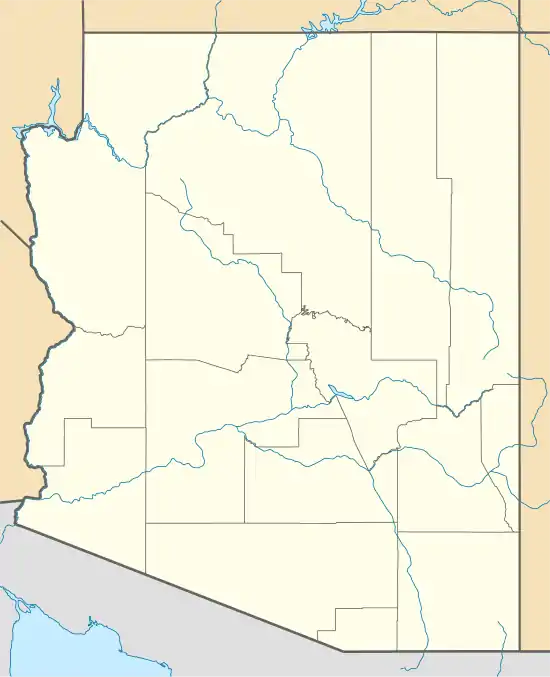  | |
| Location | Old Safford Rd., 6.8 miles southeast of Clifton, Arizona |
|---|---|
| Coordinates | 32.965251°N 109.308987°W |
| Area | 0.1 acres (0.040 ha) |
| Built | 1918 |
| Architectural style | Luten Arch bridge |
| MPS | Vehicular Bridges in Arizona MPS |
| NRHP reference No. | 88001628[1] |
| Added to NRHP | September 30, 1988 |
It is a two-span Luten arch reinforced concrete bridge which was ordered by Arizona state engineer B.M. Atwood.[2] A Luten arch is a bridge design created by Daniel B. Luten, which is widely regarded as elegant in appearance.
A longer, higher steel deck arch bridge was planned in 1917 by Arizona state engineer Thomas Haddock, but bids came in high over budget, and steel was relatively unavailable at the time (during World War I), so that approach was dropped.[2] Secondly, R.V. Leeson, the Assistant Chief Engineer of the Topeka Bridge and Iron Company, was hired to design a long open spandrel arch bridge with concrete girder approaches. But instead of that the a new state engineer, B.M. Atwood, required the design to become two equal-span Luten arches, at a lower and shorter crossing. This design was constructed by a convict work force at cost of $60,191 in 1918.[2]
The highway has since been rerouted, but the bridge remains unaltered as a county structure. Had the state engineer built the single-span concrete arch, 1t would have been one of the longest of its kind in America. The steel arch, if built, would have been the first vehicular deck arch constructed in the state -- a harbinger of the Navajo Bridge built a decade later. The Gila River Bridge, as built, was more conservative than either of the two earlier designs, but still is a visually striking and historically and technologically important structure. It was the most significant structure on the Clifton-Solomonville Highway, an important early regional route. The bridge is one of a handful of structures remaining in Arizona which were built using convict labor. Of the three most important convict-built bridges in the inventory (others: Tempe Bridge (1911-13) and Antelope Hill Bridge (1914)), it is the only one still open to vehicular traffic. Finally, the Gila River Bridge is an outstanding long-span example of the Luten arch design, patented and marketed by Daniel B. Luten - one of the most significant vehicular bridges in Arizona."[2]

It still carries traffic on the Black Hills Back Country Byway, also known as Old Safford Road.
References
- "National Register Information System". National Register of Historic Places. National Park Service. November 2, 2013.
- Clayton B. Fraser (April 1, 1987). "HABS/HAER Inventory: Gila River Bridge (Clifton Bridge) / ADOT 8152". National Park Service. Retrieved December 8, 2021. With accompanying photo
External links
 Media related to Gila River bridge, Black Hills Back Country Byway at Wikimedia Commons
| Topics | |
|---|---|
| Lists by state |
|
| Lists by insular areas | |
| Lists by associated state | |
| Other areas | |
| Related | |
| |