Gloria Arellanes
Gloria Arellanes (born March 4, 1946) is a political activist known for her involvement with the Brown Berets during the Chicano Movement and has been influential in the development of Chicana feminism. As the first female Prime Minister of the Brown Berets, Arellanes worked to include the Chicana perspective in fighting for Mexican rights in Los Angeles in the 1960s and 1970s. Conflicts of covert "macho attitude" within the delegation of labor in the Brown Berets led Gloria Arellanes along with other female Brown Berets to leave the organization and create Las Adelitas de Aztán. Similar to the Brown Berets, Las Adelitas de Aztán strived to assist its community members in creating awareness for better bilingual education in Los Angles as well as protesting against the Vietnam War. Arellanes was also a prominent figure in the National Chicano Moratorium Committee, leading Las Adelitas de Aztán to participate in marches against the violence of the Vietnam War.
With over 50 years of experience in activism, Arellanes is now a current Tongva Elder of the first nation of the Los Angeles Basin.[1][2] Arellanes' focus continues to remain on the rights of her people, defending the preservation of indigenous lifestyles through its traditions and education in Los Angeles.
Early life and Education
Arellanes was born in East Los Angeles, and a few years later her family moved to El Monte, California. Gloria's father, César Barron Arellanes, was a Mexican immigrant. Her mother, Aurora Arellanes, was of indigenous Mexican descent from present-day Azusa. Gloria as a child was never taught about her indigenous roots. Her mother found it easier for Gloria and her sibling, William (Bill) Cesar, to identify as Mexicans.
Gloria attended El Monte High School from 1960 to 1964, which is where her political consciousness began to develop. Her high school had a large mix of white and Chicano population. The Chicanos, although from different barrios, often stuck together and supported each other. Fights would break out in her high school constantly until a counselor named John Bartan held a Human Relations Club where white and Latino kids could work through their problems. Through this engagement and community-building, her identity as a Chicana began to grow. She identified many racist aspects of her high school, including discriminatory arrests made in school, teachers ignoring Chicano/a students when they raised their hands, and tracking Chicano/a students into vocational classes. Gloria became interested in the issues around race and discrimination because she knew what it was like to be discriminated against because of the color of her skin and her Mexican descent.
After graduating high school, Gloria enrolled in East Los Angeles College but quit after one year. She went on to become involved in community work and got a full-time job with the Neighborhood Adult Participation Project, an anti-poverty program where she organized Black and Chicano communities and worked on voter registration.
Brown Berets
In 1967, Arellanes and some of her friends visited La Piranya, a coffeehouse owned and operated by the Brown Berets. Arellanes met future Prime Minister of the Brown Berets, David Sánchez, and was encouraged by Sánchez to join the Berets at the coffeehouse. She began attending community meets and events and eventually decided to join.[3]: 131 In 1968, Arellanes was named the Minister of Finance and Correspondence, the first female minister of the Brown Berets.[4] Early in her career she represented the Brown Berets when they were awarded the Ghetto Freedom Award by the Greater Los Angeles Urban League in 1968.[3] The Brown Berets worked to raise their community by calling for improvement on education and employment, demanding more resources for the Chicano/a movement, and exposing police brutality against their people.[4] The first important move the Brown Berets were involved in were the 1968 East L.A. blowouts, which Arellanes had been forced to sit out by her boss at the time.[3] She was informed that her friend and companion Andrea Sánchez was arrested by Sergeant Arias of the Special Operation Conspiracy Force of LAPD under the assumption that he had arrested Arellanes. She was being watched by police because of her involvement in the Brown Berets.[3]
Arellanes organized marches during her time with the Brown Berets in partnership with the East L.A. Blowouts, in opposition to policy brutality against Chicanos, and for El Barrio Free Clinic.[3] In 1969 she arranged for the Brown Berets to use a tank for their float in the September 16 parade. She requested it without informing the clinic it would be used for Brown Berets. Arellanes was also in charge of fundraising for the Berets on a couple occasions. She organized a "Zoot Suit Party" where they made money selling cheap beer. Arellanes, among many other women Berets, organized the newsletter that went out for Mexicans and Chicanos to read, titled La Causa. [5] Limited resources and funds made the production and distribution of the paper difficult.
East L.A. Free Clinic / El Barrio Free Clinic
In 1969, David Sanchez brought the news about the Barrio Free Clinic which Arellanes was given the responsibility of coordinating. The Brown Berets created the East L.A. Free Clinic, later to be known as El Barrio Free Clinic, on Whittier Boulevard.[5] Arellanes headed the clinic for the Brown Berets, partnering with professionals that offered medical services "including drug addiction counseling, immunizations, physical exams, STI screenings and even small surgical procedures."[5] The clinic struggled to fundraise because of its casual approach in its "provided counseling for unwanted pregnancies."[5] Though it funds were not always steady, the clinic provided a space where young people in L.A. felt safe in receiving important services, even giving comfort to those who were worried of attaining health services because of their legal status in the United States.[6] Coordinating El Barrio Free Clinic, Arellanes had helped better the name of the Brown Berets, who had been seen as an outrageous radical group, as many had viewed the Black Panthers during this time.[4] In July 1969, Arellanes had become the official Clinic Director of the Barrio Free Clinic.[4] El Barrio Free Clinic is what Arellanes called, "the most significant contribution of the East L.A. Brown Berets."[3] While the clinic significantly aided the Brown Berets in their reputation within the community, it led to the departure of many female Brown Berets because of the gendered distribution of work that it came with.[6][5] Arellanes faced conflict in her duty to maintain the family-friendly environment of the Clinic while the men of the organization used the Clinic as a location of socialization, where she would be forced to remove their mess frequently to preserve its orderly image for its patients.[5][3][4]
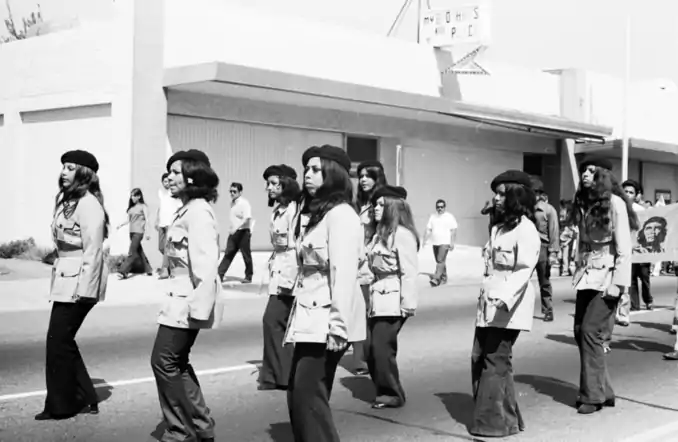
While they got along for the most part, the women were expected to work the clinic and the men took little part in volunteering and participating in the daily functions of the clinic.[3][4][5] The Beret women were not initially aware of their "second-class" membership within the organization because they "never openly expressed macho attitude," but the clinic enabled the women to recognize the difference in the roles of the men and women in the Brown Berets.[3][4][5] Arellanes mentions in her testimony that many of the women left the Brown Berets around the same time in February 1970 due to what they saw as gender inequality perpetuated by the male Brown Berets in the Chicano movement.[3] She said this was because they "found that the Brown Beret men have oppressed us more than the pig system has."[3]: 134 They left by verbal resignation but wrote letters to other chapters explaining their reasons for leaving.[3] The letter was signed, "Con Che!" due to Che Guevara's stance on equality among the sexes.
Las Adelitas de Aztán
After leaving the Brown Berets, Gloria Arellanes, alongside Gracie and Hilda Reyes, Andrea and Esther Sánchez, Lorraine Escalante, Yolanda Solis, and Arlene Sánchez, formed a Chicana group named "Las Adelitas de Aztán in 1970."[5][7] Las Adelitas de Aztán combined their activism for the Mexican-American and the women, focusing on women's rights for Chicanas. The group takes its name from the revolutionary woman who fought alongside the men in Mexico's revolution, La Adelita.[3] Las Adelitas de Aztán were a combined group of women from the Brown Berets and other similar organizations created to support one another in their goals to fight for Chicano rights and aid one another in their obstacles as women in the Chicano movement.
References
- "Gloria Arellanes • Patient Safety Movement". Patient Safety Movement. Retrieved 2021-12-16.
- Eidt, Jack (2019-09-05). "Sustaining the Legacy of the Tongva: Before and After "Los Angeles"". www.wilderutopia.com. Retrieved 2021-12-16.
- Garcia, Mario (2015). The Chicano Generation. Oakland, CA: University of California Press. ISBN 978-0-520-28602-3.
- Herrera, Juan (2015). "La Lucha Continua! Gloria Arellanes and Women in the Chicano Movement" (PDF). Cite journal requires
|journal=(help) - Martínez, Vanessa; Barajas, Julia. "How female Brown Berets created their own Chicana movement". Los Angeles Times. Retrieved 2021-11-03.
- "Chicana por mi Raza". chicanapormiraza.org. Retrieved 2021-12-17.
- "History Timeline". chicanomoratorium.org. Retrieved 2021-12-16.
Authority control  | |
|---|---|
| General | |
| National libraries | |
| Other | |