Seán McDermott Street
Seán McDermott Street is a street in northeast Dublin, Ireland. It is divided into Seán McDermott Street Lower (east end) and Seán McDermott Street Upper (west end).[2][3][4]
 Rear view of Lourdes Parish School | |||
  | |||
| Native name | Sráid Sheáin Mhic Dhiarmada[1] (Irish) | ||
|---|---|---|---|
| Former name(s) |
Great Martin's Lane (to 1764) Gloucester Street (1764–1933) | ||
| Namesake | Seán Mac Diarmada | ||
| Length | 530 m (1,740 ft) | ||
| Width | 19 metres (62 ft) | ||
| Location | Dublin, Ireland | ||
| Postal code | D01 | ||
| Coordinates | 53°21′13″N 6°15′13″W | ||
| west end | Cumberland Street Upper, Cathal Brugha Street, Champions Avenue | ||
| Major junctions | Gardiner Street, James Joyce Street | ||
| east end | Buckingham Street, Killarney Street | ||
| Construction | |||
| Construction start | early 18th century | ||
| Other | |||
| Known for | Monto, Scots Presbyterian Church, Matt Talbot | ||
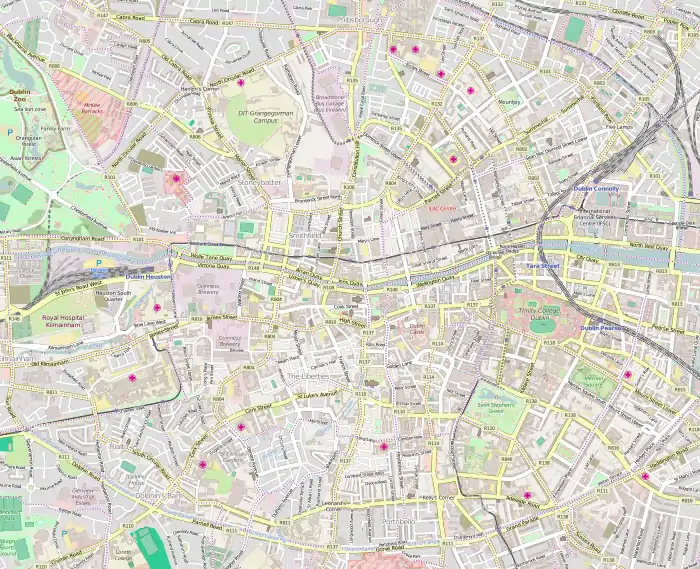
Located in the north inner city, it runs west-east as an extension of Cathal Brugha Street, for about 530 metres (1⁄3 mile) until it intersects with Buckingham Street.[5][6]
History
The street was originally named Great Martin's Lane or Saint Martin's Lane, having that name by 1712. [7]
In 1764 it was renamed Gloucester Street for Prince William Henry, Duke of Gloucester and Edinburgh, brother of King George III.[8][9] Many fine Georgian townhouses were built, but they were allowed to degrade into tenements by 1900 with most being demolished during the 20th century.[10] Most notably six regency terraced houses with a unified pediment, confusingly named Gloucester Terrace, but located at 45 to 50 Lower Seán MacDermott Street. The houses were demolished to be replaced with an ESB substation and other public buildings in the 1950s.[11][12]
In the 1860s–1920s, Gloucester Street was the northern end of the notorious Monto red-light district, where thousands of prostitutes lived and worked.[13][14]
Its intersection with Gloucester Place was known as the Gloucester Diamond, and was a centre for street football in the mid-20th century.[15] The Gloucester Diamond is mentioned in Pete St. John's song "Johnny McGory", about a First World War veteran who returns to Dublin having lost a leg.[16]
The Scots Presbyterian Church is a notable Greek-revival style church built on the street in 1846; it was later a Salvation Army building and a grain store and the façade of the building remains a landmark on the street as of 2021.[17]
An IRA safe house was located at 36 Gloucester Street Lower during the Irish War of Independence; Conor Clune, Dick McKee and Sean Fitzpatrick were arrested there on 21 November 1920, the day before Bloody Sunday.[13][18]
In 1933 the street was renamed for Seán Mac Diarmada (McDermott, 1883–1916), an executed leader of the Easter Rising.[19][20] The area was plagued by juvenile crime, including by the so-called "animal gangs."[21] In 1943–53, over 500 new homes were provided in the area by reconditioning.[22] Nevertheless, the are continued to be plagued by poverty and crime, with Michael Keating criticising the squalor of the area in the late 1970s.[23]
A Magdalene laundry for unwed mothers, including "repentant" prostitutes, opened in 1887 and did not close until 1996.[24][25][26][27]
A temporary Catholic chapel was built in 1915; it was replaced by the Romanesque Revival Church of Our Lady of Lourdes in 1954.[28] The church is known for its association with the ascetic Matt Talbot (1856–1925), whose remains were translated to the church in 1972.[29][30] Pope John Paul II visited the street in 1978, but did not enter the shrine. A banner was erected reading "John Paul Rules OK".[31]
Today, the Irish headquarters of the Society of Saint Vincent de Paul are located on Seán McDermott Street as well as a Simon Community hostel which is housed in the former carpenters' asylum, an impressive regency style former guildhall at number 35.[32][33][34]
There is also a large public swimming pool, closed since 2019 for refurbishment.[35][36]
Gallery
 Facade of the Scots Presbyterian Church
.jpg.webp) Dublin City Council offices, 52 Seán McDermott Street Lower
Dublin City Council offices, 52 Seán McDermott Street Lower Playground on Seán McDermott Street
 Multi-storey flats on the corner of Seán McDermott Street Upper and Lower Gardiner Street
 Larkin Community College
See also
 |
Wikimedia Commons has media related to Seán McDermott Street. |
References
- "Sráid Sheáin Mhic Dhiarmada Íochtarach/Sean MacDermott Street Lower". Logainm.ie.
- Holohan, Conn; Tracy, Tony (February 20, 2014). "Masculinity and Irish Popular Culture: Tiger's Tales". Springer – via Google Books.
- Bowman, John (September 15, 2016). "Ireland: The Autobiography: One Hundred Years of Irish Life, Told by Its People". Penguin UK – via Google Books.
- Pearson, Peter (December 11, 2000). "The Heart of Dublin: Resurgence of an Historic City". O'Brien Press – via Google Books.
- Power, Jack. "Homeless charity faces uncertain future following death of co-founder". The Irish Times.
- "Update on planned works to Sean McDermott Street #swimmingpool". May 16, 2021.
- "Heart of Dublin: Gloucester Diamond". Dublin City Council. April 29, 2013.
- http://dklm7jhs8nu2s.cloudfront.net/general/Archaelogical_Assessment_-_Convent_Lands.pdf?mtime=1515408553
- "Dublin Street Names". www.fionasplace.net.
- Casey, Christine (January 1, 2005). "Dublin: The City Within the Grand and Royal Canals and the Circular Road with the Phoenix Park". Yale University Press – via Google Books.
- Archives, RTÉ (5 July 2012). "RTÉ Archives". stillslibrary.rte.ie. Retrieved 16 December 2021.
- "1831 – Gloucester Terrace, Sean McDermott St., Dublin". Archiseek - Irish Architecture. 21 March 2013. Retrieved 16 December 2021.
- http://dklm7jhs8nu2s.cloudfront.net/general/NEIC_Monto_Booklet_2019_smaller_2.pdf?mtime=1566995980
- Seery, Michael. "Great Martin's Lane". Wide and Convenient Streets.
- Croke, Ruaidhrí. "Ghosts and goalposts: The soul of street football in Dublin's Gloucester Diamond". The Irish Times.
- "Johnny McGory". King Laoghaire - Irish Ballads & Tunes.
- "Record of Protected Structures in Dublin City" (PDF). Dublin City Council. Retrieved 20 July 2020.
- "McKee and Clancy Raid". www.bloodysunday.co.uk.
- "Dublin Street Names". December 20, 2007.
- Edwards, Ruth Dudley (March 22, 2016). "The Seven: The Lives and Legacies of the Founding Fathers of the Irish Republic". Simon and Schuster – via Google Books.
- Cox, Catherine; Riordan, Susannah (September 15, 2015). "Adolescence in Modern Irish History". Springer – via Google Books.
- Holland, Séamas (May 19, 2014). "Rutland Street: The Story of an Educational Experiment for Disadvantaged Children in Dublin". Elsevier – via Google Books.
- Meehan, C. (October 15, 2013). "A Just Society for Ireland? 1964-1987". Springer – via Google Books.
- Finnegan, Frances (December 11, 2004). "Do Penance Or Perish: Magdalen Asylums in Ireland". Oxford University Press – via Google Books.
- "Monastery Of Our Lady Of Charity Of Refuge, Gloucester St, Dublin QX-00470 – The Historical Picture Archive". www.historicalpicturearchive.com.
- O’Loughlin, Ed. "Ireland's last Magdalene laundry: 'They should knock it to the ground'". The Irish Times.
- Culliton, Gary. "LAST DAYS OF A LAUNDRY". The Irish Times.
- "CO. DUBLIN, DUBLIN, SEAN MACDERMOTT STREET, CHURCH OF OUR LADY OF LOURDES (RC) Dictionary of Irish Architects -". www.dia.ie.
- "Dublin, Ireland: Shrine of Venerable Matt Talbott".
- Murray, John (April 1, 2021). "Saints for the Family". Messenger Publications – via Google Books.
- "Pope Visits Seán McDermott Street". RTÉ Archives.
- "Simon Hostel, 35 Sean McDermott Street, Dublin, DUBLIN". Buildings of Ireland. Retrieved 16 December 2021.
- "CO. DUBLIN, DUBLIN, SEAN MACDERMOTT STREET, NO. 035 (CARPENTERS' HALL) Dictionary of Irish Architects -". www.dia.ie. Retrieved 16 December 2021.
- "Contact Us - St Vincent De Paul".
- Surve, Aakanksha (May 11, 2021). "Dublin pool closed for 2 years to undergo refurbishment to delight of locals". DublinLive.
- "Sean McDermott Street Swimming Pool". Dublin City Council. June 17, 2021.