Golden jellyfish
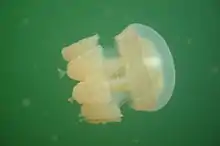
The golden jellyfish (Mastigias papua etpisoni[1]) is a subspecies of spotted jellyfish (Mastigias papua) that inhabit Jellyfish Lake.[2] They are similar to the spotted jellyfish in that they derive part of their nutrition from symbiotic algae (Zooxanthellae) that live in their tissues and part of their nutrition from captured zooplankton.[3]
| Mastigias papua etpisoni | |
|---|---|
 | |
Scientific classification  | |
| Kingdom: | Animalia |
| Phylum: | Cnidaria |
| Class: | Scyphozoa |
| Order: | Rhizostomeae |
| Family: | Mastigiidae |
| Genus: | Mastigias |
| Species: | |
| Subspecies: | M. p. etpisoni |
| Trinomial name | |
| Mastigias papua etpisoni Dawson, 2005 | |
However, the golden jellyfish are morphologically, physiologically, and behaviourally distinct from the spotted jellyfish. They are easily distinguished from the spotted jellyfish by the almost complete loss of spots on the exumbrella and the almost complete loss of their clubs, an appendage attached to the oral arms.[4]
Marine biologist Michael Dawson proposed that the golden jellyfish that inhabit Jellyfish Lake be classified as a subspecies (Mastigias cf. papua etpisoni) of the spotted jellyfish living in the nearby lagoons. The species identification is uncertain (denoted by cf. in the name) because the Mastigias papua local to Palauan lagoons may be only one of several cryptic species that make up the M. papua group, and in the future, the M. papua local to Palau may be identified as a separate species from other M. papua. He also proposed that the jellyfish living in four other Palauan marine lakes were distinctive enough to deserve recognition as unique subspecies.[4]
Quotidian migration
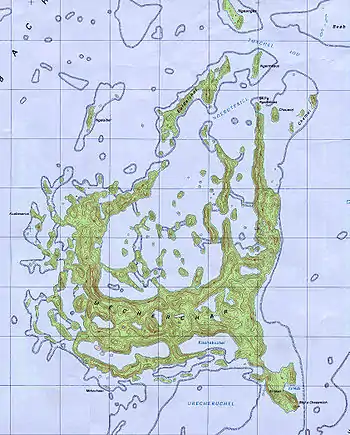
The golden jellyfish migration pattern is as follows:
- From early morning to about 09:30 - The jellyfish move from center of western basin to the eastern basin
- From early afternoon to about 15:30 - The jellyfish move from eastern basin to near western end of lake
- As the sun sets - The jellyfish move briefly eastward from western end to western basin where they remain through the night
The golden jellyfish rotate counter-clockwise as they swim at the surface, presumably to provide even exposure to the sun for the symbiotic algae in their bodies.
The Jellyfish Lake golden jellyfish migration pattern is similar to Mastigias sp. in other Palauan marine lakes and coves which all migrate west to east in the morning. However the migration patterns in other Palauan coves and marine lakes are less well defined than that of the Jellyfish Lake golden jellyfish. The east to west migration in all of these other lakes (except for Clear Lake on Eil Malk) does not begin until the late afternoon.
Hamner and Dawson proposed that the difference is caused by evolutionary change driven by the jellyfish-eating anemones (Entacmaea medusivora) that inhabit the eastern regions of Jellyfish Lake and Clear Lake. The jellyfish instinctively avoid shadows and in the morning with the shadows on the eastern end the jellyfish also avoid the anemones. By moving east to west in the early afternoon the jellyfish avoid the time of day when the setting sun would eliminate shadows on the lake in the eastern end and thereby avoid the anemones in the afternoon.[5]
Jellyfish die-off
Beginning in about the fall of 1998, a precipitous decline in the golden jellyfish medusa population was detected in Jellyfish Lake. By December 1998, the medusa population had declined to zero.[2]
Based on their extensive investigation of the disappearance of the golden jellyfish medusae, Dawson et al. determined that the most likely cause was an El Niño weather event that raised the water temperature, with the result that the symbiotic algae (Zooxanthellae) that live within the golden jellyfish medusae and the syphistomae (scyphozoan polyps) could not survive.[2]
In January 2000, the golden jellyfish medusae were observed in Jellyfish Lake for the first time since April 1999.[2] By May 2012, the medusae population had returned to pre-decline levels.[6]
Dawson et al. also surveyed the golden jellyfish populations in three other Palauan marine lakes. They found significant changes in the medusa population in two of these lakes, Clear Lake on Eil Malk and Goby Lake on Koror. The golden jellyfish population in Big Jellyfish Lake, Koror did not seem to be affected. The reason for this was not clear, but Big Jellyfish Lake experienced lower temperature increases than the other lakes and there was experimental evidence that the golden jellyfish medusa from Big Jellyfish Lake were more tolerant of higher temperatures.[2]
Although Clear Lake did not seem to have experienced the complete medusa population die-off that Jellyfish Lake did in 1998, the golden jellyfish medusae in Clear Lake are not always present. When conditions are not favorable for the short lived medusa stage or for syphistomae strobilation, the medusae disappear in Clear Lake. The medusa population is reestablished by syphistomae strobilation when conditions are favorable for strobilation and medusae again.[2]
A significant reduction in the Jellyfish Lake medusa population had also been noted in 1987. This was previously attributed to turbulence generated by scuba diving that caused disturbance of the toxic layer. However, given that it occurred within the time frame when an unusually high sea surface temperature had been detected,[7] it might reasonably be surmised that a rise in water temperature was the most likely cause of the 1998 die-off.[2]
References
- https://www.nationalgeographic.com/animals/invertebrates/facts/golden-jellyfish
- Dawson, Mike N; Martin, Laura E; Lolita K, Lolita K.; Penland (May 2001). "Jellyfish swarms, tourists, and the Christ-child". Hydrobiologia. Springer Netherlands. 451: 131–144. doi:10.1023/A:1011868925383. ISBN 978-0-7923-6964-6. S2CID 1679552.
- Dawson, Michael N (2000). "Variegated mesocosms as alternatives to shore-based planktonkreisels: notes on the husbandry of jellyfish from marine lakes". Journal of Plankton Research. 22 (9): 1673–1682. doi:10.1093/plankt/22.9.1673.
- Dawson, Michael N (2005). "Five new subspecies of Mastigias (Scyphozoa: Rhizostomeae: Mastigiidae) from marine lakes, Palau, Micronesia" (PDF). Journal of the Marine Biological Association of the United Kingdom. 85 (3): 679–694. doi:10.1017/S0025315405011604. S2CID 13572718. Archived from the original (PDF) on 2006-09-05.
- Dawson, Michael N; Hamner, William M (December 2003). "Geographic variation and behavioral evolution in marine plankton: the case of Mastigias (Scyphozoa, Rhizostomeae)" (PDF). Marine Biology. 143 (6): 1161–1174. doi:10.1007/s00227-003-1155-z. S2CID 30556970.
- Dawson, Michael N. "Marine Lakes: Experiments in Ecology and Evolution". University of California, Merced. Retrieved 20 May 2012.
- Brown, B E; Dunne, R P; Chansang, H (September 1996). "Coral bleaching relative to elevated seawater temperature in the Andaman Sea (Indian Ocean) over the last 50 years". Coral Reefs. Springer Berlin. 15 (3): 151–152. doi:10.1007/BF01145885. S2CID 39231797.