Gona, Ethiopia
Gona is an archaeological site in the Afar Triangle of Ethiopia located in the Ethiopian Lowlands.[1] The site, near the Middle Awash and Hadar regions, is primarily known for paleoanthropological study, including excavations of Late Miocene and Early Pliocene fossils, as well as Oldowan and Acheulean stone tools.[2] Evidence of Homo erectus presence at Gona dates back to as early as 1.8 million years ago, making Gona's stone tools some of the world's oldest stone tool artifacts found to date.[3] Gona is also known as a key site for the study of human evolution, with a rich hominid fossil record that includes evidence of Ardipithecus remains dating to around 4.5 million years old and Homo erectus fossils from approximately 1.8 to 1.7 million years ago.[4] Likewise, faunal remains such as cutmarked bones from Gona give insight into early hominid diets and butchery practices making it an important site for zooarchaeology.[5]
Geography
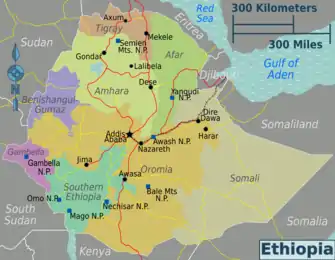
The Ethiopian Highlands are split by the Rift Valley into two zones, which include the Afar and Middle Awash to the northeast and the Omo region to the southwest.[3] Gona and its archaeological sites are located in the area of the Afar Triangle of Ethiopia.[6] This positions Gona between the Mille-Bati road to the north, the Awash River to the east, the As Bole drainage to the south, and the Western Ethiopian escarpment that rises to the west.[7] Its core covers the drainage basin of the Kada Gona, a tributary of the Awash.[2] Geologically, the area is known for basalt and trachyte rock, which is regionally used to make stone tools.[3] Many of the area's archaeological sites are located near stream channels and riverbanks.[3]
Paleoanthropology
Hominid fossils from Gona are used by palaeoanthropologists studying human evolution in the Late Miocene, Pliocene, and Early Pleistocene, which is a time period sparsely preserved in the fossil record except at a small number of key sites in Chad, Ethiopia, Kenya, Tanzania, and South Africa.[4] The uplifted western part of the Gona study area has been the site of many important hominin finds. Here, multiple cranial fragments such as jaws and teeth and several postcranial finds have been identified as Ardipithecus ramidus. These fragmentary remains were dated to 4.51-4.32 million years ago using 40Ar/39Ar dating.[4] The teeth were used to discern the species based on the distinctive wear pattern and the morphology of both the upper canine and lower P3 (third premolar).[8] Ar. ramidus dental morphology consists of thin enamel, canines with less projecting crowns and relatively high crown shoulders with cupped distal wear on the lower canine, and a lower P3 with less mesiobuccal projection and broader lower molars than chimpanzees and lastly no honing facet.[9] This change in dental anatomy from chimpanzees implies a different diet in Ar. Ramidus.[10] Additionally, Ar. ramidus has a more anteriorly situated foramen magnum which suggests that they were walking somewhat bipedally 4.5 million years ago. A partial fragmentary skeleton (GWM67/P2) and additional fragmentary finds of postcrania uncovered in Gona has supported the original analyses of Ar. ramidus’s locomotion inferred from the fossils discovered in the Middle Awash in Ethiopia. It was concluded previously, from an analysis of the ankle, hip, and foot bones, that Ardipithecus ramidus had mixed locomotory adaptations such as being bipedal when on the ground but well suited to an arboreal lifestyle when returning to the trees.[11] However, the recent discovery and analysis of the ankle and hallux from Gona shows that Ar. ramidus was more adapt for bipedalism then initially believed. The Gona Ar. ramidus fossils additionally gives us unique insight into hominin hand evolution based on its scaphoid morphology.[11]
Ardipithecus ramidus is identifiable as a unique hominin species through many aspects of its anatomy. Compared to chimpanzees, Ar. ramidus teeth had thicker enamel (but not as thick as later Australopithecus or Homo) and smaller canines, having lost the C/P3 honing complex[12]. Male and female canines were only mildly dimorphic, similar to the pattern seen in modern humans, as opposed to the extreme dimorphism seen in great apes[13]. The canine shape also changed from pointed to diamond-shaped, which is less threatening, signaling less male-male agonistic behaviors than seen in modern monkeys and apes.
Other identifiable features include a small brain (similar to that of chimpanzees today) and hands, feet, arms, legs and pelvis suited to an arboreal lifestyle through palmigrade clambering[14]. However, when on the ground Ar. ramidus lacked the adaptations for knuckle-walking or striding bipedalism, and thus was a less efficient biped than Australopithecus.
Geology
The geological record of Gona is among the most temporally extensive in East Africa for a paleoanthropological study area, with four geological formations described that span the last six million years: 1) the Adu-Asa (>6.4–5.2 Ma), 2) Sagantole (>4.6–3.9 Ma), 3) Hadar (3.8–2.9 Ma), and 4) Busidima Formations (2.7 to <0.16 Ma). The onset of deposition at Gona began as a result of rifting and volcanism in the Afar Basin in the early Miocene, which continues today (Quade et al., 2004). The Sagantole Formation in the uplifted western part of the Gona study area is “cut by largely west-dipping normal faults and is bounded on the east side by a major structural feature” (Quade et al., 2004). This feature is the As Duma Fault, which created a half-graben for the Hadar and Busidima Formations to fill in. The Busidima Formation has a slight tilt of 1-2 degrees to the southwest. The Awash River and tributaries have deeply dissection Gona’s modern landscape and is the main reason for the exposure of its rich array of fossils and archaeological sites.
Zooarchaeology
The bones, shells, and hides that animals leave behind after death are known as faunal remains, which are studied in the sub-discipline of zooarchaeology. Faunal remains provide archaeological insight into the behavior and foodways of early hominids by preserving the types of food consumed as well as methods of preparation like butchery. Excavations in the Lower Busidima Formation at Gona show that faunal food resources at the site included equids and bovids with cutmarked animal bones showing signs of butchery practices including skinning and filleting.[5]
Cutmarked bone
Archaeological sites that preserve both faunal remains and stone tool assemblages are known as Type C sites and are important to studying connections between topics like meat consumption and stone tool manufacture.[5] The DAN2 (Dana Aoule) site at Gona is an example of a Type C assemblage including five cutmarked bones dated to approximately 2.1 Ma (millions of years).[5] Cutmarked specimens are important, because they can provide evidence of early hominid behavior in regards to food acquisition like hunting (cutting, arrowhead marks, etc.) and meat preparation techniques preserved by cutmarks left on bones during butchery.
The cutmarked bones from DAN2 included a tibia midshaft fragment and four skeletal fragments that could not be definitively classified; these fragments showed signs of filleting that are most commonly left on upper limb bones during experimental butchery studies.[5] While more data is needed to make wider inferences about the acquisition of animal food sources during the Pliocene period, study at Gona and contemporary sites like the Bouri Formation associate the primary use of early stone tools with butchery.[15] The existence of cutmarked bones at Gona suggests some level of hominids acquiring "fleshed carcasses" possibly through practices of hunting rather than scavenging.[5]
Stone tools
Stone tools from Gona were first excavated from sedimentary deposits in the Hadar region of the Awash valley in 1976.[16] Basalt and trachyte rock are commonly used as local source material for the stone tools found at this site alongside smaller percentages of imported stones like chert.[17] A majority of the tools found at Gona are from the Oldowan Industry, also known as Mode 1, and date to around 2.6-1.6 mya.[3] There is also evidence of the co-occurrence of Oldowan and Acheulean, or Mode 2, stone tools at Gona discovered during an excavation that found artifacts from both stone tool industries nearby a Homo erectus cranial fossil.[18] These findings suggest an overlap of stone tool technology that challenge attributions of a single technology to a single species like early Homo.[18] Additionally, the Oldowan artifacts at Gona dating to 2.6 mya, form the oldest stone tool assemblages in the world and provide insight into the practices of early stone tool manufacture.[15] Radiometric dating and magnetic polarity methods were used to determine the dates of these stone tool artifacts.[16]
The Acheulean presence at Gona ranges between 1.6–1.2 MYA, and younger.[19] Several sites containing Acheulean artifacts include the BSN12, DAN5, and OGS12 sites.[19] Bifacially flaked handaxes, cleavers, picks, and unmodified debitage have been found at the surface of the BSN12 site in Gona, all indicative of the Acheulean tradition.[19] Handaxes recovered from the DAN5 and BSN12 sites were reduced from cobbles sourced from nearby river conglomerates.[18] Bipolar reduction strategies were practiced by Homo erectus at Gona to make the most out of the local lithics, using both Mode 1 and Mode 2 technologies. Differences in raw material sources probably account for the smaller tool sizes at Gona compared to other Acheulean sites such as Konso.[19]
Mary Leakey's stone tool typology organizes early stone assemblages into six categories: "Flaked Pieces (cores/choppers), Detached Pieces (flakes and fragments), Pounded Pieces (cobbles utilized as hammerstones), and Unmodified Pieces (manuports, stones transported to sites)."[15] Most stone tool assemblages are classified by these conventions. Artifact deposits at Gona include whole flakes, simple cores, and flaking debris like uniface and a few biface cores that are rarer at the site.[16] Practices of modified shaping by pounding and battering are preserved in artifacts like hammerstones and anvils at Gona.[16] The sharp edges, pitting, and other wear marks on the tools found at the site suggest mastery of basic stone tool manufacture and the multipurpose use of these tools for everyday activities like pounding to break bones for marrow and cutting to process meat.[15] Unlike excavations at Olduvai, there is no current evidence of retouched flakes like stone scrapers at Gona.[16] Other important sites for stone tool assemblages in Ethiopia include Omo, Hadar, and Bouri as well as Lokalalei in Kenya.
See also
- List of fossil sites (with link directory)
- List of hominina (hominid) fossils (with images)
References
- Semaw, Sileshi; et al. (2003). "2.6-Million-year-old stone tools and associated bones fromOGS-6 and OGS-7, Gona, Afar, Ethiopia" (PDF). Journal of Human Evolution. 45 (2): 169–177. doi:10.1016/S0047-2484(03)00093-9. PMID 14529651. Archived (PDF) from the original on 22 May 2016.
- "Smallest Homo erectus cranium in Africa and diverse stone tools found at Gona, Ethiopia". Michigan News. University of Michigan. 4 March 2020. Archived from the original on 7 May 2020.
- Finneran, Niall (8 November 2007). The Archaeology of Ethiopia. Routledge. p. 36. ISBN 978-0-429-23647-1.
- Semaw, Sileshi; Simpson, Scott W.; Quade, Jay; Renne, Paul R.; Butler, Robert F.; McIntosh, William C.; Levin, Naomi; Dominguez-Rodrigo, Manuel; Rogers, Michael J. (20 January 2005). "Early Pliocene hominids from Gona, Ethiopia". Nature. 433 (7023): 301–305. doi:10.1038/nature03177. ISSN 0028-0836.
- DOMINGUEZ-RODRIGO, M; PICKERING, T; SEMAW, S; ROGERS, M (2005). "Cutmarked bones from Pliocene archaeological sites at Gona, Afar, Ethiopia: implications for the function of the world's oldest stone tools". Journal of Human Evolution. 48 (2): 109–121. doi:10.1016/j.jhevol.2004.09.004. ISSN 0047-2484.
- Semaw, Sileshi; et al. (2003). "2.6-Million-year-old stone tools and associated bones fromOGS-6 and OGS-7, Gona, Afar, Ethiopia" (PDF). Journal of Human Evolution. 45 (2): 169–177. doi:10.1016/S0047-2484(03)00093-9. PMID 14529651. Archived (PDF) from the original on 22 May 2016.
- Kleinsasser, Lynnette L.; et al. (2008). "Stratigraphy and geochronology of the late Miocene Adu-Asa Formation at Gona, Ethiopia". In Quade, Jay; Wynn, Jonathan G. (eds.). The Geology of Early Humans in the Horn of Africa. G.S.A. Special paper #446. Boulder, Colorado: Geological Society of America. pp. 33–65. doi:10.1130/2008.2446(02). ISBN 978-0-8137-2446-1. S2CID 130119615.
- Haile-Selassie, Yohannes; Suwa, Gen; White, Tim D. (5 March 2004). "Late Miocene Teeth from Middle Awash, Ethiopia, and Early Hominid Dental Evolution". Science. 303 (5663): 1503–1505. doi:10.1126/science.1092978. ISSN 0036-8075.
- White, Tim D.; Suwa, Gen; Asfaw, Berhane (22 September 1994). "Australopithecus ramidus, a new species of early hominid from Aramis, Ethiopia". Nature. 371 (6495): 306–312. doi:10.1038/371306a0. ISSN 0028-0836.
- Suwa, Gen; Kono, Reiko T.; Simpson, Scott W.; Asfaw, Berhane; Lovejoy, C. Owen; White, Tim D. (2 October 2009). "Paleobiological Implications of the Ardipithecus ramidus Dentition". Science. 326 (5949): 69–99. doi:10.1126/science.1175824. ISSN 0036-8075.
- Simpson, Scott W.; Levin, Naomi E.; Quade, Jay; Rogers, Michael J.; Semaw, Sileshi (April 2019). "Ardipithecus ramidus postcrania from the Gona Project area, Afar Regional State, Ethiopia". Journal of Human Evolution. 129: 1–45. doi:10.1016/j.jhevol.2018.12.005. ISSN 0047-2484.
- Suwa, Gen; Kono, Reiko T.; Simpson, Scott W.; Asfaw, Berhane; Lovejoy, C. Owen; White, Tim D. (2 October 2009). "Paleobiological Implications of the Ardipithecus ramidus Dentition". Science. 326 (5949): 69–99. doi:10.1126/science.1175824. ISSN 0036-8075. line feed character in
|title=at position 36 (help) - Suwa, Gen; Sasaki, Tomohiko; Semaw, Sileshi; Rogers, Michael J.; Simpson, Scott W.; Kunimatsu, Yutaka; Nakatsukasa, Masato; Kono, Reiko T.; Zhang, Yingqi; Beyene, Yonas; Asfaw, Berhane (7 December 2021). "Canine sexual dimorphism in Ardipithecus ramidus was nearly human-like". Proceedings of the National Academy of Sciences. 118 (49): e2116630118. doi:10.1073/pnas.2116630118. ISSN 0027-8424.
- White, Tim D.; Asfaw, Berhane; Beyene, Yonas; Haile-Selassie, Yohannes; Lovejoy, C. Owen; Suwa, Gen; WoldeGabriel, Giday (2 October 2009). "Ardipithecus ramidus and the Paleobiology of Early Hominids". Science. 326 (5949): 64–86. doi:10.1126/science.1175802. ISSN 0036-8075. line feed character in
|title=at position 21 (help) - Semaw, Sileshi (2000). "The World's Oldest Stone Artefacts from Gona, Ethiopia: Their Implications for Understanding Stone Technology and Patterns of Human Evolution Between 2·6–1·5 Million Years Ago". Journal of Archaeological Science. 27 (12): 1197–1214. doi:10.1006/jasc.1999.0592. ISSN 0305-4403.
- Semaw, Sileshi; et al. (23 January 1997). "2.5-million-year-old stone tools from Gona, Ethiopia". Nature. 385: 333–336.
- Finneran, Niall (8 November 2007). The Archaeology of Ethiopia. Routledge. pp. 36–38. ISBN 978-0-429-23647-1.
- Semaw, Sileshi; Rogers, Michael J.; Simpson, Scott W.; Levin, Naomi E.; Quade, Jay; Dunbar, Nelia; McIntosh, William C.; Cáceres, Isabel; Stinchcomb, Gary E.; Holloway, Ralph L.; Brown, Francis H. (6 March 2020). "Co-occurrence of Acheulian and Oldowan artifacts withHomo erectuscranial fossils from Gona, Afar, Ethiopia". Science Advances. 6 (10): eaaw4694. doi:10.1126/sciadv.aaw4694. ISSN 2375-2548.
- Semaw, Sileshi; Rogers, Michael J.; Cáceres, Isabel; Stout, Dietrich; Leiss, Amanda C. (2018), Gallotti, Rosalia; Mussi, Margherita (eds.), "The Early Acheulean ~1.6–1.2 Ma from Gona, Ethiopia: Issues related to the Emergence of the Acheulean in Africa", The Emergence of the Acheulean in East Africa and Beyond, Cham: Springer International Publishing, pp. 115–128, doi:10.1007/978-3-319-75985-2_6, ISBN 978-3-319-75983-8, retrieved 7 December 2021