Gopa (caste)
Gopa or Gop or Gope is a synonym of the Yadav (Ahir) caste in Bihar, Jharkhand & West Bengal of East India.[1][2][3] They are further divided into sub-division like Krishnaut, Majhraut, Sadgop etc.[4][5][6][7][8]
| Gopa (Yadav) | |
|---|---|
| Kuladevta (male) | Shri Krishna |
| Religions | Hinduism |
| Languages | Hindi and Bengali |
| Populated states | Bihar, Jharkhand and West Bengal |
| Subdivisions | Krishnaut, Majhraut, Sadgop |
Origin and History
In Rigved Dasam Mandal Maharaj Yadu is mentioned as Gopa.[9][10] The Gopa and Gopati were epithets given to the King.[11][12]
The Yadavas of the Mahabharata period were known to be the followers of Vaishnavism, of which Krishna was the leader: they were Gopas (cowherd) by profession, but at the same time they held the status of the Kshatriyas, participating in the battle of Kurukshetra. The present Ahirs are also followers of Vaisnavism.[13][14]
In Harivamsa Purana, it has been said that Gopas and Yadav are generic of same lineage and they are called Gope or Yadav.[15]
Mahabharat's Narayani (Gopayan) Army
Narayani Sena (Gopayan)[16][17] or Yadav(Ahir) Sena, the army of Lord Krishna of Dwarka Kingdom is called as the supreme Sena of all time. It is described in the Mahabharat as being all of the Abhira caste.[18] They were the basic threat to the rival kingdoms. Fearing Narayani Sena, many Kings didn’t try fighting against Dwaraka. Because Dwaraka sorted most of the threats through Krishna’s politics and talent of Yadavas. Using Narayani Sena, the Yadavas extended their empire to most of India.[19][20][21]
Krishna had offered Arjuna, the choice of selection between him or his whole army of Narayani Sena against Duryodhana. He possessed 10 million fighting Gopes who were brave fighters and were famous by the name of Narayan. In Harivansa Purana, it has been said that Gope or Yadav are generic of the same lineage.[22]
Before the war started in the Kurukshetra battlefield in Mahabharat (one of the two major epics of ancient India), both sides – the Kauravas and the Pandavas started out in all directions to meet various kings to solicit support. Incidentally, both Duryodhana (from Kauravas side) and Arjuna (from Pandavas side) reached Dwarika, the kingdom of Shree Krishna together. Lord Krishna put forward a condition in front of both – you can have either me on your side or my entire army, the Yadav army – known as the Narayani Sena. He also told both that he wouldn't take to any arms during the entire war. So when Krishna first asked Arjun what he wanted, much to Duryodhana's delight, he opted for the Lord- 'Narayan' and Duryodhana got these great warriors of the strong army-'the Narayani Sena. When Narayani Sena was fighting for Kauravas, only Kritavarma and his army unit fought for the Kauravas. Satyaki fought for the Pandavas. The rest of the Atirathas and Maharathis were withheld from the Kurukshetra war on the advice of Balram and Krishna.[23][24][25][26]
These Gopas, whom Krishna had offered to Duryodhana to fight in his support when he himself joined Arjuna's side, were no other than the Yadavas themselves, who were also the Abhiras.[27][28][29] They were the supporters of the Duryodhana[30][31] and Kauravas, and in the Mahabharata,[32] Abhir, Gopa, Gopal[33] and Yadavas are all synonyms.[34][35][36] They defeated the hero of Mahabharatha war (Arjuna), and spared him when he disclosed the identity of the members of the family of Sri Krishna.[37]
Kingdoms
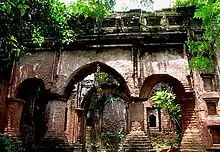
Culture
In Kosi division of Bihar, people of the Gopa or Ahir (Yadav) caste worship their caste deity Bisu Raut, whose temple is situated on the banks of the Gogri river.[46][47]
Gop Jatiye Mahasabha
Gop Jatiye Mahasabha was formed by Babu Ras Bihari Lal Mandal in 1911, It was the regional organization of Gope or Ahir caste of Bihar, Bengal & Orissa.[48][49][50]
Later, the All-India Yadav Mahasabha was formed by merging the Gop Jatiye Mahasabha and Ahir/Yadav Kshatriya Mahasabha.
All India Yadav Mahasabha's first National Conference was held in Purnea, Bihar on 17 to 20 April 1924, Raja Of Nazargunj Prithvi Chand Lal Chaudhary was one of the main organisers along with Rai Sahib Ballabh Das of & Swayambar Das.[51]
Present Circumstances
Gopa (Yadav) are mainly a landholding community and they are rich cultivators.[52]
References
- Madhusudan Das (1980). Madhusudan Das, the Legislator: His Speeches. Pragati Utkal Sangha.
- Dalip Kumar (2007). Rural Development and Social Change: Thoughts of Swami Sahajanand. Deep & Deep Publications. pp. 106–. ISBN 978-81-8450-000-4.
- "रोम पोप का, मधेपुरा गोप का..." Dainik Bhaskar. Retrieved 23 June 2020.
- Hunter, Sir William Wilson (1875). A statistical account of Bengal.
- Singh, Rana P. B. (1977). Clan Settlements in the Saran Plain (Middle Ganga Valley): A Study in Cultural Geography. National Geographical Society of India, Banaras Hindu University.
- Aniruddha Ray (2011). The Varied Facets of History: Essays in Honour of Aniruddha Ray. Primus Books. pp. 95–. ISBN 978-93-80607-16-0.
- Ray, Ratnalekha (1979). Change in Bengal Agrarian Society, C1760-1850. Manohar.
- Risley, Sir Herbert Hope (1892). The Tribes and Castes of Bengal. Printed at the Bengal secretariat Press.
- Halahawi, Shalomim Y. (2007-10-01). The Way! the Prophetic Messianic Voice to the Path of the Edenic Kingdom Redemption. Lulu.com. ISBN 978-1-4303-0816-4.
- Catalogue of syriac manuscripts in the British Museum, acquired since the Year 1838. Gilbert & Rivington. 1860.
- Indian History. Allied Publishers. 1988. ISBN 978-81-8424-568-4.
- Soni, Lok Nath (2000). The Cattle and the Stick: An Ethnographic Profile of the Raut of Chhattisgarh. Anthropological Survey of India, Government of India, Ministry of Tourism and Culture, Department of Culture. ISBN 978-81-85579-57-3.
- Shashi, Shyam Singh (1994). Encyclopaedia of Indian Tribes: The tribal world in transition. Anmol Publications, 1994. p. 76. ISBN 9788170418368.
The Yadavas of the Mahabharata period were known to be the followers of Vaisnavism, of which Krsna was the leader: they were gopas (cowherd) by profession, but at the same time they held the status of the Ksatriyas, participating in the battle of Kurukshetra. The present Ahirs are also followers of Vaisnavism.
- Vaidya, Chintaman Vinayak (2001). Epic India, Or, India as Described in the Mahabharata and the Ramayana. Asian Educational Services, 2001. p. 423. ISBN 9788120615649.
The fact that the Yadavas were pastoral in their habits is distinctly proved by the fact that Krishna's sister Subhadra when she was taken away by Arjuna is described as having put on the dress of a Gopi or female cowherd. It is impossible to explain this fact unless we believe that the whole tribe was accustomed to use this dress. The freedom with which she and other Yadava women are described as moving on the Raivataka hill in the festivities on that occasion also shows that their social relations were freer and more unhampered than among the other Kshatriyas. Krishna again when he went over to Arjuna's side is said in the Mahabharata to have given in balance for that act an army of Gopas to Duryodhana. The Gopas could have been no other than the Yadavas themselves.
- Soni, Lok Nath (2000). The Cattle and the Stick: An Ethnographic Profile of the Raut of Chhattisgarh. Anthropological Survey of India, Government of India, Ministry of Tourism and Culture, Department of Culture. ISBN 978-81-85579-57-3.
- Soni, Lok Nath (2000). The Cattle and the Stick: An Ethnographic Profile of the Raut of Chhattisgarh. Anthropological Survey of India, Government of India, Ministry of Tourism and Culture, Department of Culture. p. 16. ISBN 978-81-85579-57-3.
- Nava Kumar (1979). The Mahabharata: A Spiritual Interpretation. Sura Sadan Pub.
- Pandey, Braj Kumar (1996). Sociology and Economics of Casteism in India: A Study of Bihar. Pragati Publications, 1996. p. 78. ISBN 9788173070365.
The Narayani Army which he organized, and which made him so powerful that his friendship was eagerly sought by the greatest kings of his time, is described in the Mahabharat as being all of the Abhira caste.
- Hasan, Amir (2005). People of India: Uttar Pradesh, Volume 42, Part 1. Anthropological Survey of India, 2005. p. 17. ISBN 9788173041143.
- Gopal Chowdhary (4 March 2014). The Greatest Farce of History. Partridge Publishing India. pp. 129–. ISBN 978-1-4828-1925-0.
- Subhash Krishna (19 July 2020). Salvation by Lord Shri Krishna. Notion Press. pp. 431–. ISBN 978-1-64587-108-8.
- Soni, Lok Nath (2000). The Cattle and the Stick: An Ethnographic Profile of the Raut of Chhattisgarh. Anthropological Survey of India, Government of India, Ministry of Tourism and Culture, Department of Culture. p. 16. ISBN 978-81-85579-57-3.
- "The Narayani Sena Dilemma - Follow Krishna or follow Conscience". media.radiosai.org. Retrieved 2020-08-09.
- "Narayan or the narayani sena?". StoryMirror. 2020-01-03. Retrieved 2020-08-09.
- Jyoti Bhusan Das Gupta (2007). Science, Technology, Imperialism, and War. Pearson Education India. pp. 291–. ISBN 978-81-317-0851-4.
- Amit Palkar (1 February 2019). Moral Stories for All. Evincepub Publishing. pp. 46–. ISBN 978-93-88277-92-1.
- Man in India – Google Books. 1974.
- Shah, Popatlal Govindlal (13 February 2009). Ethnic history of Gujarat – Popatlal Govindlal Shah – Google Books.
- Ethnic history of Gujarat
- Man in India – Google Books. 17 July 2007.
- Man in India, Volume 54-page-39
- Ancient Nepal
- Regmi, D. R. (1 December 1973). Ancient Nepal – D. R. Regmi, Nepal Institute of Asian Studies – Google Books.
- Kapoor, Subodh (2002). Encyclopaedia of ancient Indian ... – Subodh Kapoor – Google Books. ISBN 9788177552980.
- Rao, M. S. A. (14 December 2006). Social movements and social ... – M. S. A. Rao – Google Books. ISBN 9780333902554.
- Rao, M. S. A. (14 December 2006). Social movements and social ... – M. S. A. Rao – Google Books. ISBN 9780333902554.
- Singh Yadav, J. N. (28 August 2007). Yadavas through the ages, from ... – J. N. Singh Yadav – Google Books. ISBN 9788185616032.
- "Gopegarh Eco Park: Where nature is your only companion". Outlook (India). Retrieved 2021-03-09.
- Nepālī Saṃskr̥ta abhilekhoṃ kā Hindī anuvāda (in Hindi). Īsṭarna Buka Liṅkarsa. 1985.
- Satyal, Yajna Raj (1988). Tourism in Nepal: A Profile. Nath Publishing House.
- Bengal (India), West (1965). West Bengal District Gazetteers: Barddhamān. State editor, West Bengal District Gazetteers.
- Smith, William L. (1980). The One-eyed Goddess: A Study of the Manasā Maṅgal. Almqvist & Wiksell International. ISBN 978-91-22-00408-0.
- McLane, John R. (2002-07-25). Land and Local Kingship in Eighteenth-Century Bengal. Cambridge University Press. ISBN 978-0-521-52654-8.
- Chatterji, Joya (2002-06-06). Bengal Divided: Hindu Communalism and Partition, 1932-1947. Cambridge University Press. ISBN 978-0-521-52328-8.
- Bandyopadhyay, Sekhar (2004-07-01). Caste, Culture and Hegemony: Social Dominance in Colonial Bengal. SAGE Publications India. ISBN 978-81-321-0407-0.
- Bihar (India); Choudhury, Pranab Chandra Roy (1965). Bihar District Gazetteers: Saharsa. Superintendant, Secretariat Press, Bihar.
- Byrne, Joseph (2011). Bhagalpur. Concept Publishing Company. ISBN 978-81-7268-203-3.
- Madhusudan Das (1980). Madhusudan Das, the Legislator: His Speeches. Pragati Utkal Sangha.
- Banerjee, Supurna; Ghosh, Nandini (17 September 2018). Caste and Gender in Contemporary India: Power, Privilege and Politics-Google Books. ISBN 9780429783951. Retrieved 14 June 2020.
- Alam, Jawaid (January 2004). Government and Politics in Colonial Bihar, 1921-1937,from ... – Jawaid Alam- Google Books. ISBN 8170999790. Retrieved 14 June 2020.
- Banerjee, Supurna; Ghosh, Nandini (2018-09-17). Caste and Gender in Contemporary India: Power, Privilege and Politics. Taylor & Francis. ISBN 978-0-429-78395-1.
- Bandyopadhyay, Suraj; Rao, A. R.; Sinha, Bikas Kumar; Sinha, Bikas K. (2011). Models for Social Networks With Statistical Applications. SAGE. ISBN 978-1-4129-4168-6.