Goslings Bank
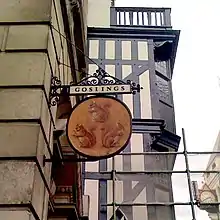
Goslings Bank was a historical English private bank, located since at least 1743 at No. 19 Fleet Street, London, and identified to customers by a hanging signboard depicting three squirrels.
History
The bank originated in the business of Henry Pinckney, a goldsmith-banker who began trading in about 1650 at the sign of the Three Squirrels. The first Gosling partner entered the business in 1742. After becoming Goslings and Sharpe it was a constituent bank in the Barclays & Co merger of 1896 with 18 other banks.[1][2] The name of this well-known banking family is perpetuated in parentheses on all Barclays cheques relating to accounts held at the Fleet Street branch.
Customers
Goslings Bank boasted a number of prominent customers, including St John's College, Oxford, St John's College, Cambridge, The Times newspaper, the Law Society, the Stationers Company, and the Society of Licensed Victuallers.[3] Prominent individuals known to have banked with Goslings include Edward Austen Knight, Thomas Longman, and Sir Edwin Landseer.[3]
Legacy
The Goslings name is perpetuated by Barclays Bank as part of the group's history, and in several practical ways. The three squirrels sign is still maintained outside the Fleet Street branch at 19 Fleet Street, and the Goslings name is still printed on cheques issued at that branch, as it has been since the 1896 merger.[4]
See Also
References
- Ackrill, Margaret; Leslie Hannah (2001). Barclays: the business of banking, 1690-1996. Cambridge: Cambridge University Press. p. 57. ISBN 0-521-79035-2.
- Essie, Rackley; Jeffrey E.Walker (2004). Business cheques with an extra. Bristol: University of Bristol.
- "Legends in the ledgers". Barclays Bank. 18 May 2017. Retrieved 22 February 2021.
- "Cheque of Barclay's Bank". British Museum. Retrieved 22 February 2021.