Herren von Graben
Herren von Graben, also named von (dem) Graben, vom Graben,[1] Grabner, Graben von (zum) Stein,[2] and ab dem Graben was the name of an old Austrian noble family.
| Herren von Graben Grabner, Graben, Graben zu Kornberg, Graben zu Sommeregg, Grabner zu Rosenburg, Graben zum Stein, Graben von Stein | |
|---|---|
| noble family | |
 „Daß ich grabe bürgt mein Habe.“ „Ich baue, indem ich haue.“ | |
| Parent house | House of Meinhardin-Gorizia |
| Country |  Austria Austria |
| Founded | 12th century |
| Founder | Konrad and Grimoald von Graben |
| Final ruler | Felix Jakob von Graben |
| Titles | knights |
| Style(s) | Burgrave of Graz Burgrave of Marburg Burgrave of Lienz Burgrave of Hohenwang Burgrave of Heinfels Burgrave and Lord of Gleichenberg Burgrave and Lord of Sommeregg Lord of Kornberg Lord of Rosenburg Lord of Pottenbrunn Lord of Stein im Drautal Lord of the high Lordship of Straß in Steiermark Stadtholder of Lienz and East Tyrol etc |
| Dissolution | 1776/1780/1781 |
| Cadet branches | De Graeff, Stadl zu Kornberg, Rain zu Sommeregg |
History
Originally from Carniola, an apparent (or illegitimate) branch of the House of Meinhardin,[3][4] the family spread in neighboring countries. The earliest known members of the Graben family, Konrad and his brother Grimoald von Graben, lived around 1170.[5][6][7]
During the middle ages family went on to rule some Carinthian, Lower Austrian, Tyrolian, East Tyrols, Styrian, Gorizian and modern Italian districts as Burggrafen (a sort of viscount) and Herren (lords) from the early Middle Ages until the 16th-17th centuries. The last member was Felix Jakob von Graben who lives in Tyrol; the family died out in 1776 or 1780.
Coat of arms
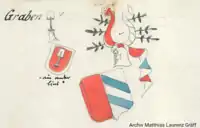
There are three forms of representation of the gender coat of arms, Von Graben, which have their connection to one another through the established family genealogy.[8][7] A distinction is made between the family coat of arms with the blue diagonal left bar on white (also variant with diagonal right bar), the shovel coat of arms on red and the coat of arms split from red, and divided three times by blue and white (or black).
.jpg.webp) Coat of arms (ancient)
Coat of arms (ancient)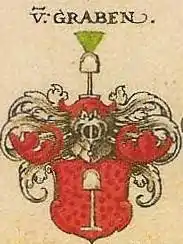 Coat of arms (variant with shovel)
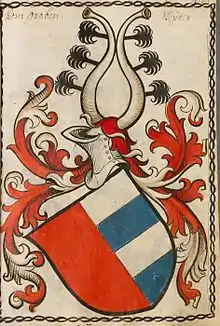 Coat of arms (variant with blue and white divided)
- Both coat of arms versions of the Von Graben (archiv Matthias Laurenz Gräff)
The lines of the family
Originally from Carniola, a line settled in Styria around Graz. This line is named "Line Am Graben". During the later 13th century the later princely family Orsini-Rosenberg descended from a member of the family who lived at the Grazer Castle Alt-Grabenhofen, between Reinerkogel and Rosenberg.[9] During the early 14th century, the family split into four main lines, the Styrian Grabenhofen line, the Grabner (zu Rosenburg) line in Lower Austria, the Kornberger line and their Dutch offspring (De) Graeff,[10][7] and during the earlier 15th century in the Carynthian-Lienzer Sommeregger line.[11] In 1500, the family split into a new line, the Stein Line at Castle Stein. Two other lines of the Graben family can be found in Tyrol, and one in Switzerland.
Kornberger line

The Grabner zu Kornberg came from Styria in Graz and belonged to the same tribe as the Grabner zu Rosenburg. The first important member of the family was Ulrich II von Graben (named between 1300–1361), who was elevated to the Styrian title of Burggraf of Hohenwang. The Styrian line's residence between 1328 and 1556 was at Schloss Kornberg. Between 1456 and 1564, the Kornberg line was owned the important Lordship Marburg with Obermarburg and the Marburg Castle. They were linked by marriage with the Lords of Windisch-Graetz,[12] Auersperg,[13] Stubenberg,[14] and Guttenberg.[15] The Dutch family De Graeff claimed descent from Wolfgang von Graben, a member of the Graben family.[16] Andries de Graeff and his son Cornelis became Free Imperial knights of the Holy Roman Empire. That diploma dates from 19 July 1677.[17]
Members
- Ulrich II von Graben (named between 1300 and 1361)
- Friedrich II von Graben († before 1463)
- Ulrich III von Graben († 1486)
- Wolfgang von Graben (1465-1521)
- Andrä von Graben († 1556)
Line Grabner zu Rosenburg
The Grabner zu Rosenburg came from Styria in Graz and belonged to the same tribe as the Kornberger Graben. They had extensive property with the Rosenburg and Pottenbrunn as well as in Moravia and was one of the advocates of Protestantism during the Reformation in Lower Austria. In the 16th century the Grabner Rosenburg made a center of the Austrian Reformation history.[18] During the 16th and early 17th centuries, the Grabner were among the richest and most respected families in Austria,[19] and one of the country's dominant Protestant noble families.[20]
Members
- Sebastian I Grabner zu Rosenburg ( † 1535), leading Protestant
- Leopold Grabner zu Rosenburg (1528–1583), leading protestant
- Sebastian II Grabner zu Rosenburg, leading Protestant
Sommeregger line
.jpg.webp)
The Sommeregger line which came from the Kornberg line, was the most important family at the court of the Meinhardins of Gorizia in the late 15th and early 16th centuries.[21] During the later Middle Ages, the success of that family arose from the steady accumulation of land, and loyalty to the Counts of Görz and later to the Habsburg Emperor. The line resided in Lienz, East Tyrol and Carinthia, and became "the most prominent of the family". Family members held the noble titles as the Burgraves of Sommeregg, Heinfels and Lienz. After the death of Leonhard of Gorizia in 1500, they became his successors as stadtholders of Lienz and East Tyrol. The Lienzer line died out in the year 1534, and the zum Stein in 1664.
They were linked by marriage with the Lords of Auersperg,[13] Saurau[22] and Breuner.[23]
Members
- Andreas von Graben (early 15th century-1463)
- Cosmas von Graben (15th century)
- Virgil von Graben (15th century-1507)
- Rosina von Graben von Rain (15th century-1534)
Line at Stein
The line at Stein came from Carinthia and East Tyrol and sprang out of the Sommeregger line.
- Lukas von Graben zum Stein (15th-16th century)
Tyrolian line
The Tyrolian line came from Carinthia and East Tyrol and sprang out of the line Graben zum Stein.
- Otto von Graben zum Stein, was named "Graf zum Stein" (1690–1756)
Burgraviates

- Burgrave of Lienz
- Burgrave and Lord of the manor Heinfels
- Burgrave and Lord of the manor Hohenwang
- Burgrave and Lord of the manor Sommeregg
- Burgrave and Lord of the manor Lengberg
- Burgrave and Lord of the manor Saldenhofen
- Burgrave and Lord of the manor Gleichenberg
- Burgrave and Lord of the manor Riegersburg
- Burgrave and Lord of the manor Landskron
High Lordships
- High Lordship and Castle of Straß
- High Lordship of Marburg an der Drau and Castle of Obermarburg
Lordships
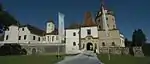
.JPG.webp)
Lord of the manor
- Lord of the manor Graben near Rudolfswerth (Novo Mesto)
- Lord of the manor Schloss Alt-Grabenhofen in the north of Graz
- Lord of the manor Stein
- Lord of the manor Herbstenburg
- Lord of the manor Weidenburg
- Lord of the manor Eppenstein
Castles, residences
- Ansitz Graben at Lienz
- Burg Bruck at Lienz
See also
Notes
- In Upper Carynthia and East Tyrol, they are called generally vom Graben. Die Salzburger Lehen in Kärnten bis 1520
- Lukas von Graben zum Stein changed his name from von Graben into (von) Graben von (zum) Stein in 1500
- Rudolf Granichstaedten-Czerva (1948): "Brixen - Reichsfürstentum und Hofstaat".
- Google book search: Das Land Tirol: mit einem Anhange: Vorarlberg: ein Handbuch für Reisende. Von Beda Weber
- Johann Weichard Freiherr von Valvasor: Die Ehre dess Hertzogthums Crain: das ist, Wahre, gründliche, und recht eigendliche Belegen- und Beschaffenheit dieses Römisch-Keyserlichen herrlichen Erblandes; Laybach (Ljubljana) 1689
- Adalbert Sikora: Die Herren vom Graben in Zeitschrift des historischen Vereines für Steiermark. 51. Jahrgang, Graz 1960, p 43
- Von Graben Forschung (german)
- Adalbert Sikora: Die Herren vom Graben in Zeitschrift des historischen Vereines für Steiermark. 51. Jahrgang, Graz 1960, p 55
- Collegium Res Nobilis Austriae: Orsini und Rosenberg Archived 2016-03-03 at the Wayback Machine
- Family De Graeff at the Nieuw Nederlandsch Biographisch Woordenboek, part II
- Google book search: Kaiser Friedrich III. (1440-1493): Hof, Regierung und Politik
- Roots web: Adelheid von Wolfsthal
- Marek, Miroslav. "Genealogy of the House of Auersperg". Genealogy.EU.
- Das Archiv des Hauses Stubenberg: Supplement
- Genealogie der Freiherren von Guttenberg, S. 78
- Familienverband Gräff-Graeff e. V. (german, english)
- Family De Graeff at the Nieuw Nederlandsch Biographisch Woordenboek, part II
- "Wanderungen durch die Oesterreichisch-Ungarische Monarchie", p 333; by Friedrich Umlauft (1879)
- "Allgemeine Encyclopädie der Wissenschaften und Künste", book 77, p 220–222 (Leipzig 1864)
- www.gedaechtnisdeslandes.at - Pottenbrunn
- www.dolomitenstadt.at Ein Kirchlein mit Geschichte
- Google book search: Schauplatz des landsässigen nieder-oesterreichischen Adels vom Herren- und Ritterstande. Band 1. Von Franz Karl Wissgrill und Karl von Odelga (Ulrich von Graben and Barbara von Auersperg)
- Marek, Miroslav. "Genealogy of the House of Breuner". Genealogy.EU.
External links
 |
Wikimedia Commons has media related to Von Graben. |
- Von Graben Forschung (german)
- Familienverband Gräff-Graeff e. V. (german, english)
- Das Land Tirol: mit einem Anhange: Vorarlberg: ein Handbuch für Reisende. Von Beda Weber (de)
- Geschichte von Sankt Johann am Graben - Schloss Graben (de)
- De Graeff at the dutch DBNL
- Burg Hohenwang (de)
- Burg Sommeregg (de)
- Burg Heinfels (de)
- Schloss Kornberg (de)
- Schloss Straß in Steiermark (de)
- Ansitz Herbstenburg (de)
- Austro Archiv (Beiträge zur Familiengeschichte Tirols), Graben von Stein (de).
- Rudolf Granichstaedten-Czerva (1948): "Brixen - Reichsfürstentum und Hofstaat".