Greece–Poland relations
Greek-Polish relations are relations between Greece and Poland. Both countries are full members of the European Union, OECD, Organization for Security and Co-operation in Europe and NATO. There are circa 4,000 people of Greek descent living in Poland, and over 20,000 people of Polish descent living in Greece.[1]
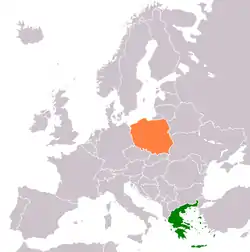 | |
 Greece |
 Poland |
|---|---|
History
Since antiquity there have been direct and indirect contact between Greece and Poland. Historic Greek cities in present-day Ukraine had contacts with the people of Poland.[2] During the Middle Ages Polish authors, politicians and philosophers were influenced by Greek literature, democracy and sense of freedom.[3] Greeks, many of whom were merchants, lived in Poland since the Late Middle Ages (see Greeks in Poland).
Since the 19th century both nations often shared a similar fate, and their history has sometimes intertwined. In the 19th century both were under the rule of foreign powers. Greece was ruled by the Ottoman Empire, and Poland was partitioned between Austria, Prussia (afterwards Germany) and Russia. Greece eventually regained independence during the Greek War of Independence in the 1820s, while several Polish 19th-century uprisings remained unsuccessful, and Poland regained independence only after World War I in 1918. In 1919 both countries officially established diplomatic relations. Both nations exchanged ambassadors in 1922.[4] In 1937–1939, both ethnic Poles and Greeks in the Soviet Union were subjected to genocidal campaigns carried out by the NKVD, known as the Polish Operation and the Greek Operation respectively. Both countries were invaded and occupied during World War II — Poland by Germany and the Soviet Union, and Greece by Germany and Italy. In 1946, Greece entered into a civil war which saw over 14,000 Greeks migrate and find refuge in Poland after the communists in Greece were defeated in 1949. The Greeks settled predominantly in the Polish cities and towns of Zgorzelec, Wrocław,[5] Bielawa, Bielsko-Biała, Dzierżoniów, Gdynia, Jelenia Góra, Katowice, Kraków (in the Nowa Huta district), Legnica, Lubań, Niemcza, Szczecin, Świdnica, Wałbrzych and Warsaw.[6]
In 1981, Greece joined the European Union. Poland joined the union in 2004. Since Polish ascension into the union, over 20,000 Poles have migrated to Greece for employment, however, since the Greek government-debt crisis beginning in 2009, many Poles have returned and many Greeks have migrated to Poland in search of employment.[7]
High-level visits
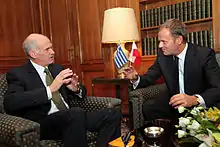
High-level visits from Greece to Poland
- Prime Minister Kostas Simitis (2003)
- President Karolos Papoulias (2013)
High-level visits from Poland to Greece[8]
- President Aleksander Kwaśniewski (2003)
- Prime Minister Leszek Miller (2003)
- Prime Minister Donald Tusk (2009)
- President Andrzej Duda (2017)
Bilateral Treaties[9]
- Memorandum of Mutual Understanding on Cooperation in the Defence Industry (Warsaw, June 29, 2004),
- Agreement on economic, scientific, and technical cooperation in Agriculture and Food Economics (Athens, September 7, 1995),
- Agreement on Cooperation in Science and Technology (Warsaw, November 9, 1998)
- Agreement on the avoidance of double taxation (May 28, 1987).
Transportation
There are direct flights between Greece and Poland with the following airlines: Aegean Airlines, Ryan Air, LOT Polish Airlines, Small Planet Airlines, SmartWings and Wizz Air.
Resident diplomatic missions
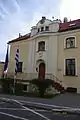 Embassy of Greece in Warsaw
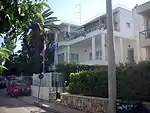 Embassy of Poland in Athens
See also
Notes
- Polish immigrants in Greece
- The ancient Greeks in Ukraine
- A Handbook to Classical Reception in Eastern and Central Europe
- Greece's Bilateral Relations: Poland
- Light shed on Greece and Poland’s entwined past
- Kubasiewicz, Izabela (2013). "Emigranci z Grecji w Polsce Ludowej. Wybrane aspekty z życia mniejszości". In Dworaczek, Kamil; Kamiński, Łukasz (eds.). Letnia Szkoła Historii Najnowszej 2012. Referaty (in Polish). Warszawa: IPN. pp. 117–118.
- “But why Poland?”: The Greek Cracovians
- Poland has signed the Accession Treaty
- Greek Ministry of Foreign Affairs about the relation with Poland
- Embassy of Greece in Warsaw
- Embassy of Poland in Athens
|  | |||||||||||||||||
|
| ||||||||||||||||||
| Africa |  | |
|---|---|---|
| Americas | ||
| Asia | ||
| Europe | ||
| Oceania | ||
| Former | ||
| Multilateral relations | ||
| Diplomatic missions | ||