Greyfriars Burial Ground
Greyfriars Burial Ground is an historic cemetery in Perth, Scotland, dating to 1580. It is a Category A listed building.[1] Its collection of gravestones is considered one of the best in Scotland.[2][3] It occupies the former location of the Greyfriars Monastery, founded by Laurence Oliphant, 1st Lord Oliphant, in 1496 and destroyed in 1559 at the start of the Scottish Reformation.[4] The cemetery closed to burials in 1978.
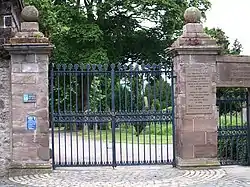 The main entrance, on Canal Street, in 2009 | |
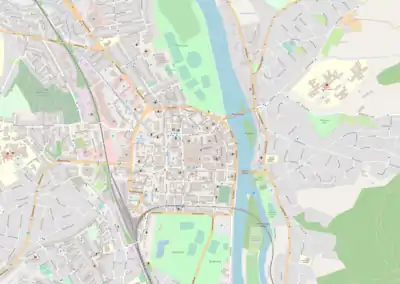  Shown within Perth | |
| Details | |
|---|---|
| Established | 1580, 441 years ago |
| Closed | 1978 |
| Location | Canal Street Perth |
| Country | Scotland |
| Coordinates | 56.39367°N 3.42718°W |
| Owned by | Perth and Kinross Council |
| Find a Grave | Greyfriars Burial Ground |
The cemetery is located at the eastern end of Canal Street, near its junction with Tay Street. It has been extended south on two occasions,[5] and it now abuts the bridge carrying the Perth to Dundee section of the Scottish railway network.
A tablet commemorating John Mylne, who "rebuilt the ancient bridge over the River Tay," was erected by Robert Mylne in 1784.[5]
In 1997, when proposals were made to dismantle and rebuild the cemetery's eastern wall, two test pits were dug by the Scottish Urban Archaeological Trust (SUAT). One of the pits found what is believed to be the original monastery wall foundations. A "succession of wall foundations" hinted at several wall replacement and repair efforts undertaken during the monastery's lifespan, each raising the ground level. Medieval pottery was also discovered, likely associated with the soil of lower garden abutting the original monastery wall. The other pit demonstrated a lack of a progression of wall foundations, confirming that that area was inside the 1795 graveyard extension and outside the original monastery grounds. The second pit also showed signs of infilling or levelling layers, possibly from when a burn, which ran along the burial ground's southern wall, was covered with soil.[5]
In 2019, several headstones deemed a hazard to passersby, were removed and restored.[2]
Notable interments
- Andrew Heiton (1823–1894), architect[6]
- William Macdonald Mackenzie (1797–1856), architect[7]
- John Mylne (c. 1585 – 1657), mason
See also
Gallery
.jpg.webp) A 2013 view, with the Church of St John the Baptist in the background
A 2013 view, with the Church of St John the Baptist in the background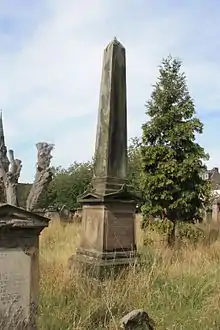 1846 grave of physicist Adam Anderson, architect of Perth Water Works, located around 500 feet (150 m) south of his resting place
References
- Greyfriars Burial Ground, Canal Street, Perth – British Listed Buildings
- "Hazardous headstones marked for removal at historic Perth churchyard" – The Courier, 4 June 2019
- Greyfriars Burial Ground – Undiscovered Scotland
- The Tourist's Hand-book to Perth and Neighbourhood (1849), p. 26
- Perth, Canal Street, Greyfriars Burial Ground – Canmore
- Ordnance Gazetteer of Scotland: A Graphic and Accurate Description of Every Place in Scotland, Francis Hindes Groome (1901)
- Ordnance Gazetteer of Scotland: A Graphic and Accurate Description of Every Place in Scotland, Francis Hindes Groome (1901)
External links
 |
Wikimedia Commons has media related to Greyfriars Burial Ground, Perth. |