Grigory Zass
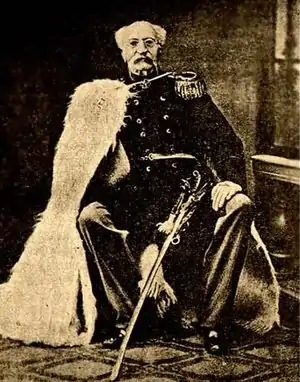
Grigory Khristofovich Zass (Russian: Григорий Христофорович Засс; German: Georg Otto Ewald Freiherr von Saß) was a Russian Imperial general who commanded Russian cavalry troops in the Russo-Circassian War,[1][2][3][4][5][6] initially gaining prominence for his actions against the Circassians, whom he reportedly saw as a "lowly race".[7][8][9] He was the founder of Armavir.[10]
Grigory Zass | |
|---|---|
 | |
| Native name | Григорий Христофорович фон Засс |
| Born | 29 April 1797 Westphalia |
| Died | 4 December 1883 Russia |
| Allegiance |  Russian Empire Russian Empire |
| Years of service | 1813-1849 |
| Battles/wars | Napoleonic Wars Russo-Circassian War Russo-Turkish War (1828–29) Crimean War Hungarian Revolution of 1848 |
| Awards | Order of St. George Order of Saint Vladimir Order of Saint Anna Order of Saint Stanislaus Cross of St. George Golden Weapon Award |
In 2003, the Russian Federation controversially erected his statue on former Circassia territories where the Circassian genocide, in which he played a big part, occurred, infuriating Circassians and Circassian nationalist establishments worldwide.[11][12]
Biography
Early life
Originally from Westphalia's German nobility, he rose through the ranks of the Russian army, particularly during the Battle of Leipzig. He was transferred to the Novgorod division in 1820. During the Russo-Turkish War, he fought against the Turks. In a 1832 battle against the Chechens, he was severely wounded while attempting to burn a village and consequentially promoted to colonel.
Racist views
Zass considered Circassians to be subhumans inferior to the "European Race", particularly Germans and Russians. Russians and other Europeans.[13][9][8][7][4][6] The only way to deal with the Circassians, in his opinion, was to scare them away "just like wild animals."
Zass advocated ruthless military methods predicated on this notion, including burning people alive, cutting off heads for enjoyment, burning populated villages to the ground, spreading epidemics on purpose, and mass rape of children.[3][14] He was alleged to have said that, "By all means necessary, our Russia aims to conquer the Caucasus. With these creatures, Circassians as our enemies, how else are we meant to defeat them if not by instilling dread and causing a thunderstorm? Good deeds aren't welcome here. In the highlands, our blessed names are still uttered, scaring tiny children."
Participation in the Russo-Circassian War
In 1833, at the height of the Russo-Circassian War, he was appointed as chief commander and given full authority.[3] In August, he led the first expedition into Circassian territory, destroying as many villages and towns as possible. This was followed by a series of other expeditions. He attacked the Besleney region between November and December, destroying most villages, including the village of the double agent Aytech Qanoqo.
Zass spent a significant amount of money on espionage. During attacks on Circassian land, he never forgot about reconnaissance tasks: his men thoroughly investigated all wooden beams that could serve as enemy shelter, demolished farms, and killed farmers so the enemy wouldn't be able to get food. He made a list of all the Circassians he personally killed.
He continued to exterminate the Circassian population between 1834 and 1835, particularly in the Abdzakh, Besleney, Shapsug, and Kabardian regions. In 1835, he was promoted.
Zass' main strategy was to intercept and retain the initiative, terrorize the Circassians, and destroy Circassian settlements. After a victory, he would usually burn several villages and seize cattle and horses to show off, acts which he proudly admitted. He paid close attention to the enemy's morale. In his reports, he frequently boasted about the destruction of villages and glorified the mass murder of civilians.[15]
Zass loved spreading rumors about himself by exploiting Circassian tribal superstitions. Using various tricks and cutting-edge technology, he was able to convince and deceive the Circassians into thinking that he had various magical abilities, including being bulletproof and able to turn gunpowder into gold. He was known as a magical man who could do anything he wanted to do. As a result, when he attacked, the Circassians believed they had no chance and suffered a significant loss of morale; knowing Zass's cruel methods, they mostly attempted to save their lives rather than fighting for honor and going up against Adyghe Xabze.
On 18 August, the Russian army burned the residency of Hajji Tlam, a Circassian elder from the Abdzakh region, and killed his family. As revenge, Circassian commander Jembulat Boletoqo made plans for a new campaign. General Zass sent Circassian commander Jembulat Boletoqo word in October 1836 that he wanted to make peace. Boletoqo knew that he would be slain if he went, but he also knew that if he did not go, the Russians would accuse him of being a warmonger. He chose, reportedly, honor over life and decided to go.[16]
Boletoqo visited Zass at his residence. For his initial visit, Zass was not present. Zass wrote him a letter and instructed him to come on a specific date when he would undoubtedly be in his residency. At the said date, Boletoqo was killed on non-warzone territory while on his way to the Prochnyi Okop fortress by a Russian sniper employed by Zass who was hiding in the forest on the Russian bank of the Kuban River at the intersection with the Urup River.[17] After this, in 1836, Zass was promoted again.
General Zass' main headquarters was in the Prochnyi Okop fortress. Ajgeri Kusikupsh, Shogen Shumaf and Khirtsizhiqo Ale of the Circassian army raided this base and kidnapped General Zass' daughter. They adopted the young girl as their own and taught her Circassian language and traditions. After three years, they sent Zass a letter in which they informed him that they were returning his daughter and agreed on the location and terms of delivery.[15][18][19]
Circassian negotiators arrived on time and took the girl off the horse, dressed in a Circassian dress, and handed her over to her father. General Zass immediately wanted to order his army to kill all Circassians after receiving his daughter; however, the girl talked her father down, and both parties returned to their bases.[15][18][19]
Repordetly, when Kusikupsh handed the girl over to her father, he said to General Zass, "The objective of this action was to make you understand the grief of fathers and mothers whose daughters were stolen or murdered by you through your own daughter. When the girl stayed with us, we would not fight you. But we'll be enemies again from now on".[15][18][19]
In 1838, Zass spread false rumors about his serious illness, then staged his own death, weakening the Circassians' vigilance. On the same night, when the Circassians were celebrating their oppressor's death, the suddenly "resurrected" Zass launched a raid that destroyed two villages.
Between 1840 and 1841, he burned his last villages and built Russian villages on top of them. He left the Caucasus in 1842.
Methods of massacre of Circassians
Colonel Grigory Zass was a key figure in the Circassian genocide through ethnic cleansing, which included methods such as burning entire Circassian villages, deliberately causing epidemics, and entering villages and towns under a white flag and killing everyone.[7][1][8][20][9][13][5][6] It is estimated that 70% of the East Circassian population died in the process.[7][1]
In addition, it was recorded that Zass dismembered Circassian corpses, hid them as ornaments and sent them abroad to be used as test subjects.[7][4][13][5][6] Zass especially sent the severed Circassian heads to his fellow Germans in Berlin who were professors and used them to study anatomy.[21] He would pick random Circassian males from the towns he attacked and burn them alive as a form of entertainment. He didn't stop at burning women; he also cut the pregnant women's bellies with a bayonet.[15]
Zass with his thick mustache,
Is hanging the skulls of our men on sticks.
Our children in the wombs of mothers,He stabs them out with a sword.
Children's bodies taken from the mother's womb,They play with them on sticks.
The atrocities committed by the enemy,Our new born generations should not forget.
— A Circassian elegy describing Zass
Hobby of collecting heads and body parts
Zass is said to have washed and cooked Circassian heads' flesh before putting them under his bed in his tent. He also had Circassian heads impaled on lances on a hill near his tent. After the battle, Circassian corpses were beheaded and the heads were sent to Zass for collection.[22][23][24][25] Zass erected Circassian heads on poles outside of his tent and witnesses saw the wind blowing the beards of the heads.[26] In addition, Russian soldiers and Cossacks were paid for sending Circassian heads to General Zass.[27][28][29][30] He kept his personal collection of decapitated Circassian heads and body parts in a box under his bed.[15]
Besides cutting Circassian heads off and collecting them, Zass used a premeditated policy of annihilating Circassians in mass, burning entire Circassian towns with their inhabitants and inciting the abuse of Circassian women and children.[31][32] All Circassian elderly, women, and men were referred to as "bandits, "animals," "barbarians," "plunderers," or "thieves" by Zass' soldiers.[upper-roman 1]
Advocacy of genocidal rape
Nikolai Yevdokimov and Grigory Zass allowed their officers and soldiers to rape 7 years and older Circassian girls.[upper-roman 2] Russians raped Circassian girls during the 1877 Russo-Turkish war from the Circassian refugees who were settled in the Ottoman Balkans.[33][34]
Zass worked with another German officer in the Russian army named Georg Andreas von Rosen during the genocide against the Circassians. Zass wrote letters to Rosen proudly admitting he ordered Cossacks to slaughter Circassian civilians.[35]
Founding of Armavir
In the end of 1836, the Armenians of Circassia declared their allegiance for Russia and begged Zass to locate them a place to live. In 1839, Zass established an Armenian colony in the region that had previously belonged to the Circassians. To make room for the Armenians, Circassian villages and the people who lived in them were destroyed. This year is regarded the official year of Armavir's establishment.
Sources
-
- Richmond, Walter (2013). The Circassian Genocide. Genocide, Political Violence, Human Rights. Rutgers University Press. p. 56. ISBN 978-0813560694.
- Tahabsem, Natascha (22 May 2021). "Special Report: The Plight Of The Circassians". BU News Service. Archived from the original on 2021.
- RICHMOND, WALTER (2013). The Circassian Genocide (PDF). RUTGERS UNIVERSITY PRESS.
- "Кавказская война". Кавказский узел. 21 May 2021.
- Bashqawi, Adel (2017). Circassia: Born to Be Free. ISBN 978-1543447651.
- Bashqawi, Adel (2019). The Circassian Miracle: the Nation Neither Tsars, nor Commissars, nor Russia Could Stop. ISBN 978-1796076851.
- Kingston, William Henry Giles (2020). The Circassian Chief: A Romance of Russia. Library of Alexandria. ISBN 978-1465593184.
- Kingston, William Henry G. (1854). The Circassian chief, Volume 101. p. 192.
-
- Юсупов, Заур Тагирович а. "Геноцид". Адыги.RU.
- МАКОВСКАЯ, ДАРЬЯ ВЛАДИМИРОВНА; ПАТЕЕВ, РИНАТ ФАИКОВИЧ (2014). "ФОРМЫ, МЕТОДЫ И ТЕХНОЛОГИИ КОНСТРУИРОВАНИЯ ИСТОРИЧЕСКИХ МИФОВ НА ПРИМЕРЕ МИФОЛОГИЗАЦИИ "ЧЕРКЕССКОГО ВОПРОСА"" (in Russian). 6 (79). Севастопольский экономико-гуманитарный институт Таврического национального университета имени В.И. Вернадского 2 Северо-Кавказский научный центр высшей школы Южного федерального университета: 149–159. Cite journal requires
|journal=(help)
- Эльмесова, А. М. ИЗ ИСТОРИИ РУССКО-КАВКАЗСКОЙ ВОЙНЫ.
- ""Мой Дагестан": Самый тяжелый удар Русско-Кавказской войны пришелся на адыгов". NatPress. 17 December 2013.
- ""Черкесский холокост" или "проект Тибет-2"". АПН. 8 October 2008.
- "ДЕПОРТАЦИЯ ЧЕРКЕСОВ ИЛИ КАК ЦЕЛЫЙ НАРОД СТАЛ ЗАЛОЖНИКОМ ИСТОРИИ". Адыги.RU. 28 May 2020.
- "153 годовщина окончания многолетней Кавказской войны". МКОУ СОШ № 5 г.п. Нарткала - Главная страница - uCoz. 22 May 2017.
- "Кавказский окрик". Кавказский окрик новости Lenta.ru с комментариями. 23 December 2013.
- Эльмесов, А.М. (7 April 2009). "21 МАЯ В ИСТОРИИ АДЫГОВ". gazavat.ru.
- "Во дворе мечети в Кабардино-Балкарии произошел взрыв". Кавказский Узел. 18 October 2013.
- "21 МАЯ - ДЕНЬ ПАМЯТИ АДЫГОВ – ЖЕРТВ КАВКАЗСКОЙ ВОЙНЫ". 21 May 2016.
- "В офисе и в доме лидера "Черкесского конгресса" Адыгеи прошли обыски Источник". Кавказский Узел. 19 August 2010.
- * "ИЗ ИСТОРИИ РУССКО-КАВКАЗСКОЙ ВОЙНЫ. Отрывки из книги А. М. Эльмесова" Check
|url=value (help). newsland. 16 December 2013.
- Щербина Ф. А. История Армавира и черкесо-горцев. — Екатеринодар: Электро-тип. т-во «Печатник», 1916.
- ki, Muzaffer yıldırım dedi (31 May 2018). "General Zass'ın Kızının Adigeler Tarafından Kaçırılışı". ÇERKES-FED (in Turkish). Archived from the original on 14 January 2021. Retrieved 13 January 2021.
- "Jembulat Bolotoko: The Prince of Princes (Part One)". Jamestown. Archived from the original on 25 October 2020. Retrieved 5 January 2021.
- "Bianet :: Çerkeslerden Rusya'ya: Kolonyalist politikalarınız nefret ekiyor". m.bianet.org. Archived from the original on 14 January 2021. Retrieved 13 January 2021.
- Узел, Кавказский. "Засс Григорий Христофорович". Кавказский Узел. Archived from the original on 23 July 2016. Retrieved 13 January 2021.
- "ЗАСС Григорий Христофорович фон (1797–1883), барон, генерал от кавалерии, герой Кавказской войны". enc.rusdeutsch.ru. Archived from the original on 11 December 2018. Retrieved 13 January 2021.
- Richmond, Walter (2 September 2013). "Velyaminov, Zass ve insan kafası biriktirme hobisi". Jıneps Gazetesi (in Turkish). Archived from the original on 13 October 2020. Retrieved 26 September 2020.
- Duvar, Gazete (14 September 2020). "Kafkasya'nın istenmeyen Rus anıtları: Kolonyal geçmişi hatırlatıyorlar". Gazeteduvar (in Turkish). Archived from the original on 17 September 2020. Retrieved 13 January 2021.
- Rajović, G. & Ezhevski, D.O. & Vazerova, A.G. & Trailovic, M.. (2018). The Tactics and Strategy of General G.Kh. Zass in the Caucasus. Bylye Gody. 50. 1492-1498. 10.13187/bg.2018.4.1492.
- Щербина Ф. А. История Армавира и черкесо-горцев. — Екатеринодар: Электро-тип. т-во «Печатник», 1916.
- P., T. (2020). "Çerkeslerden Rusya'ya: Kolonyalist politikalarınız nefret ekiyor". Bianet. Archived from the original on 14 January 2021. Retrieved 13 January 2021.
- "New Monuments of Russian Heroes of Russian-Circassian War Anger Circassians". Jamestown. Archived from the original on 13 August 2021. Retrieved 13 August 2021.
- "Son Haber | 21 Mayıs 1864 Çerkes Soykırımı". Son Haber (in Turkish). 20 May 2020. Archived from the original on 15 June 2020. Retrieved 13 January 2021.
- Ibid., p. 420.
- Dönmez, Yılmaz (31 May 2018). "General Zass'ın Kızının Adigeler Tarafından Kaçırılışı". ÇERKES-FED (in Turkish). Archived from the original on 14 January 2021. Retrieved 13 August 2021.
- "JEMBULAT BOLOTOKO: PRENSLERİN PRENSİ (PŞIXEM 'ARİPŞ*)". cherkessia.net. 2013. Archived from the original on 5 October 2013. Retrieved 5 January 2021.
- "Jembulat Bolotoko: The Prince of Princes (Part One)". Jamestown. Archived from the original on 25 October 2020. Retrieved 5 January 2021.
- Shalakho, Abu. "Literaturer, Pıunığer"
- Bestepe, Yılmaz. "Ajheriy oğlu Kusikupsh". Infocherkessia. Archived from the original on 30 November 2021. Retrieved 13 August 2021.
- "'Benim Adım 1864'". Sivil Sayfalar (in Turkish). 21 May 2020. Archived from the original on 30 May 2020. Retrieved 13 January 2021.
- Bashqawi, Adel (2017). Circassia: Born to Be Free. ISBN 978-1543447651. Archived from the original on 30 November 2021. Retrieved 1 June 2021.
- "THE REPORTS AND THE TESTIMONIES ABOUT RUSSIAN - CIRCASSIAN WAR AND THE CIRCASSIAN GENOCIDE". Circassian World. Archived from the original on 3 June 2021. Retrieved 28 May 2021.
- Richmond, Walter (2013). The Circassian Genocide. Genocide, Political Violence, Human Rights. Rutgers University Press. p. 55. ISBN 978-0813560694. Archived from the original on 30 November 2021. Retrieved 1 June 2021.
- Bullough, Oliver (2010). Let Our Fame Be Great: Journeys Among the Defiant People of the Caucasus. Basic Books. p. 60. ISBN 978-0465022571. Archived from the original on 30 November 2021. Retrieved 1 June 2021.
- Treisman, Daniel (2011). The Return: Russia's Journey from Gorbachev to Medvedev (illustrated, reprint ed.). Simon and Schuster. p. 455. ISBN 978-1416560722. Archived from the original on 30 November 2021. Retrieved 1 June 2021.
- "Засс Григорий Христофорович". Кавказский Узел. 20 May 2014. Archived from the original on 23 July 2016. Retrieved 13 January 2021.
- Mamedov, Mikail. “‘Going Native’ in the Caucasus: Problems of Russian Identity, 1801-64.” The Russian Review, vol. 67, no. 2, 2008, pp. 275–295. JSTOR, https://www.jstor.org/stable/20620748?seq=1 Archived 3 June 2021 at the Wayback Machine. Accessed 28 May 2021.
- Tlis, Fatima (1 August 2008). "Moscow's Favoritism Towards Cossacks Mocks Circassian History". North Caucasus Weekly. 9 (30). Archived from the original on 3 June 2021. Retrieved 28 May 2021.
- Zhemukhov, Sufian (9 November 2011). "Jembulat Bolotoko: The Prince of Princes (Part Two)". Eurasia Daily Monitor. 8 (207). Archived from the original on 30 November 2021. Retrieved 28 May 2021.
- Golovin, Ivan (1954). The Caucasus (PDF). Trubner, & Co. Archived (PDF) from the original on 10 April 2021. Retrieved 28 May 2021.
- Sykes, Heather (2016). The Sexual and Gender Politics of Sport Mega-Events: Roving Colonialism. Routledge Critical Studies in Sport. Taylor & Francis. p. 124. ISBN 978-1317690016. Archived from the original on 30 November 2021. Retrieved 1 June 2021.
- Khodarkovsky, Michael (2011). Bitter Choices: Loyalty and Betrayal in the Russian Conquest of the North Caucasus. Cornell University Press. p. 134. ISBN 978-0801462900. Archived from the original on 30 November 2021. Retrieved 1 June 2021.
- The New Review, Volume 1. Longmans, Green and Company. 1889. p. 309. Archived from the original on 3 June 2021. Retrieved 1 June 2021.
- The New Review, Volume 1. Longmans, Green and Company. 1889. p. 309. Archived from the original on 3 June 2021. Retrieved 1 June 2021.
- Capobianco, Michael (13 October 2012). "Blood on the Shore: The Circassian Genocide". Caucasus Forum. Archived from the original on 3 June 2021. Retrieved 28 May 2021.