Physical education
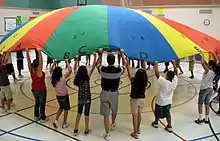
Physical education, also known as Phys Ed., PE, or gym is a subject taught in schools. It is taught during primary and secondary education and encourages psychomotor learning in a play or movement exploration setting to promote health and physical fitness.[1]

.jpg.webp)
In addition, physical literacy is a 21st-century term that first emerged in the sport literature before also being applied to physical education. The concept of physical literacy covers a variety of conditions for a student.[2]
Whether the class produces positive effects on students' health, behaviour, and academic performance depends upon the kind of program that is taught.[3] Physical Education programs vary all over the world. However, there are worldwide organizations that allow for a better understanding of how much exercise a child should be getting daily. Popular games in PE include football, netball, hockey, rounders, athletics and cricket.
Trends
_(cropped).jpg.webp)
SHAPE America's National Standards & Grade-Level Outcomes for K-12 Physical Education define what a student should know and be able to do as result of an effective physical education program.[4]
Another trend is the incorporation of health and nutrition into the physical education curriculum. In the United States, the Child Nutrition and WIC Reauthorization Act of 2004 required that all school districts with a federally-funded school meal program develop wellness policies that address nutrition and physical activity.[5] PE teachers are now incorporating short health and nutrition lessons into the curriculum. This is more prevalent at the elementary school level, where students do not have a specific Health class.[6]
Research has shown that there is a positive correlation between brain development and exercising.[7]
Studies have been done on how physical education can help improve academic achievement. In a 2007 article, researchers found a profound gain in English Arts standardized testing test scores among students who had 56 hours of physical education in a year, compared to those who had 28 hours of physical education a year.[8]
In 1975, the United States House of Representatives voted to require school physical education classes include both genders.[9]
Technology use in physical education
Many physical education classes utilize technology to assist their pupils in effective exercise. One of the most affordable and popular tools is a simple video recorder. With this, students can see the mistakes they're making in things such as a throwing motion or swinging form.[10] Studies show that students find this more effective than having someone try to explain what they are doing wrong, and then trying to correct it.[10] Educators may use technologies such as pedometers and heart rate monitors to make step and heart rate goals for students.[11]
Other technologies that can be used in a Physical Education setting include video projectors, GPS and games and gaming systems such as Kinect, Wii Fit and Dance Dance Revolution. Projectors can show students proper form or how to play certain games. GPS systems can be used to get students active in an outdoor setting, and active exergames can be used by teachers to show students a good way to stay fit in and out of the classroom setting.[12]
Another type of technology that is commonly used in Physical Education is the pedometer. This does not necessarily track how far a person is going, but lets them know the number of steps they are taking.[13][14]
Around the world
According to the World Health Organization it is suggested that young children should be doing 60 minutes of exercise per day at least 3 times per week in order to maintain a healthy body.[15]
Asia
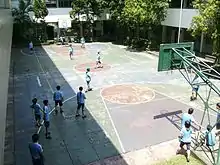
A Biennial compulsory fitness exam, NAPFA, is conducted in every school to assess pupils' physical fitness in Singapore.[16] This includes a series of fitness tests (pull-ups/inclined pull-ups for girls, standing broad jump, sit-ups, sit-and-reach and 1.6 km for primary [10- to 12-year-olds]/2.4 km for secondary and junior college levels [13- to 18-year-olds]). Students are graded by gold, silver, or bronze, or as fail. NAPFA for pre-enlistees serves as an indicator for an additional two months in the country's compulsory national service if they attain bronze or fail.
In the Philippines, PE is mandatory for all years, unless the school gives the option for a student to do the Leaving Certificate Vocational Programme instead for fifth and sixth year. Some schools have integrated martial arts training into their physical education curriculum.[17][18][19][20][21]
Australia
In Australia, physical education was first made an important part of the curriculum in government primary and secondary schools in 1981. The policy was outlined in a Ministerial Statement to the Victorian Legislative Assembly by the Minister for Educational Services, Norman Lacy MP on 17 September.[22] Many of the schools of Australia are moving to use the Praxis Model of Physical Education. Shane Pill of Flinders University defines the Praxis model as a teaching method of physical education that seeks to create a curriculum that promotes activities that teach the links between thinking, feeling, and behavior, and how positively affecting these aspects can increase the quality of life for Students. This model has been introduced with initiatives such as Healthy Active Australia Schools (HAAS) and Be Active-Let's Go. Rather than focusing on the traditional aspects of physical education, such as teaching how to perform a certain sport, this model focuses on a broader understanding of what it means to be educated in physical activity. The large goal of this initiative is to create a curriculum that makes an active difference in the pupils "lived reality now" so that students are making proactive changes to their behavior to increase overall health.[23]
Europe
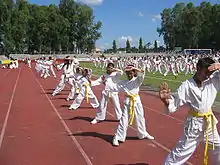
In England, pupils are expected to do two hours of PE a week in year 7, 8 and 9 and at least one in year 10 and 11.[24]
In Wales, pupils are expected to do two hours of PE a week.[25]
In Poland, pupils are expected to do at least three hours of PE a week during primary and secondary education.[26] Universities must also organise at least 60 hours of physical education classes at undergraduate courses.[27]
In Sweden, the time school students spend in PE lessons per week varies between municipalities but generally, year 0 to 2 has 55 minutes of PE a week, year 3 to 6 has 110 minutes a week and year 7 to 9 has 220 minutes. In upper secondary school, all national programs have an obligatory course, Idrott och hälsa 1, containing 100 points of PE, which corresponds to 90–100 hours of PE during the course. (One point should be one hour, but due to holidays this isn't true.) The schools can spend these hours as they like during the three years students attend. Most schools have students take part in this course during the first year and offer the follow-up course, Idrott och hälsa 2, which also contains 100 points.[28]
In Ireland, one is expected to do 2 classes worth of PE. (80 Minutes). This also includes shower and changing times, so on average 60–65 minutes activity.[29]
.jpg.webp)
North America

_Amy_Winczura_(5694030475).jpg.webp)
In the United States, the goal of physical education is to "develop physically literate individuals who have the knowledge, skills and confidence to enjoy a lifetime of healthful physical activity."[30] The 2012 Shape Of The Nation Report by the National Association for Sport and Physical Education (part of SHAPE America) and the American Heart Association found that while nearly 75 percent of states require physical education in elementary through high school, over half of states permit students to substitute other activities for their required physical education credit, or otherwise fail to mandate a specific amount of instructional time. According to the report, only six states—Illinois, Hawaii, Massachusetts, Mississippi, New York and Vermont—require physical education at every grade level, from K-12.[31] A majority of states in 2016 did not require a specific amount of instructional time and more than half allow exemptions or substitution. These loopholes can lead to reduced effectiveness of the physical education requirements.[32] In North America, there are certain guidelines as to how much exercise a child needs per day to stay fit. The American Heart Association recommends that kids and teens (ages 6–17) get at least 60 minutes of moderate to vigorous physical activity every day.[33]
Zero Hour is a before-school physical education class first implemented by Naperville Central High School. In the state of Illinois this program is known as Learning Readiness PE (LRPE). It was based on research indicating that students who are physically fit are more academically alert and experience growth in brain cells or enhancement in brain development. NCHS pairs a PE class that incorporates cardiovascular exercise, core strength training, cross lateral movements, and literacy and math strategies with literacy and math classes that utilize movement to enhance learning and improve achievement.[34]
In British Columbia, Canada, the government has stated in the grade one curriculum that students must participate in physical activity daily five times a week. The teacher is also responsible for planning Daily Physical Activity (DPA), which is thirty minutes of mild to moderate physical activity a day, not including curriculum physical education classes. The curriculum requires students in grade one to be knowledgeable about healthy living. For example, they must be able to describe benefits of regular exercise, identify healthy choices that require them to be more physically active, and describe the importance of choosing healthy food.[35]
Ontario, Canada has a similar procedure in place. On October 6, 2005 the Ontario Ministry of Education (OME) implemented a Daily Physical Activity policy in elementary schools, grades 1–8. It requires that all students in grades 1 to 8, including those with special needs, be provided with opportunities to participate in a minimum of twenty minutes of sustained moderate to vigorous physical activity each school day during instructional time.[36] There are many factors that contribute to the ease of implementing and sustaining a quality program, including the involvement of the administration, parents, and community. However, it ultimately comes down to the willingness of the physical education teacher(s) to do their best no matter the situation.[37]
References
- Anderson, D. (1989). The Discipline and the Profession. Foundations of Canadian Physical Education, Recreation, and Sports Studies. Dubuque, IA: Wm. C. Brown Publishers.
- Mitchell, Stephen (2016). The Essential of Teaching Physical Education. Shape America - Society of Health and Physical Educators. pp. 1 page cited (4 page). ISBN 978-1-4925-0916-5.
- Wong, Alia (2019-01-29). "Gym Class Is So Bad Kids Are Skipping School to Avoid It". The Atlantic. Retrieved 2019-01-30.
- "National PE Standards-Highly Effective Physical Education".
- Pangrazi, Robert (2007) "Dynamic Physical Education for Elementary School Children" 15th ed.
- Castelli, Darla M.; Centeio, Erin E.; Hwang, Jungyun; Barcelona, Jeanne M.; Glowacki, Elizabeth M.; Calvert, Hannah G.; Nicksic, Hildi M. (December 2014). "Vii. The History of Physical Activity and Academic Performance Research: Informing the Future". Monographs of the Society for Research in Child Development. 79 (4): 119–148. doi:10.1111/mono.12133. PMID 25387418.
- REYNOLDS, GRETCHEN. "Phys Ed: Can Exercise Make Kids Smarter?". The New York Times. Retrieved 18 April 2013.
- Tremarche, Pamela V.; Robinson, Ellyn M.; Graham, Louise B. (2007). "Physical Education and Its Effect on Elementary Testing Results". Physical Educator. 64 (2): 58–64.
- "Physical Education – Jul 18, 1975 – NBC – TV news: Vanderbilt Television News Archive". Tvnews.vanderbilt.edu. 1975-07-18. Retrieved 2015-08-13.
- Wang, Lin; Myers, Deborah L.; Yanes, Martha J. (2010). "Creating Student-Centered Learning Experience through the Assistance of High-End Technology in Physical Education: A Case Study". Journal of Instructional Psychology. 37 (4): 352–356. ProQuest 853876818.
- Woods, Marianne L.; Karp, Grace Goc; Miao, Hui; Perlman, Dana (26 April 2008). "PHYSICAL EDUCATORS' TECHNOLOGY COMPETENCIES AND USAGE". The Physical Educator. 65 (2). ProQuest 232994591.
- Grimes, G. (2011, November 21). Interview by M Massey [Personal Interview].
- "Using pedometers to assess physical activity participation levels". Humankinetics.com. 2010-04-01. Retrieved 2015-08-13.
- "PEC: Pedometer Lesson Activities". Pecentral.org. Retrieved 2015-08-13.
- “Physical Activity and Young People.” World Health Organization, World Health Organization, 19 June 2015, www.who.int/dietphysicalactivity/factsheet_young_people/en/.
- "Napfa: From fitness test to education tool". AsiaOne. Retrieved 2018-10-19.
- Archived September 30, 2008, at the Wayback Machine
- Archived May 23, 2007, at the Wayback Machine
- "Regional Commissions and Chapters International Modern Arnis Federation Philippines Mindanao Commission". Imafp.com. Retrieved 2010-11-07.
- Archived January 15, 2009, at the Wayback Machine
- "Sunday Inquirer Magazine: Life Lessons from Karate". Showbizandstyle.inquirer.net. 2008-12-14. Archived from the original on 2012-03-04. Retrieved 2010-11-07.
- Ministerial Statement on New Directions in Physical Education. Retrieved 2015-08-13.
- Pill, S. (January 2007). "Physical education what's in a name? A praxis model for holistic learning in physical education". ACHPER Healthy Lifestyles Journal. doi:10.3316/aeipt.160155 (inactive 31 October 2021). ISSN 1445-8918.CS1 maint: DOI inactive as of October 2021 (link)
- "National curriculum in England: physical education programmes of study". GOV.UK. Department for Education. Retrieved 24 November 2016.
- "PE Provision in Secondary Schools" (PDF). Sports Council Wales. Retrieved 28 July 2016.
- "Dz.U. 2002 nr 15 poz. 142. Rozporządzenie Ministra Edukacji Narodowej i Sportu z dnia 12 lutego 2002 r. w sprawie ramowych planów nauczania w szkołach publicznych". Internetowy System Aktów Prawnych. Retrieved 31 October 2010.
- "Standardy kształcenia dla poszczególnych kierunków studiów i poziomów kształcenia". Biuletyn Informacj Publicznej. Archived from the original on 20 November 2010. Retrieved 31 October 2010.
- "Physical Education and Health" (PDF). Skolverket. Retrieved April 15, 2019.
- “Primary School Curriculum .” Curriculumonline, 1996, www.curriculumonline.ie/getmedia/ca8a385c-5455-42b6-9f1c-88390be91afc/PSEC05_Physical-Education_Curriculum.pdf.
- "Shape America Home Page". www.shapeamerica.org. Retrieved 2015-10-25.
- "Majority of States Have Loopholes That Let Kids Get Out of Gym Class". HuffPost. 2012-11-14.
- https://www.shapeamerica.org/uploads/pdfs/son/Shape-of-the-Nation-2016_web.pdf
- “How Can I Help My Child Be More Physically Active?” Www.heart.org, 17 Apr. 2018, www.heart.org/en/healthy-living/fitness/fitness-basics/aha-recs-for-physical-activity-in-children.
- Enhancing P.E. in Illinois, http://iphionline.org/pdf/P.E._Case_Study_Naperville.pdf
- BC curriculum package
- Archived December 12, 2006, at the Wayback Machine
- The Importance of Physical Education
External links
- . Encyclopedia Americana. 1920.
The Sociological Aspects of Physical Education


Authority control  | |
|---|---|
| General | |
| National libraries | |
| Other | |