Romani people in fiction
Many fictional depictions of the Romani in literature and art present Romanticized narratives of their supposed mystical powers of fortune telling, and their supposed irascible or passionate temper paired with an indomitable love of freedom and a habit of criminality. Critics of how Romani people have been portrayed in popular culture point out similarities to portrayals of Jewish people, with both groups stereotyped negatively as wandering, spreading disease, abducting children, and violating and murdering others.[1]
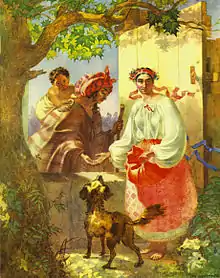
Romani people were portrayed in Victorian and modern British literature as having "sinister occult and criminal tendencies"[2] and as associated with "thievery and cunning",[3] and in English Renaissance and baroque theatre as incorporating "elements of outlandish charm and elements which depict [them] as the lowest of social outcasts," connected with "magic and charms," and "juggling and cozening."[4] In opera, literature and music, throughout Europe, Romani women have been portrayed as provocative, sexually available, gaudy, exotic and mysterious.[5] Hollywood and European movies, as well as popular music and other forms of pop culture, have promoted similar stereotypes.[6][7][8][9][10]
Particularly notable representations of Romani people appear in classics like Carmen by Prosper Mérimée and adapted by Georges Bizet, Victor Hugo's The Hunchback of Notre-Dame and Miguel de Cervantes' La Gitanilla. The Romani were also heavily romanticized in the Soviet Union, a classic example being the 1975 Tabor ukhodit v Nebo. A more realistic depiction of contemporary Romani in the Balkans, featuring Romani lay actors speaking in their native dialects, although still playing with established clichés of a Romani penchant for both magic and crime, was presented by Emir Kusturica in his Time of the Gypsies (1988) and Black Cat, White Cat (1998). Another realistic depiction of Romanies in Yugoslavia is I Even Met Happy Gypsies (1967).
Literature
- 1596: A Midsummer Night's Dream by William Shakespeare – Which includes the lines "Sees Helen's beauty in the brow of Egypt" ("Egyptian" was used to refer to the Romani people of England). Here, Theseus is imagining the face of a lover can make the dark-skinned gypsy look like Helen of Troy, a great beauty.[11][12]
- 1600: As You Like It a pastoral comedy by Shakespeare – He uses the word "ducdame" (Act II, Sc. 5), possibly a corruption or mishearing of the old Anglo-Romani word dukka me or (I foretell or I tell fortunes).[13][14]
- 1603: Othello by Shakespeare – Desdemona's handkerchief a gift to Othello's mother is a gift from an "Egyptian charmer" who can almost read the thoughts of people.[15]
- 1611: The Tempest by Shakespeare – Caliban, the only human inhabitant of the mythical island, is thought to be named after the word Kaliban meaning "black" or "with blackness" in Anglo-Romani.[16] As the first Romani immigrants arrived in England a century before Shakespeare wrote The Tempest, it is thought he may have been influenced by their exotic looks.[14][15]
- 1613: Miguel de Cervantes' novel La Gitanilla
- 1631: Ben Jonson's play Bartholomew Fair. A comedy set in London's Bartholomew Fair where a band of Romani entertain a crowd.
- 18th century: William Wordsworth's Vagrant Muse. A young homeless woman is welcomed by a band of Gypsies who take her in and offer her charity and companionship.
- 1722: Daniel Defoe's Moll Flanders. Moll's earliest memory is of wandering "among a group of people they call Gypsies or Egyptians" in England.
19th century
- 19th century: Guy de Maupassant's short stories. Romani appear in several short stories by the French writer.
- 19th century: John Clare's Vagabond in a Native Place. A selection of poems romanticizing the lives, culture, and wanderings of the English Gypsy people.
- 1815: Jane Austen's Emma. Gypsies make a brief appearance in Emma as children who bait Harriet in a lonely lane. Austen's description of the Gypsies is romanticized.
- 1815: Walter Scott's novel Guy Mannering.
- 1823: Scott's novel Quentin Durward. Called Bohemians.
- 1831: Victor Hugo's novel The Hunchback of Notre Dame
- 1835: Karel Hynek Mácha’s novel Cikáni (Gypsies; because of problems with a censorship, it was published only in 1857).
- 1841: Charles Dickens's The Old Curiosity Shop. Describes the first literary mention of an English Romanichal vardo or wagon.
- 1845: Robert Browning's "The Flight of the Duchess," loosely inspired by the English ballad The Raggle Taggle Gypsy. A Duchess runs away from her husband after speaking with an old Gypsy woman.
- 1845: Prosper Mérimée's short story "Carmen", upon which the opera was based.
- 1847: Emily Brontë's novel Wuthering Heights. Heathcliff is described as looking like a gypsy and is presumed to be one by several characters, although this is never confirmed.
- 1847: Charlotte Brontë's Jane Eyre. English Romanies visit Thornfield Hall as fortune tellers.
- 1853: Matthew Arnold's "The Scholar Gypsy". A poem based on a legend recounted by Joseph Glanvill in The Vanity of Dogmatizing (1661), on the thoughts and reflections of Gypsies' relationship, belief in, and relationship with God.
- 1853: Józef Ignacy Kraszewski's "Chata za wsią (Polish)" "The Cottage behind the Village." Realistic depiction of gypsies in Poland in the 1800s.
- 1856: Elizabeth Barrett Browning's verse novel Aurora Leigh. Marian Erle is Rom.
- 1857: George Borrow's novels Lavengro and The Romany Rye
- 1860: George Eliot's The Mill on the Floss. The protagonist Maggie runs away to Gypsies, but decides she has gone out of her depth. They do not harm her, but the episode darkly prefigures the steps that she will take in adulthood.
- 1891: J. M. Barrie's novel The Little Minister. A young Scottish minister falls in love with a wild Gypsy girl.
- 1892: Arthur Conan Doyle's Sherlock Holmes story, "The Adventure of the Speckled Band".
- 1892: Maxim Gorky's short story "Makar Chudra" (Макар Чудра). A love story between the gypsy girl Rada and the horse thief Zobar.
- 1897: Bram Stoker's Dracula. Features a group of Romanies working for the Count.
20th century
- 1902: E. Nesbit's Five Children and It. The children run into a band of English Gypsies on the road.
- 1908: Kenneth Grahame's The Wind in the Willows. Toad, owner of Toad Hall, an impulsive and conceited character, buys a horse-drawn English Gypsy vardo. Toad later trades a stolen horse to a Gypsy for food.
- 1911: Saki's short story "Esme" (included in The Chronicles of Clovis). Features a degrading depiction of a Gypsy child that is used to foreground the heartless nature of the English aristocrats.
- 1926: D. H. Lawrence's The Virgin and the Gypsy. A young Romani hero is a useful antidote to a rigid social class system.
- 1930: Hermann Hesse's novel Narcissus and Goldmund. Features a Romani girl called Lisa.
- 1943–1978: Malcolm Saville's Lone Pine books. A Gypsy family (Reuben, Miranda and Fenella) are friends and allies of the Lone Pine Club's members especially of the club's vice captain Petronella Sterling.
- 1940: Ernest Hemingway's For Whom the Bell Tolls. Featured a Romani named Rafael.
- 1947: The Nancy Drew Mystery Story The Clue in the Old Album. Some of the main characters are Gypsies.
- 1951: Hergé's The Adventures of Jo, Zette and Jocko comic book Destination New York. Features several Romani characters in a very sympathetic manner.
- 1956: Dodie Smith's The Hundred and One Dalmatians. After escaping from Cruella De Vil's country house, the dogs are nearly trapped by an old Gypsy woman who wants to sell them. Her horse helps the dogs escape again.
- 1957: Ian Fleming's James Bond novel From Russia, with Love. Set in a Gypsy encampment in Turkey, features a fight to the death between two Gypsy girls vying for the affection of the same man.
- 1958: Elizabeth Goudge's The White Witch. Features a description of the lifestyle of the Romnichals of the UK during the civil war.
- 1963: Hergé's The Adventures of Tintin comic book The Castafiore Emerald. Features several Romani characters and a few Romani words. This graphic novel is very sympathetic to the Romani characters.
- 1967: Gabriel García Márquez's One Hundred Years of Solitude.
- 1969-1981: Swedish writer and Romani civil rights leader Katarina Taikon publishes her series of autobiographical children's book about Romani girl Katitzi.
- 1971, 1972: Martin Cruz Smith's Gypsy in Amber and Canto for a Gypsy.
- 1972: Rumer Godden's children's book The Diddakoi (also published as Gypsy Girl). Winner of the Whitbread Award. Adapted for television by the BBC as Kizzy.
- 1975: Roald Dahl's children's book Danny, the Champion of the World. A young boy lives with his father in a traditional English vardo, although it is unclear if the protagonist Danny and his father are themselves Romanichal and admire the culture or prefer the lifestyle.
- 1978–present: The Star Wars expanded universe books. A race of aliens known as the Ryn possess many stereotypical Gypsy traits, including clan family structures, wanderer natures, reputations as thieves and more.
- 1981, 1988: Robertson Davies's novels The Rebel Angels and The Lyre of Orpheus. Feature major characters who maintain Romani traditions, including the care and repair of musical instruments, in modern Canada.
- 1983: Tim Powers' novel The Anubis Gates. Features a band of Romanies led by Egyptian magicians and utilizes quite a few expressions from the Romani language.
- 1984: Stephen King's novel Thinner. Includes the classic plot device of the Romani curse. It was also made into a movie.
- 1984-2013: Robert Jordan's fantasy series The Wheel of Time features a race of Romani-like people called the Tinkers, who travel in caravans and practice strict pacifism.
- 1985: Charles de Lint's novel Mulengro. Contemporary fantasy portrayal of the Romani and their cultural myths.
- 1986: Robert Silverberg's Star of Gypsies. A sci-fi epic about the King of the Romanies searching out the long lost Romany home star system.
- 1987: Piers Anthony's Incarnations of Immortality series. The latter half features the Romani in a hugely positive light, most prominent in Being A Green Mother.
- 1987: John Crowley's Ægypt cycle. Much of the narrative of unfolds from an encounter with a Gypsy fortune-teller, and revolves around the question of why people believe Romanies can tell the future.
- 1987: Isobelle Carmody's Obernewtyn series. A fantasy fiction novel about the land of men and beings destroyed by what they call the "Great White". This story includes many Gypsies, and how the townspeople are very jealous of their very good living.
- 1988–present: Mercedes Lackey's Valdemar series. Features a fictional race of people based loosely on the Romani, even to the extent of using Romani language; most prominent in the Vows and Honor books.
- 1992: Joe Gores's novel 32 Cadillacs. The DKA investigate a network of American Romani criminals.
- 1995: The Parsley Parcel by Elizabeth Arnold is a children's novel set among Gypsies in the English New Forest and was the basis for a seven-part Gypsy Girl TV series in 2001.
- 1995-2000: Philip Pullman's His Dark Materials trilogy. Features a nomadic race called the "Gyptians". Gyptians are roughly the equivalent of Gypsies in our universe, with the exception that they use narrowboats in place of caravans. Throughout the books they are portrayed as good and kindly people.
- 1996-2001: Tad Williams's Otherland series of science fiction books. A Romani character and references to Romani appear as nomads who disregard the borders of an advanced virtual reality cyberspace.
- 1999: Bernard Ashley's novel Johnnie's Blitz features a Gypsy family.
- 1999: Ana Castillo's novel Peel My Love Like an Onion.
- 1999: Thomas Harris's novel Hannibal. A member of a seemingly Romani band of travellers is hired by Inspector Pazzi to pickpocket Hannibal Lecter, in order to lift a fingerprint.
- 1999: Joanne Harris's novel Chocolat (and the 2000 film based on the novel), features a group of French river gypsies.
- 1999–2003: In the Star Wars New Jedi Order series of books, the Ryn race are inspired by the Roma.
21st century
- 2001: Jacqueline Carey's Kushiel's Legacy series of fantasy novels. Includes the Tsingani, based on the Roma.
- 2001: James Herbert's novel Once. A wiccan called Nell Quick is described as alluring and dressed in the manner of a Gypsy woman. She is noted for her extremely beautiful looks and raven-colored dark hair. The novel never fully explains her origins or if she is connected to the Gypsies.
- 2003: Louise Doughty's novel Fires in the Dark. A boy from a group of nomadic Kalderash Roma, born in a barn in rural Bohemia in 1927, grows up during the Great Depression and the rise of Nazism, is interned in a camp and escapes to take part in the Prague Uprising of May 1945.
- 2005: Isabel Allende's novel Zorro. Features a clan of Romanies who ally themselves with the titular hero in post-Napoleonic Spain.
- 2005: Edith Layton's novel Gypsy Lover. Daffyd, the illegitimate son of a noblewoman and a Gypsy, returns to England from a penal colony in Botany Bay to pardon and clear the name of his adopted father the Earl of Egremont.
- 2006: Louise Doughty's novel Stone Cradle charts one family's path through persecution and tragedy, asking, can the Romany spirit survive in a century that no longer has space for them?
- 2006–present: Rob Thurman's Cal Leandros novel series. The lead character and his brother are both half-Romani on their mother's side.
- 2007: Lisa Kleypas's novel Mine Till Midnight and its companion Seduce Me at Sunrise. Feature two half-Romani male protagonists.
- 2007: Nikki Poppen's The Romany Heiress. The heir to the Earl of Spelthorne is captivated by the arrival of a beautiful Gypsy shows up on his doorstep claiming to be his deceased parents' long lost daughter.
- 2007: Colum McCann's novel Zoli. Explores the life of a fictional Slovak Romani artist.
- 2007: Paulo Coelho's novel The Witch of Portobello. The character Athena's biological mother is a Gypsy.
- 2007: In Sally Gardner's novel The Red Necklace, the main character Yann and his companion Têtu are Gypsy along with the antagonist Kalliovski.
- 2007: Deanna Raybourn's Lady Julia Grey series (Silent in the Grave, Silent in the Sanctuary, Silent on the Moor, Dark Road to Darjeeling, Dark Inquiry) feature Nicholas Brisbane as the protagonist. Brisbane is the son of a reprobate Scottish nobleman and a Gypsy woman with the power of sight. Throughout the series, a number of Gypsy characters feature prominently.
- 2007, 2008: Kate Wild's teenage/young adult novels FightGame and FireFight. Thrillers with a science fiction overtone featuring a young Gypsy protagonist called Freedom Smith.
- 2008: James Rollins' novel The Last Oracle. Cmdr. Gray Pierce must stop a rogue group in Russia from using autistic savant Gypsy descendants from being used as weapons.
- 2010: Sonia Meyer's novel Dosha, Flight of the Russian Gypsies. About Romani in the 1950s Soviet Union.
- 2010: Levi Pinfold's children's book The Django (2010), inspired by Romani musician Django Reinhardt
- 2011: Stef Penney's novel The Invisible Ones. Ray Lovell, a small-time PI of Gypsy descent, is hired to investigate the disappearance of a Romani woman, 7 years previously.
- 2013: Cazzarola! Anarchy, Romani, Love, Italy by Norman Nawrocki, features an entire Romani family and camp living in Rome, Italy. Talks about the persecution and discrimination the Romani face in Europe.
- 2015: Linda De Quincey's novel Roma: Charlie and Poppy. The tale of an orphaned Romany child who is adopted by an abusive mother and falls for his adoptive sister who lifts his spirits as he plans his escape.
Other media
- Georges Bizet's 1875 opera Carmen.
- The Cirque du Soleil traveling show Varekai takes its name from the Romani language and the characters represented on stage are loosely based on the nomadic way of life associated with the Romani people.
- Warhammer Fantasy includes an ethnic group of humans, the Strigany, who are often referred to as gypsies. They conflate the Romani with Romanians: the Strigany are from the same geographical area as Romania, and negative stereotypes about the Romani people are justified against the Strigany, who are persecuted for vampire worship and sometimes actually enabling the Undead.
- The Curse of Strahd supplement for Dungeons & Dragons includes a fantasy version of the Romani, the Vistani. Early printings portrayed the Vistani in a stereotyped light.[17]
- The video for the English synth-pop duo Erasure song "Love to Hate You" features a group of dancing women, wearing Romani dress.
Comics
- In the Batman series of comics, the character Richard Grayson (a.k.a. Robin and Nightwing) is shown to be of at least 1/4 Romani descent.
- DC Comics character Cynthia Reynolds, styles herself after the stereotypical depictions of gypsies and adopts Gypsy (comics) as her superhero identity. Her costume would be updated several times in later years to something less stereotype and her heritage retconned as being Romani.
- Marvel Comics superheroes and twins Wanda Maximoff (Scarlet Witch) and Pietro Maximoff (Quicksilver) have had several origin stories over the decades. In 1979, the twins were revealed to have been raised by Romani couple Django and Marya Maximoff, as part of their tribe. Their biological mother was established to be a Romani woman named Magda.[18] In 1982, the twins biological father was revealed to be the Jewish mutant Magneto.[19] In 2014, Marvel Comics retconned the twins origin. Their biological parents were no longer Magda and Magneto. In 2016, the twins were revealed to be the children of Natalya Maximoff (an earlier Scarlet Witch), a Romani woman and sister of Django Maximoff.[20] Pietro has a daughter named Luna Maximoff, together with Crystal (a member of the Inhumans).[21] Wanda once had twin sons, named William and Thomas, with the android superhero Vision.[22] William and Thomas were eventually erased from existence,[23] but were reincarnated as Young Avengers members Billy Kaplan (Wiccan) and Tommy Shepherd (Speed).[24]
- Canonical origin of the supervillain Doctor Doom of the Romani people, and was driven to his nominally villainous actions as a response to the persecution of his family. As dictator of the fictional nation of Latveria, Doom has taken a special interest in the welfare of Gypsies, as that is his heritage, and often that race is first to be taken care of in a manner similar to Saddam Hussein showering his Tikriti tribe with benefits.
- Meggan of the Marvel comics superhero team Excalibur was born to a band of Romanies in England. She was expelled when they saw that she was a shapeshifter, and believed her to be a demon.
- Margali Szardos, the foster-mother of Nightcrawler (comics) of the Marvel comics superhero teams Excalibur and X-Men, is a French Romani sorceress.
- In the web comic The Science Table Comic, Alex, one of the recurring characters, is a gypsy and is adorned in what is stated by another character as his "Traditional native garbs."
- Katerina Donlan of Gunnerkrigg Court is referred to as "gypsy" by another character. Tom Sidell, the comic's author, confirmed she is half-Roma, her mother belonging to the gitano ethnical group.
- Tora Olafsdotter (the DC Comics superherone known as "Ice") was originally presented as a princess of an isolated tribe of magic-wielding Norsemen. In the series Justice League: Generation Lost, that origin is revealed to have been a lie. It is revealed that Tora was born Romani, with her grandfather being the leader of a clan of Romani criminals. When Tora began manifesting her cryokinetic powers, her parents feared that her grandfather would try using her for crime, and fled from the clan. Tora had made up her previous origin story, upon becoming a superhero, to make herself more acceptable to the world (stating that heroes come from better stock than her).[25][26]
Anime and manga
- In the anime Blood +, it is implied that the character Haji is Roma. However, he was bought from his caravan at a young age and does not identify as such thereafter.
- In the anime Cowboy Bebop, the character Faye Valentine claims to be one of the Romani people, though this is later dispelled through her own personal flashbacks.
- In the anime Kaze to Ki no Uta, Serge Battour is the orphaned son of a viscount and a beautiful Roma woman.
- In the Code Geass OVA spinoff, Akito the Exiled, the main cast of characters encounter a group of elderly Romani.
- The Fullmetal Alchemist movie, Conqueror of Shamballa, features Romani women in Pre-Nazi Germany.
Video games
- The videogame Dragon Quest VIII: Journey of the Cursed King features Romani characters Kalderasha, named after the Kalderash, and his daughter Valentina.
- In the videogame Psychonauts and it's sequel, Psychonauts 2, The main character, Razputin Aquato, and his family are Romani.
- In Assassin's Creed: Revelations, courtesan NPCs are replaced by Romanies which act as moving hiding spots and can be used to distract guards.
- The Crimson Skies character Nathan Zachary has claimed Romani heritage.
- The four protagonists of Mother Russia Bleeds are all referred to as Romani (their background is vague, but they were apparently raised in an impoverished roma camp somewhere in Russia).
- The videogame Bohemian Killing features a Romani protagonist guilty of murder, who has to try and convince the jury he didn't do it.
Television
- In the television series Car 54, Where Are You episode "The Gypsy Curse" (aired November 12, 1961), Maureen Stapleton plays a Romani matriarch telling fortunes from a storefront in Toody and Muldoon's precinct. Stereotypical jokes abound. She lifts a guy's wallet, the father is a layabout, the children don't go to school, they pack up and move to another storefront in short order, etc.
- The Dennis the Menace episode "Dennis in Gypsyland" (aired November 4, 1962), featured a group of Romanies who visited Dennis's town, were accused of theft, and almost inveigled police Officer Murphy into marrying one of their women, to whom he had offered bread at dinner.
- In The Andy Griffith Show, episode 182 in the sixth season is titled "The Gypsies" (aired February 21, 1966). A family of Romanies (one of whom is played by Jamie Farr) places a curse on the town of Mayberry.
- The Canterville Ghost (1974) Television dramatization - Based on the (1887) short story by Oscar Wilde. An English gypsy group are suspected of kidnapping a girl but are innocent and join in the search.
- In Jim Henson's Fraggle Rock (1983-1987), the sentient anthropomorphic Trash Heap refers to herself as a 'gypsy Trash Heap' when she performs her only act of magic. The character "The Old Gypsy Woman" appears in several episodes.
- In the MacGyver episode "Thief of Budapest" (aired May 18, 1990), MacGyver helps a Romani family escape from the KGB.[27]
- In the television film Young Indiana Jones: Travels with Father (aired June 16, 1996), a 10-year-old Indiana Jones visits Russia in 1909, with his family, and runs away with Leo Tolstoy. On their journey, the duo hitches a ride with a traveling Romani tribe, and spend the night in their camp. During the night, Imperial Cossack troops (that the government uses to rid themselves of undesirable ethnic groups) attacks the camp and kills many of the Romani people there. Indiana and Tolstoy barely make it away alive. They seeks refuge at a church, only to almost be cast out by a priest, who mistake them for Romani.
- 1997 Greek television series Whispers of the Heart (Greek: Ψίθυροι Καρδιάς) was about a rich architect who falls in love with a young beautiful gypsy girl. It aired in 1997 and it is one of the most popular, Greek television series.
- On the television series Buffy the Vampire Slayer (1997-2003), Romanies in 19th Century Romania place a curse on the vampire Angelus to punish him for the murder of a teenage Romani girl, by restoring his human soul (and by extension, his conscience) and forcing him to feel guilt for his crimes. Angel was doomed to misery until he could enjoy a moment of pure happiness. It is later revealed that these Romanies were members of the Kalderash tribe and that the character Jenny Calendar, actually Janna of the Kalderash, is a member of the tribe.
- The Chilean telenovela Romané (2000) features the life of the Romani in the north of Chile.
- The Simpsons:
- In "Simpson Tide" (aired March 29, 1998), Milhouse Van Houten comes to school with an earring. Principal Skinner tells Milhouse that earrings are specifically forbidden by the school's dress code. When Skinner notes that people of Romani heritage are excepted from this rule, Milhouse claims to be Romani, which Skinner asks him to prove. In a faux Transylvanian accent, Milhouse says: "I 'vant' to suck your blood!". Skinner corrects Milhouse: "That's a vampire. But, uh, they're also covered".
- In "Treehouse of Horror XII" (aired November 6, 2001), the Simpson family visit a Romani fortune teller. After Homer destroys the fortune teller's business, she places a curse on him (causing Homer's loved ones to be transformed or killed). In retaliation, Homer sics a leprechaun on the fortune teller. To Homer's surprise, the leprechaun and the fortune teller fall in love. At the end of the story, Homer and Marge attend their wedding. Marge (whom the curse has left covered in hair from head to toe) remarks that "The best thing about a Gypsy wedding is I'm not the hairiest woman here".
- In "The President Wore Pearls" (aired November 16, 2003), Lisa is elected student body president at Springfield Elementary. She declares an intent to take back the playground from the Romani people. The episode then cuts to a stereotypical Romani family, living on the Springfield Elementary playground. When two students are playing with a frisbee, a Romani man takes it mid-air and says "Is our frisbee now".
- The television series WB television series Charmed episode "The Eyes Have It" (aired October 20, 2002), depicted Romanies, referred to as "gypsies", as practicing a magical craft similar to those of modern-day witches. Much like the star witches in the series, Romanies possess supernatural powers and pass down family Books of Shadows.
- A 2002 episode of The Twilight Zone features a female Romani.
- In the HBO series Carnivàle (2003-2005), the characters of Sophie and her mother Apollonia are said to be Roma.
- In the House episode "Needle in a Haystack" (aired February 6, 2007), Dr. House and his team must treat a 16-year-old Romani boy with respiratory distress. The boy's parents (who are established as having made their son drop out of school, and work for them) are played up as being anti-science and hostile towards outsiders (to the extent that they can't touch people who aren't Romani). The Doctors have to lie and distract the parents, in order to be able to examine and treat the boy. Dr. Foreman is critical of the parents, whom he feels are wasting their son's potential, and offers to help him get a job at the hospital. The boy rejects the offer, because none of the Doctors treating him are married (convincing the boy that the same would happen to him, unless he goes home with his family).
- In the Heartbeat episode "Danse Macabre" (series 17, episode 16. Aired July 27, 2008), a group of Romani arrives in Aidensfield. When a 15-year-old girl named Natalie disappears from a house, the butler of the house speculates that she might have been taken by the Romani people. However, PC Joe Mason (Joe McFadden) dismisses that idea as something that only happens in fairytales. In an ironic twist, Natalie is revealed to be a Romani child (her father's among the newly arrived group), whom the butler had taken from her family years earlier.
- Lark Rise to Candleford, Series 2 Episode 1 (aired December 21, 2008) — A BBC costume drama. The village is haunted by the spirit of a young English Romany girl who drowned in the local lake.
- In the television show Criminal Minds, the fourth-season episode "Bloodlines" (aired January 21, 2009) depicts a family of Romani who kidnap little girls to marry their sons.
- Ashes to Ashes Series 2, Episode 2 (aired April 27, 2009) — A British television police drama series set in the 1980s. A police officer tries to clear her name when she is involved in the accidental death of an English Romanichal. She uncovers a premeditated plot to murder him. The episode does include some stereotypical elements as the plot unfolds; namely the plot device of an old Romani clairvoyant and friction between the police and the Romani camp. However these stereotypes are turned on their head as the local doctor who was obsessed with the victims wife is found guilty of poisoning and elements of police corruption. A supporting principal character is revealed to be part Romani.
- In the Law & Order: Special Victims Unit episode "Lost Traveller" (season 13, episode 9. Aired November 30, 2011), the detectives investigate a missing Romani boy.
- The character Willa Monday on the TV show The Finder (2012) is a Romani juvenile delinquent.
- The television series Hemlock Grove (2013-2015) features a family of Romani.
- The BBC television series Peaky Blinders (2013-present) revolves around protagonist Tommy Shelby and the Shelby crime family who are of Romani heritage. It also features the Romani Lee family which includes main character Esme Lee, who marries one of the Shelby brothers.
- The television series Legion (2017-2019) centers around protagonist and mutant David Haller (based on the Marvel Comics character), whom the show depicts as being half-Romani. David is the son of mutant Charles Xavier and his wife, Gabrielle (Stephanie Corneliussen), a Romani Holocaust survivor. Charles and Gabrielle met in a mental hospital, after World War II, where they were both patients. Gabrielle had been rescued from the camps, but had lost her entire family and the trauma of the Holocaust had left Gabrielle catatonic. With his telepathy, Charles managed to get her out of that state. The two became close (helping each other get better), fell in love, and left the hospital together. Afterwards, they got married and had their son David. Gabrielle is depicted as a loving wife and mother, who struggles with the trauma of the Holocaust, when Charles leaves her alone for a while, to seek out the mutant Amahl Farouk.[28][29] In the comics, Gabrielle was a Jewish Holocaust survivor.[30]
- On the television Series What We Do in the Shadows (2019-present) the character Nadja is a Romani Vampire.
Film
Romani characters are frequently depicted in werewolf films, including Maleva the fortuneteller (Maria Ouspenskaya) in The Wolf Man and the Romani clan of female werewolves in Cry of the Werewolf.
| Year | Title | Country | Notes |
|---|---|---|---|
| 2019 | Doctor Sleep (2019 film) | US | The spirit Dick Hallorann implies that the film's antagonists, a cult of psychic vampires, began as a group of Romani. |
| 2018 | Carmen & Lola | Spain | A love story of two Romani lesbians. |
| 2014-2019 | John Wick (franchise) | US | Dir. : Chad Stahelski. John Wick (aka Jardani Jovonovich), is a Belarussian Ruska Roma. |
| 2012 | The Dark Knight Rises | US | Romani villain - Bane. |
| 2011 | Sherlock Holmes: A Game of Shadows | US | Dir. : Guy Ritchie. Madam Simza (Sim) Heron - 'a mysterious Gypsy' of the French Romanies or Manouche. |
| 2010 | The Wolfman | US | A group of Romani are camped outside a town in the film and blamed by the townspeople for the death of the main character's brother. The main character visits a fortune teller among them named Maleva, played by Geraldine Chaplin, who informs him of his brother's curse. Later on the titular Wolfman rampages in their camp. |
| 2009 | Drag Me to Hell | US | Dir. : Sam Raimi. Horror. An ambitious bank worker incurs the wrath of an elderly Romani woman (Sylvia Ganush), played by Lorna Raver, who places an ancient curse on her.[31] |
| 2009 | Korkoro | France | A Romani family travels the roads of Vichy France during the Second World War. They learn that a new law forbids them from being nomadic. Depicts the rarely documented subject of Porajmos (the Romani Holocaust). |
| 2008 | Khamsa | France | The main character, Marco/Khamsa is half-Romani, half-Algerian. Most of the main characters are his Romani relatives, who live together in a camp in the city. |
| 2008 | Filth and Wisdom | UK Ukraine | Ukrainian Rom lives in London |
| 2008 | Stone of Destiny | UK | Scottish nationalists bury the Stone of Scone in a field. They return to find a Romanichal camp, and one barters with the Romany leader for the stone. |
| 2006 | Children of Men | UK US | Features a gypsy woman called Marichka in the refugee camp. At one point when she is trying to help the mother and baby escape, Marichka and the woman engage in a tug of war with the baby, recalling the stereotype of gypsies stealing babies. Based on the P.D. James novel. |
| 2006 | Transylvania | France | Italian girl pursues a gypsy violinist across Europe. |
| 2006 | The Indian and the Nurse | Czech Republic | Romani nurse and non-Rom in love. |
| 2005 | Fullmetal Alchemist the Movie: Conqueror of Shamballa | Japan | Romani character Noa is pursued by Nazis. |
| 2004 | Van Helsing | US | Kate Beckinsale plays Anna Valerious, a Princess whose father is identified as having been King of the Gypsies. |
| 2003 | Japigia Gagi Roma Stories | Italy | documentary by Giovanni Princigalli who lived one year in an illegal camp of Roms of Romania emigrated in Italy |
| 2003 | Holes | US | Romani friend. |
| 2002 | Swing | France Japan | Max becomes friends with Swing, a boyish Romani girl, who shows him nature and takes him to exuberant music evenings. |
| 2001 | Brotherhood of the Wolf | France | Set during the French Revolution, the film features a group of Romani bandits and a witch as antagonists. |
| 2001 | Gypsy Woman | UK | Starring Jack Davenport and Neve McIntosh. |
| 2000 | Chocolat | UK France | Johnny Depp plays Rom love interest of mysterious chocolatier Juliette Binoche. |
| 2000 | The Man Who Cried | UK France | Johnny Depp portrays Rom in France. |
| 2000 | Geppetto | US | TV Remake. |
| 1998 | Train de Vie | France et al | A group of fleeing Jews meet up with a large group of Roma. |
| 1998 | Black Cat, White Cat | Serbia | Romani central characters. |
| 1998 | The Red Violin | Canada | The Romani takes the red violin across Europe from Vienna to Oxford over a century. |
| 1997 | Gadjo dilo | France | French lives with Romanies in Romania. |
| 1997 | The Hunchback | New Zealand | TV adaptation. |
| 1996 | Thinner | US | Man cursed by Romanies after killing one. |
| 1996 | The Hunchback of Notre Dame | US | Animated adaptation. |
| 1995 | Haunted | UK | Starring Aidan Quinn and Kate Beckinsale, an old Romanichal fortune reads the palms of two characters. |
| 1993 | Latcho Drom | France | The journey of the Romani people told through musicians and dancers of India, Egypt, Turkey, Romania, Hungry, Slovakia, France and Spain. |
| 1992 | Bram Stoker's Dracula | US | Dracula's henchmen are gypsies. |
| 1988 | Time of the Gypsies | Yugoslavia | Telekinetic Romani in realistic community at home, and in Italy. |
| 1988 | The Raggedy Rawney | UK | Starring Dexter Fletcher and Zoë Wanamaker, about a young soldier who falls in with a gypsy camp. |
| 1986 | Tras el cristal | Spain | Dir.: Agustí Villaronga. |
| 1983 | Angelo My Love | US | All-Romani cast; dir.: Robert Duvall. |
| 1982 | Corre, gitano | Spain | Romanies from Granada and Seville. |
| 1982 | The Hunchback of Notre Dame | UK US | TV adaptation. |
| 1979 | Tsygan | USSR | Romani's child was adopted by a Russian woman; after 17 years, a single old Romani man appears in the village and gains the respect and love of the boy, disturbing the peace of the family (Цыган). |
| 1978 | King of the Gypsies | US | Gypsies in New York City come into conflict with modernity as they use ancient traditions to select their new king. Starring: Judd Hirsch, Eric Roberts, Susan Sarandon, and Brooke Shields.[32] |
| 1977 | Count Dracula | UK | Dracula's henchmen are gypsies. |
| 1977 | The Hunchback of Notre Dame | UK | TV adaptation. |
| 1976 | Rosy Dreams | Czechoslovakia | Romani and non-Romani lovers, societies. |
| 1975 | Tabor ukhodit v Nebo | USSR | Free-spirited Gypsy central characters; US title: Queen of the Gypsies. Loosely based on short stories ("Makar Chudra" and "Old Izergil") by Maxim Gorky. |
| 1970 | Count Dracula | Spain Italy Germany UK | Dracula's henchmen are gypsies. |
| 1969 | The Valley of Gwangi | US | A tribe of gypsies try to dissuade the main characters from stealing prehistoric animals from the titular "Lost Valley" for their circus on the grounds that they will suffer a curse. Later, a member of the tribe frees the title character Gwangi from his cage. |
| 1967 | I Even Met Happy Gypsies | Yugoslavia | Realistic Romani central characters. |
| 1966 | Sky West and Crooked | UK | Inspired by the novel The Gypsy and the Gentleman by D. H. Lawrence. A young girl played by Hayley Mills finds happiness and friendship with a young English Romany played by Ian McShane. |
| 1963 | From Russia with Love | UK | James Bond in Gypsy camp in Turkey. |
| 1961 | Babes in Toyland | US | Musical. |
| 1958 | Touch of Evil | US | Romani fortune-teller. |
| 1956 | The Hunchback of Notre Dame | France Italy | Sound adaptation. |
| 1955 | The Night of the Hunter | US | Drama. |
| 1951 | My Favourite Spy | US | Comedy. |
| 1950 | Gone to Earth | UK | Romani love interest. |
| 1949 | Black Magic | US Italy | Romani character Balsamo in France. |
| 1949 | The Queen of Spades | UK | Russian gypsies. |
| 1948 | The Loves of Carmen | US | Rita Hayworth is Carmen. |
| 1948 | Secret Beyond the Door | US | Mexican gypsies. |
| 1947 | Golden Earrings | US | Marlene Dietrich is Hungarian Gypsy in Germany |
| 1946 | Caravan | UK | American marries Gypsy in Spain. |
| 1944 | House of Frankenstein | US | Romani love interest. |
| 1944 | Cry of the Werewolf | US | Romani werewolves. |
| 1944 | Gypsy Wildcat | US | Romani love interest. |
| 1943 | For Whom the Bell Tolls | US | Romani character Rafael in Spain. |
| 1943 | Frankenstein Meets the Wolf Man | US | Romani fortune-teller. |
| 1941 | The Wolf Man | US | Romani fortune-teller. The film's main character becomes a werewolf, after being bitten by a werewolf (who was Romani). |
| 1939 | The Hunchback of Notre Dame | US | Sound adaptation. |
| 1937 | Heidi | US | German gypsies. |
| 1936 | The Bohemian Girl | US | Comedy. |
| 1935 | The Bride of Frankenstein | US | The Monster tries to get some food from gypsies. |
| 1934 | The Little Minister | US | The heroine poses as a romani. |
| 1927 | The Unknown | US | Romani love interest. |
| 1923 | The Hunchback of Notre Dame | US | Romani woman Esmeralda helps the Hunchback. |
| 1917 | The Darling of Paris | US | Adaptation of The Hunchback of Notre-Dame. In this version, Esmeralda is depicted as a wealthy girl whom gypsies kidnapped at birth. The film ends with Esmeralda having been reunited with her wealthy family. |
| 1915 | Carmen | US | Geraldine Farrar is Carmen. |
| 1913 | The Student of Prague | German Empire | Romani love interest. |
| 1905 | Rescued by Rover | UK | Romani villain: a begger woman, who steals a baby.[33] |
| 1905 | Esmeralda | France | The oldest adaptation of The Hunchback of Notre-Dame. |
See also
References
- Mayall, David (2009). Gypsy Identities 1500-2000: From Egipcyans and Moon-men to the Ethnic Romany. Routledge. p. 266. ISBN 978-0415566377.
- Bardi, Abigail R. (2007). The Gypsy as Trope in Victorian and Modern British Literature. p. 65. ISBN 978-0549452898.
- MacKay, edited by Marina (2009). The Cambridge companion to the literature of World War II. Cambridge: Cambridge University Press. p. 35. ISBN 978-0521887557.CS1 maint: extra text: authors list (link)
- (eds), Paola Pugliatti & Alessandro Serpieri (2008). English Renaissance scenes: from canon to margins (1. Aufl. ed.). Bern: Peter Lang. pp. 293–295. ISBN 978-3039110797.CS1 maint: extra text: authors list (link)
- Button, edited by Marilyn Demarest; Reed, Toni (1999). The foreign woman in British literature: exotics, aliens, and outsiders (1. publ. ed.). Westport, Conn.: Greenwood Press. pp. 152–155. ISBN 978-0313309281.CS1 maint: extra text: authors list (link)
- Segal, [edited by] Vasiliie Demos, Marcia Texler (1994). Ethnic women: a multiple status reality. Dix Hills, N.Y.: General Hall. p. 52. ISBN 978-1882289233.CS1 maint: extra text: authors list (link)
- Smith, Jerilyn. The marginalization of shadow minorities (Roma) and its impact on opportunities (Thesis). p. 90.
- Smith, Paul Julian (2000). The moderns: time, space, and subjectivity in contemporary Spanish culture (1. publ. ed.). Oxford: Oxford University Press. p. 181. ISBN 978-0198160007.
- Malvinni, David (2004). The Gypsy caravan: from real Roma to imaginary Gypsies in Western music and film. New York, N.Y.: Routledge. ISBN 978-0415969994.
- Brunvand, edited by Jan Harold (1998). American folklore: an encyclopedia. New York: Routledge. p. 743. ISBN 978-0815333500.CS1 maint: extra text: authors list (link)
- The tragedy of Romeo and Juliet by William Shakespeare, Joseph Allen Bryant
- When Romeo Met Juliet by Leslie Dunkling
- As You Like It by William Shakespeare Editorial Review - School Library Journal vol. 55 iss. 3 p. 171 (c) 3 January 2009
- E. K. Chambers. William Shakespeare: A Study of Facts and Problems, 2 vols., (Vol. 1, Oxford: Clarendon Press, 1930)
- Shakespeare's Caliban: a cultural history by Alden T. Vaughan, Virginia Mason Vaughan 1993 Cambridge University Press
- Albert Kluyber, "Kalis and Calibon", trans. A. E. H. Swain. Englische Studien XXI (1895): 326-28; John Holland A Hystorical Survey of The Gypsies (London printed for the author 1816) p. 148; B.C. Smart and H. T. Crofton, eds., The Dialect of The English Gypsies 2nd ed., London 1875. p. 92.
- Marshall, Cass. "Wizards of the Coast is addressing racist stereotypes in Dungeons & Dragons". Polygon. Retrieved 25 June 2020.
- Avengers Vol 1 #186 (August, 1979)
- Vision and the Scarlet Witch Vol 1 #4 (February, 1983)
- Scarlet Witch Vol 2 #4 (May, 2016)
- Fantastic Four Vol 1 #240 (March, 1982)
- Vision and the Scarlet Witch Vol 2 #12 (September, 1986)
- Avengers West Coast Vol 2 #52 (December, 1989)
- Avengers: The Children's Crusade #2-3 (Marvel Comics, 2011).
- Justice League: Generation Lost #12 (October 2010)
- Justice League: Generation Lost #13 (November 2010)
- "#34: Thief of Budapest". The MacGyver Project. 16 February 2015.
- "Chapter 22". Legion. Season 3. Episode 3. July 2019. FX.
- "Chapter 23". Legion. Season 3. Episode 4. July 2019. FX.
- Uncanny X-Men Vol 1 #161 (September, 1982)
- Sumner, Don (2010). Horror Movie Freak. Krause Publications. p. 89. ISBN 978-1-4402-0824-9.
Drag me To Hell directed by Sam Raimi gypsy.
- "Archived copy". Archived from the original on 17 June 2011. Retrieved 16 September 2010.CS1 maint: archived copy as title (link)
- "Where It All Began". Cinema Europe: The Other Hollywood. Episode 1. 1 October 1995.
Authority control: National libraries  |
|---|