Hypocretin (orexin) receptor 2
Orexin receptor type 2 (Ox2R or OX2), also known as hypocretin receptor type 2 (HcrtR2), is a protein that in humans is encoded by the HCRTR2 gene.[5]




| Orexin receptor type 2 | |||||||||
|---|---|---|---|---|---|---|---|---|---|
| Identifiers | |||||||||
| Symbol | Orexin_rec2 | ||||||||
| Pfam | PF03827 | ||||||||
| InterPro | IPR004060 | ||||||||
| |||||||||
Structure
The structure of the receptor has been solved to 2.5 Å resolution as a fusion protein bound to suvorexant using lipid-mediated crystallization.[6]
Function
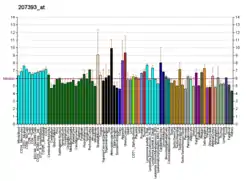
OX2 is a G-protein coupled receptor expressed exclusively in the brain. It has 64% identity with OX1. OX2 binds both orexin A and orexin B neuropeptides. OX2 is involved in the central feedback mechanism that regulates feeding behaviour.[5] Mice with enhanced OX2 signaling are resistant to high-fat diet-induced obesity.[7]
Ligands
Agonists
- Danavorexton (TAK-925) – selective OX2 receptor agonist
- Firazorexton – selective OX2 receptor agonist[8][9]
- Orexins – dual OX1 and OX2 receptor agonists
- SB-668875 – selective OX2 receptor agonist
- Suntinorexton – selective OX2 receptor agonist[8][9]
- TAK-861 – selective OX2 receptor agonist[12]
- TAK-994 – selective OX2 receptor agonist
Antagonists
- Almorexant - Dual OX1 and OX2 antagonist
- Daridorexant (nemorexant) - Dual OX1 and OX2 antagonist
- EMPA - Selective OX2 antagonist
- Filorexant - Dual OX1 and OX2 antagonist
- JNJ-10397049 (600x selective for OX2 over OX1)[13]
- Lemborexant - Dual OX1 and OX2 antagonist
- MK-1064 - Selective OX2 antagonist[14]
- MK-8133 - Selective OX2 antagonist[15]
- SB-649,868 - Dual OX1 and OX2 antagonist
- Seltorexant - Selective OX2 antagonist
- Suvorexant - Dual OX1 and OX2 antagonist
- TCS-OX2-29 - Selective OX2 antagonist
- (3,4-dimethoxyphenoxy)alkylamino acetamides[16]
- Compound 1m - Selective OX2 antagonist[17]
See also
References
- GRCh38: Ensembl release 89: ENSG00000137252 - Ensembl, May 2017
- GRCm38: Ensembl release 89: ENSMUSG00000032360 - Ensembl, May 2017
- "Human PubMed Reference:". National Center for Biotechnology Information, U.S. National Library of Medicine.
- "Mouse PubMed Reference:". National Center for Biotechnology Information, U.S. National Library of Medicine.
- "Entrez Gene: HCRTR2 hypocretin (orexin) receptor 2".
- Liszewski, Kathy (1 October 2015). "Dissecting the Structure of Membrane Proteins". Genetic Engineering & Biotechnology News. 35 (17): 16. doi:10.1089/gen.35.07.09.
- Funato H, Tsai AL, Willie JT, Kisanuki Y, Williams SC, Sakurai T, Yanagisawa M (January 2009). "Enhanced orexin receptor-2 signaling prevents diet-induced obesity and improves leptin sensitivity". Cell Metabolism. 9 (1): 64–76. doi:10.1016/j.cmet.2008.10.010. PMC 2630400. PMID 19117547.
- "WHO Drug Information, Vol. 34, No. 2, 2020 Proposed INN: List 123 263 : International Nonproprietary Names for Pharmaceutical Substances (INN)" (PDF). Who.int. Retrieved 2021-11-30.
- WO application 2019027058, Kajita, Yuichi; Mikami, Satoshi & Miyanohana, Yuhei et al., "Heterocyclic compound and use therof", published 2019-02-07, assigned to Takeda Pharmaceutical Company
- Smart D, Jerman JC, Brough SJ, Rushton SL, Murdock PR, Jewitt F, Elshourbagy NA, Ellis CE, Middlemiss DN, Brown F (September 1999). "Characterization of recombinant human orexin receptor pharmacology in a Chinese hamster ovary cell-line using FLIPR". Br. J. Pharmacol. 128 (1): 1–3. doi:10.1038/sj.bjp.0702780. PMC 1571615. PMID 10498827.
- Langmead CJ, Jerman JC, Brough SJ, Scott C, Porter RA, Herdon HJ (January 2004). "Characterisation of the binding of [3H]-SB-674042, a novel nonpeptide antagonist, to the human orexin-1 receptor". British Journal of Pharmacology. 141 (2): 340–6. doi:10.1038/sj.bjp.0705610. PMC 1574197. PMID 14691055.
- "Wave 1 Pipeline Market Opportunity Conference Call" (PDF). Takeda Pharmaceutical Company Limited. 8 December 2020. Archived from the original (PDF) on 2021-10-20.
TAK-861, a second oral OX2R agonist will begin clinical testing in 2H FY20
- McAtee LC, Sutton SW, Rudolph DA, Li X, Aluisio LE, Phuong VK, Dvorak CA, Lovenberg TW, Carruthers NI, Jones TK (Aug 2004). "Novel substituted 4-phenyl-[1,3]dioxanes: potent and selective orexin receptor 2 (OX(2)R) antagonists". Bioorganic & Medicinal Chemistry Letters. 14 (16): 4225–9. doi:10.1016/j.bmcl.2004.06.032. PMID 15261275.
- Roecker AJ, Mercer SP, Schreier JD, Cox CD, Fraley ME, Steen JT, Lemaire W, Bruno JG, Harrell CM, Garson SL, Gotter AL, Fox SV, Stevens J, Tannenbaum PL, Prueksaritanont T, Cabalu TD, Cui D, Stellabott J, Hartman GD, Young SD, Winrow CJ, Renger JJ, Coleman PJ (Feb 2014). "Discovery of 5-chloro-N-[(5,6-dimethoxypyridin-2-yl)methyl]-2,2':5',3-terpyridine-3'-carboxamide (MK-1064): a selective orexin 2 receptor antagonist (2-SORA) for the treatment of insomnia". ChemMedChem. 9 (2): 311–22. doi:10.1002/cmdc.201300447. PMID 24376006. S2CID 26114114.
- Kuduk SD, Skudlarek JW, DiMarco CN, Bruno JG, Pausch MH, O'Brien JA, Cabalu TD, Stevens J, Brunner J, Tannenbaum PL, Garson SL, Savitz AT, Harrell CM, Gotter AL, Winrow CJ, Renger JJ, Coleman PJ (Jun 2015). "Identification of MK-8133: An orexin-2 selective receptor antagonist with favorable development properties". Bioorganic & Medicinal Chemistry Letters. 25 (12): 2488–92. doi:10.1016/j.bmcl.2015.04.066. PMID 25981685.
- Cole AG, Stroke IL, Qin LY, Hussain Z, Simhadri S, Brescia MR, Waksmunski FS, Strohl B, Tellew JE, Williams JP, Saunders J, Appell KC, Henderson I, Webb ML (Oct 2008). "Synthesis of (3,4-dimethoxyphenoxy)alkylamino acetamides as orexin-2 receptor antagonists". Bioorganic & Medicinal Chemistry Letters. 18 (20): 5420–3. doi:10.1016/j.bmcl.2008.09.038. PMID 18815029.
- Fujimoto T, Kunitomo J, Tomata Y, Nishiyama K, Nakashima M, Hirozane M, Yoshikubo S, Hirai K, Marui S (Nov 2011). "Discovery of potent, selective, orally active benzoxazepine-based Orexin-2 receptor antagonists". Bioorganic & Medicinal Chemistry Letters. 21 (21): 6414–6. doi:10.1016/j.bmcl.2011.08.093. PMID 21917455.
Further reading
- Flier JS, Maratos-Flier E (Feb 1998). "Obesity and the hypothalamus: novel peptides for new pathways". Cell. 92 (4): 437–40. doi:10.1016/S0092-8674(00)80937-X. PMID 9491885. S2CID 14768585.
- Willie JT, Chemelli RM, Sinton CM, Yanagisawa M (2001). "To eat or to sleep? Orexin in the regulation of feeding and wakefulness". Annual Review of Neuroscience. 24: 429–58. doi:10.1146/annurev.neuro.24.1.429. PMID 11283317.
- Hungs M, Mignot E (May 2001). "Hypocretin/orexin, sleep and narcolepsy". BioEssays. 23 (5): 397–408. doi:10.1002/bies.1058. PMID 11340621. S2CID 541650.
- de Lecea L, Kilduff TS, Peyron C, Gao X, Foye PE, Danielson PE, Fukuhara C, Battenberg EL, Gautvik VT, Bartlett FS, Frankel WN, van den Pol AN, Bloom FE, Gautvik KM, Sutcliffe JG (Jan 1998). "The hypocretins: hypothalamus-specific peptides with neuroexcitatory activity". Proceedings of the National Academy of Sciences of the United States of America. 95 (1): 322–7. Bibcode:1998PNAS...95..322D. doi:10.1073/pnas.95.1.322. PMC 18213. PMID 9419374.
- Sakurai T, Amemiya A, Ishii M, Matsuzaki I, Chemelli RM, Tanaka H, Williams SC, Richardson JA, Kozlowski GP, Wilson S, Arch JR, Buckingham RE, Haynes AC, Carr SA, Annan RS, McNulty DE, Liu WS, Terrett JA, Elshourbagy NA, Bergsma DJ, Yanagisawa M (Feb 1998). "Orexins and orexin receptors: a family of hypothalamic neuropeptides and G protein-coupled receptors that regulate feeding behavior" (PDF). Cell. 92 (4): 573–85. doi:10.1016/S0092-8674(00)80949-6. PMID 9491897. S2CID 16294729.
- Sakurai T, Amemiya A, Ishii M, Matsuzaki I, Chemelli RM, Tanaka H, Williams SC, Richarson JA, Kozlowski GP, Wilson S, Arch JR, Buckingham RE, Haynes AC, Carr SA, Annan RS, McNulty DE, Liu WS, Terrett JA, Elshourbagy NA, Bergsma DJ, Yanagisawa M (Mar 1998). "Orexins and orexin receptors: a family of hypothalamic neuropeptides and G protein-coupled receptors that regulate feeding behavior". Cell. 92 (5): 1 page following 696. doi:10.1016/S0092-8674(02)09256-5. PMID 9527442.
- Peyron C, Faraco J, Rogers W, Ripley B, Overeem S, Charnay Y, Nevsimalova S, Aldrich M, Reynolds D, Albin R, Li R, Hungs M, Pedrazzoli M, Padigaru M, Kucherlapati M, Fan J, Maki R, Lammers GJ, Bouras C, Kucherlapati R, Nishino S, Mignot E (Sep 2000). "A mutation in a case of early onset narcolepsy and a generalized absence of hypocretin peptides in human narcoleptic brains". Nature Medicine. 6 (9): 991–7. doi:10.1038/79690. PMID 10973318. S2CID 18076282.
- Wright GJ, Puklavec MJ, Willis AC, Hoek RM, Sedgwick JD, Brown MH, Barclay AN (Aug 2000). "Lymphoid/neuronal cell surface OX2 glycoprotein recognizes a novel receptor on macrophages implicated in the control of their function". Immunity. 13 (2): 233–42. doi:10.1016/S1074-7613(00)00023-6. PMID 10981966.
- Hartley JL, Temple GF, Brasch MA (Nov 2000). "DNA cloning using in vitro site-specific recombination". Genome Research. 10 (11): 1788–95. doi:10.1101/gr.143000. PMC 310948. PMID 11076863.
- Mazzocchi G, Malendowicz LK, Gottardo L, Aragona F, Nussdorfer GG (Feb 2001). "Orexin A stimulates cortisol secretion from human adrenocortical cells through activation of the adenylate cyclase-dependent signaling cascade". The Journal of Clinical Endocrinology and Metabolism. 86 (2): 778–82. doi:10.1210/jc.86.2.778. PMID 11158046.
- Blanco M, López M, García-Caballero T, Gallego R, Vázquez-Boquete A, Morel G, Señarís R, Casanueva F, Diéguez C, Beiras A (Apr 2001). "Cellular localization of orexin receptors in human pituitary". The Journal of Clinical Endocrinology and Metabolism. 86 (4): 1616–9. doi:10.1210/jc.86.4.1616. PMID 11297593.
- Blanco M, López M, GarcIa-Caballero T, Gallego R, Morel G, SeñarIs R, Casanueva F, Diéguez C, Beiras A (Jul 2001). "Cellular localization of orexin receptors in human pituitary". The Journal of Clinical Endocrinology and Metabolism. 86 (7): 1616–9. doi:10.1210/jc.86.7.3444. PMID 11443222.
- Karteris E, Randeva HS, Grammatopoulos DK, Jaffe RB, Hillhouse EW (Sep 2001). "Expression and coupling characteristics of the CRH and orexin type 2 receptors in human fetal adrenals". The Journal of Clinical Endocrinology and Metabolism. 86 (9): 4512–9. doi:10.1210/jc.86.9.4512. PMID 11549701.
- Randeva HS, Karteris E, Grammatopoulos D, Hillhouse EW (Oct 2001). "Expression of orexin-A and functional orexin type 2 receptors in the human adult adrenals: implications for adrenal function and energy homeostasis". The Journal of Clinical Endocrinology and Metabolism. 86 (10): 4808–13. doi:10.1210/jc.86.10.4808. PMID 11600545.
- Olafsdóttir BR, Rye DB, Scammell TE, Matheson JK, Stefánsson K, Gulcher JR (Nov 2001). "Polymorphisms in hypocretin/orexin pathway genes and narcolepsy". Neurology. 57 (10): 1896–9. doi:10.1212/wnl.57.10.1896. PMID 11723285. S2CID 38597998.
- Blanco M, García-Caballero T, Fraga M, Gallego R, Cuevas J, Forteza J, Beiras A, Diéguez C (Mar 2002). "Cellular localization of orexin receptors in human adrenal gland, adrenocortical adenomas and pheochromocytomas". Regulatory Peptides. 104 (1–3): 161–5. doi:10.1016/S0167-0115(01)00359-7. PMID 11830291. S2CID 30238394.
- Strausberg RL, Feingold EA, Grouse LH, Derge JG, Klausner RD, Collins FS, Wagner L, Shenmen CM, Schuler GD, Altschul SF, Zeeberg B, Buetow KH, Schaefer CF, Bhat NK, Hopkins RF, Jordan H, Moore T, Max SI, Wang J, Hsieh F, Diatchenko L, Marusina K, Farmer AA, Rubin GM, Hong L, Stapleton M, Soares MB, Bonaldo MF, Casavant TL, Scheetz TE, Brownstein MJ, Usdin TB, Toshiyuki S, Carninci P, Prange C, Raha SS, Loquellano NA, Peters GJ, Abramson RD, Mullahy SJ, Bosak SA, McEwan PJ, McKernan KJ, Malek JA, Gunaratne PH, Richards S, Worley KC, Hale S, Garcia AM, Gay LJ, Hulyk SW, Villalon DK, Muzny DM, Sodergren EJ, Lu X, Gibbs RA, Fahey J, Helton E, Ketteman M, Madan A, Rodrigues S, Sanchez A, Whiting M, Madan A, Young AC, Shevchenko Y, Bouffard GG, Blakesley RW, Touchman JW, Green ED, Dickson MC, Rodriguez AC, Grimwood J, Schmutz J, Myers RM, Butterfield YS, Krzywinski MI, Skalska U, Smailus DE, Schnerch A, Schein JE, Jones SJ, Marra MA (Dec 2002). "Generation and initial analysis of more than 15,000 full-length human and mouse cDNA sequences". Proceedings of the National Academy of Sciences of the United States of America. 99 (26): 16899–903. Bibcode:2002PNAS...9916899M. doi:10.1073/pnas.242603899. PMC 139241. PMID 12477932.
This article incorporates text from the United States National Library of Medicine, which is in the public domain.
This article is issued from Wikipedia. The text is licensed under Creative Commons - Attribution - Sharealike. Additional terms may apply for the media files.