HMS Valerian (1916)
HMS Valerian was an Arabis-class sloop of the Royal Navy, built by Charles Rennoldson and Company, South Shields, and launched 21 February 1916. After service in the First World War, she was assigned with sister ships to the America and West Indies Station, based at the Royal Naval Dockyard on Ireland Island in the Imperial fortress colony of Bermuda. She foundered off Bermuda in the 1926 Havana–Bermuda hurricane, on 22 October, 1926.
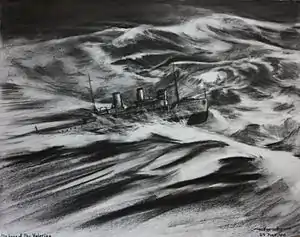 Artist's impression of the loss of HMS Valerian | |
| History | |
|---|---|
 United Kingdom United Kingdom | |
| Name | HMS Valerian |
| Namesake | Valeriana officinalis |
| Builder | Charles Rennoldson and Company, South Shields, England |
| Laid down | 1915 |
| Launched | 21 February 1916 |
| Homeport | Royal Naval Dockyard, Bermuda |
| Fate | Foundered off Bermuda in the 1926 Havana–Bermuda hurricane, on 22 October 1926 |
| General characteristics | |
| Class and type | Arabis-class sloop |
| Displacement | 1,250 tons |
| Length | |
| Beam | 33 ft 6 in (10.21 m) |
| Draught | 11 ft 9 in (3.58 m) |
| Propulsion |
|
| Speed | 17 knots (31 km/h; 20 mph) |
| Range | 2,000 nmi (3,700 km; 2,300 mi) at 15 kn (28 km/h; 17 mph) with max. 260 tons of coal |
| Complement | 104 |
| Armament |
|
History
After the commissioning, the Valerian completed security tasks off the British east coast, being used in 1917 and 1918 mainly to monitor coastal convoy routes and the mine barriers of the North Sea Mine Barrage. The sloop was not involved in combat operations, although it was briefly suspected that the she had sunk the German submarine SM U-99 in the northern North Sea in July 1917. However, this submarine was sunk by the British submarine HMS J2.
Loss
HMS Valerian, under her Captain, Commander W. A. Usher, was returning to the HMD Bermuda from providing hurricane relief in the Bahamas (her second post-hurricane mission of mercy to the British West Indies that autumn), trailed by another hurricane. A shortage of coal in the Bahamas had forced her to put to sea with only enough to complete her journey, which meant that her mass, and hence her displacement, was a great deal less than would normally be the case, reducing her stability in rough seas. She last radioed after sighting Gibb's Hill Lighthouse early in the morning of the 22 October 1926, at which time the crew saw no sign of an approaching storm. By the time she reached the Five Fathom Hole, she was being overtaken by the storm and conditions were too rough to risk the channel through the reefs. The crew were forced to turn southward to obtain sea room from the reefline lest they be driven on the rocks, and headed directly into the storm. She fought the storm for more than five hours before she was sunk with the loss of 85 men. The British merchant ship Eastway was also sunk near Bermuda. When the centre of the storm passed over Bermuda, winds increased to 114 mph (183 km/h) at Prospect Camp, whereupon the Army took down its anemometer to protect it. The Royal Naval Dockyard was being hammered and never took its anemometer down. It measured 138 mph (222 km/h) at 13:00 UTC, before the wind destroyed it.[1] This roughly co-incided with the moment Valerian was overwhelmed.
The report of the court martial of the survivors of the Valerian included survivors' descriptions of her loss:[2]
MEMBERS OF THE COURT.
The Court was composed of: -
Captain A. B. Cunningham, D.S.O., Chief of Staff, North America and West Indies Station, H.M.S. Calcutta;
Captain A. T. Tillard, D.S.O., H.M.S. Malabar.
Captain H. D. Bridges, D.S.O., H.M.S. Curlew.
Captain A. M. Lecky, D.S.O., H.M.S. Colombo.
Commander H. B. Maltby, H.M.S. Calcutta.
Captain O. H. Dawson, H.M.S. Capetown, was Prosecutor, and Paymaster-Commander G. H. DeDenne, D.S.O., H.M.S. Calcutta (Admiral's Secretary), was Deputy Judge Advocate.
Commander W.A. Usher, who was in command of the Valerian, Lieutenant F. G. Hughes, Navigator, and the other 17 members of the crew who were saved, attended the Court as the accused.
COMMANDER USHER'S REPORT.
On the preliminary formalities having been complied with, the Deputy Judge Advocate read Commander Usher's narrative of the loss of the ship. This in full is as follows:-
Royal Naval Hospital,
Bermuda,
27th October, 1926.
Sir,
I have the honour to forward the following report of the circumstances under which H.M.S. "Valerian" foundered during a hurricane while off Bermuda at 1.30 on 22nd October, 1926.
2. "Valerian" left Nassau for Bermuda at 1330, 18th October, having completed the services required in the Bahamas on account of the recent hurricane there. Sufficient coal had been obtained locally to make the passage, but supplies there are very scarce and what could be spared only gave a reserve of just over 35 tons, after the passage was completed at economical speed.3. During the evening of the 18th October, a report was received of a tropical disturbance having formed south of Cuba, but the direction was stated to be North or N.N.W. The next day further reports were received which indicated that although the storm was not travelling at any great speed, it was definitely curving to the North Eastward. Reports of a similar nature were received from time to time until Thursday 21st October, when the storm centre was estimated to be about 700 miles from Bermuda and "Valerian" was about 200 miles. The weather forecast from Washington then stated that the storm would reach Bermuda on Friday morning, 22nd October, and that winds would reach gale force. Speed of "Valerian" was increased to 9 1/2 knots, which is the maximun continuous speed on one boiler, and No. 2 boiler was also lighted up so as to do all that was possible to race the storm as it was considered most undesirable that the ship should not reach harbour on account of the shortness of coal and her very light condition, which renders her difficult to handle.
4. Throughout Thursday the wind remained at about S. by E., force 5-6. All awnings were furled, freeing ports worked, and all precautions taken to render the ship as seaworthy as possible. Just before midnight No. 2 boiler was connected up and 120 revolutions (11 1/2 knots) ordered, but the continual racing of the propeller resulted in a hot bearing and speed had to be reduced to 105 revolutions (10 knots).
5. Gibbs Hill Light was sighted at about 0440, 22nd October, and although it was obscured for some time after that, the land was again made soon after daylight and about 0800 Gibbs Hill Light was abeam 5 miles. Although the wind was blowing with a force 6-7 there was comparatively little sea and I anticipated no difficulty in entering the Narrows having done so before under similar conditions. Indeed, at that time, I felt fully assured of reaching harbour in safety as there was no immediate indication of a violent storm: also there was a complete absence of swell that sometimes denotes the approach of a storm.
6. About half-an-hour later the weather became very thick and the wind was blowing up strongly from the South East. At the same time reports were being received from merchant ships a short distance away of having encountered a hurricane of great intensity. Here was evidently no ordinary storm and was something far more intense than might have been anticipated from the Washington reports, that had forecasted winds of gale force at Bermuda. The weather was now too thick to go further towards the Narrows, and with a rising wind the ship's head was turned to South East so as to head the sea and wind and to gain as much sea room as possible, a speed of 9 knots being maintained.
7. At about 0830 the wind was blowing gale force. The driving rain and flying spray obliterated everything from view. The ship was steaming at 9 knots, or as fast as the engine room could manage with a propeller that was continually racing. Even with this speed the ship had practically no steerage way and it was one long effort trying to keep the ship as near as possible head to the wind, which was S.E. The ship occasionally got into the trough of the sea and was with great difficulty brought back again, but in spite of all this a mean course of S.E. was maintained throughout. This question of steering was naturally made more difficult having only one propeller and the ship being very light. From this time on, until nearly noon, the wind was blowing at hurricane force about 100 miles per hour, the barometer dropped rapidly 29.60 to 28.50 and the rain was driven along in a continual sheet of water. At Noon, the centre of the storm was reached and the clearing came. The seas were now mountainous and seemed to approach the ship from all sides, but more particularly from the South and East. As the ship balanced on the crest, or fell into the trough, it seemed as if she must break her back and it speaks very well of her construction that she withstood these stresses so well. So far no damage had been done to the hull or fittings.
8. At 1215 the wind came out of the N.W., at first in fitful gusts and then with a fury that was indescribable. The sea was still coming from the S.E. and any question of turning at that time was not to be thought of. Further, it was considered better to keep her heading seaward as long as possible so as to keep away from the land. Under these conditions, with the ship steaming 9 knots, the wind rather on the starboard quarter and the sea ahead, a comparatively good balance was obtained and in some ways was a little easier than in the first half of the hurricane as there was less racing. This was maintained for about half-an-hour, during which time the ship's head was roughly S.S.E.
9. Just before 1300, a series of squalls struck the ship on the port side with a fury that beggars all description. The ship was thrown on her beam ends, heeling 70 degrees over to starboard. The helm was hard-a-port, to keep her head to sea, but this was evidently holding her over and on letting go the helm and putting it hard-a-starboard, the ship righted and came slowly up to the wind, wallowing heavily in the trough of the sea as she came round. It was at this moment the mainmast and wireless were carried away. The ship was brought within about 6 points of the wind, but these tremendous squalls kept forcing her over to leeward and it seemed only a matter of moments before the ship must go. Soon after the engines stopped and the report came up that the ship was ashore but this seems more than doubtful as nothing was felt on the bridge, and although the ship was in a mass of blinding spray, nothing in the nature of breakers was seen. At the time the engines stopped the ship was heeled over to about 60 and then went slowly over.
10. There was little to be done except to order everyone from below, let go the rafts and try and make an S.O.S., but as the mainmast was gone it is unlikely that any message could have ben sent. Within about one minute the ship was over, the funnels went under and when the boilers burst a black wave came up and swept me away from the bridge, to which I was hanging, and carried me under. I came up part of the way and bumped my head and after going down again a little, finally came up alongside a raft to which I clung.
11. There was a lot of wreckage all round and such men I could as see had hold of something.The raft to which I held had 28 men in all and we were swept away in a mass of spray and foam.
Unfortunately the bottom of the raft got kicked out and this entailed much greater effort in holding on. The experience of clinging to this raft for 21 hours, with only a problematical chance of being picked up was indeed trying enough for the hardest. Luckily the water was warm, but the N.W. wind felt bitterly cold to those parts which were exposed, Sunset came and as it grew dark we looked for Gibbs Hill Light or some other Light, as we had no idea of our position, but nothing was seen, not even the glare. The twelve hours of night, with waves breaking over us, were an experience never to be forgotten and many gave up during that time. They got slowly exhausted and filled up with water and then slipped away. The raft was slowly losing its bouyancy and as everyone wanted, as far as possible, to sit on the edge, it capsized about every 20 minutes, which was exhausting; we all swallowed water in the process and the effort of climbing back again began to tell. Twelve held out until the end, when H.M.S. "Capetown" was most thankfully sighted at about 1000 the following day. The bouyancy of the raft was then very small and in another hour it is thought would not have supported anyone. The men picked up were most carefully looked after by "Capetown" and every kindness shown.
12. I should like to bear witness to the brave and calm way in which the ship's company bore themselves to the last and upheld in every way the finest traditions of the Service. While deeply regretting the loss of the ship and so many gallant lives I do not feel that by any act of mine it would have been in any way possible to have averted this terrible disaster; the forces of nature being as they were overwhelmingly powerful, nor could the loss of so many lives have been in any degree minimized. By the greatest ill-luck the ship could not quite reach her goal, just one hour, away, where she could have ridden out the storm with good prospects of success, and where in any event the safety of so many valuable lives would have been assured.
13. The following is a list of the survivors:-
Commander William Arthur Usher, R.N.
Lieutenant Frank George Hughes, R.N.
Harry Arthur Tandy, Petty Officer O.N.J. 21089
Charles George Marshall, Petty Officer J. 17931
George Archibald T. Lindsey, Ldg. Seaman, 216088
Lloyd George Webb, Leading Seaman, J. 84421
Harold Morley, Able Seaman, J. 25758
Albert Bell, Able Seaman, J. 25328
James Francis Smith, Able Seaman, J. 111524
George Smith Howell, Able Seaman, J. 90675
Arthur Henry Card, Able Seaman, J. 95510
Albert George Hughes, Signalman, J. 35582
Laurence Godfrey Saunders, Telegraphist, J. 81166
Albert Thomas Matthews, Stoker, P.O. K. 16841
Reginald William Drinkwater, Ldg. Stoker, K. 1962
John Francis Hill, Stoker 1st Class, K. 59422
Alexander Patrick Webster, Stoker 1st Class, K. 61612
Thomas George ?, Stoker 1st Class, K. 36577
Edgar George Bone, Stoker 1st Class, K. 18368All the above ratings are attached to the Portsmouth Port Division, excepting Able Seaman Card whose Division is Chatham.
I have the honour to be, Sir, Your obedient Servant,
Sgd. W. A. USHER Commander, late in command of H.M.S. "Valerian."
Giving evidence, Commander Usher enlarged on paragraph 1 of his report to the extent of saying that it was only by the personal influence of the Administrator of Nassau that he was able to obtain 31 tons of coal to replenish his bunkers. The nearest Florida port was Jacksonville, 350 miles away, but he considered he had sufficient to bring him back to Bermuda, having regard to the possibility of encountering hurricanes in October. His supply all told was 105 tons, and on the day of the loss he estimated he had 46 tons left. With regards to the movements of the storm, Commander Usher pointed out the difficulty of estimating the speed of a hurricane.
As to a report supposed to have emanated from the engine room that the ship was aground, he did not believe that the ship did touch. The condition of the wind and sea was such as to account for the loss of the ship.
With regard to the seaworthiness of the vessel, the wind had a great effect on her heeling, and when the ship heeled over to 70 degrees he was quite sure that the leeward battery (I.e. a vacant space on deck bulwarked in) must have been full of water. The coal in the cross bunkers might also have shifted, and the water in the boilers would also go to leeward. All these things, combined with the hurricane force of the wind, were quite sufficient to destroy the stability of the ship.
In cross-examination, Cdr. Usher said that if the coal were Welsh, it would take 60 tons from Nassau to Bermuda, but very often the coal was inferior.
The last he saw of the land was 4 miles beyond Gibbs Hill lighthouse, 4 miles towards the Narrows, the lighthouse being on the port quarter. Some time prior to that he had picked up the light at 26 miles visibility.
Lieut. Hughes confirmed that part of Cdr. Usher's relative to the last position taken off Gibbs Hill. Visibility was fairly good early on Oct. 22nd, but decreased later to 100 yards. He described the difficulty of keeping the vessel on her course, and admitted receiving a report from the engine room that the ship was aground. Before that he had no reason to believe that the ship was aground or had sustained any underwater damage. At the time he received the information it really made no difference, because the ship was in a sinking condition.
Various survivors of the crew were then examined, but it was difficult to confirm the report of the ship going aground or stopping. Several, however, said that the amount of water which went below did not amount to much, and did not inconvenience the stoke-hold crew.
Petty Officer Tandy said that about 5 minutes before the Valerian sank he asked the Navigator what had happened, and the latter said that they were aground, and that he did not know where the land was. Asked if it was a case of every man for himself, the Navigator said yes, and witness accordingly passed the order out.
Lieut. Hughes was recalled with regard to this conversation, and said that Tandy came on the bridge after the Captain had given the order regarding every man for himself. He could not remember saying anything about the ship being ashore, but he had no reason to think the ship was ashore except for the engine room report.
Asked what made the ship list so much, he replied that the weather was ever so much stronger than in the second than in the first part of the hurricane. Really, there was no comparison between the first and second parts of the storm.
He was not in a position to tell where the ship foundered, and later on Cdr. Usher, recalled, said he only sent the signal that they were 5 miles south of Gibbs Hill to indicate that they could not get in in the time ordered.
Tandy, recalled, said he did not believe the ship was ashore.
Navigators from the other cruisers on the station gave expert testimony, Commdr. Benn, H.M.S. Calcutta, and Lt.-Cdr. Leigh, H.M.S. Curlew, and they said they found the hurricane was moving on Oct. 22nd at 440 miles in 12 hours.
Lieut. Nicholls, H.M.S. Wistaria, said the maximum stability of his ship was 29 degrees, and 52 degrees the vanishing angle when she had 40 tons of coal on board and the forecastle doors closed. With 130 tons it was 30 and 57 degrees. The Wistaria was, however, slightly differently fitted to the Valerian.
THE FINDING
The Court closed for its finding at 1.16, and reopening at 7.40 the Deputy Advocate read the following questions submitted by the Prosecutor, and the Court's answers, followed by the Court's finding:-
Questions
1. (a). When the ship sailed from Nassau for Bermuda was there a sufficient supply on board to make the passage with safety? (b) Were all reasonable steps taken to augment the supply?
2. When it became evident on Thursday 21st October from weather reports that a tropical storm would be in the neighbourhood of Bermuda on the morning of Friday, 22nd October, should an alteration of course have been made to the South East or North West with a view to avoiding it?
3. (a). Was it advisable to keep the ship heading South Eastward during the lull at the centre of the storm; and (b) with the wind coming from the North Westward; and (c) was the action of eventually trying to bring the ship to the wind necessary?
4. Were all seamanlike precautions taken for the safety of the ship?
5. Did the ship touch the ground? If so what action on the part of the Commanding Officer would have prevented this?
6. If the ship did not touch the ground what was the cause of the sinking?
7. (a). Were all practicable steps taken for preserving life and (b) what was the behaviour of Officers and Men?
8. What is considered the most probable position of the foundering of the ship?
Answers
1. (a). Yes, observing that from the evidence 46 tons were remaining when "Valerian" was 10 miles from her destination. (b). The Commanding Officer of "Valerian" augmented her supply of coal with difficulty which made his supply sufficient for the passage.
2. The storm arrived with unprecedented speed and was of greater violence than that which Washington's weather report led "Valerian" to expect. It is considered that the Commanding Officer's action in attempting to arrive at Bermuda in advance of the storm was justified.
3. (a). Yes, owing to the heavy South Easterly sea. (b). Even with the wind from the North West the ship would have had to be kept heading into the heavy South Easterly swell. (c). No evidence was obtained to decide that the Commanding Officer's action was other than correct.
4. Yes, although certain communicating doors appear to have been left open, there is evidence to show that water, in sufficient quantities to endanger the ship, did not find its way below. The little that did was easily controlled.
5 and 6. Although there is no direct evidence of the ship having taken the ground, after the satisfactory manner in which she rode the previous four hours South Easterly gale with no danger, there is a likelihood of her having done so. In forming this opinion we have taken the following points into consideration: In favour of:- a. (1) the report which reached the bridge that the ship was ashore. (2) The evidence of Petty Officer Tandy that the Navigating Officer stated they were ashore. (3) The position of the ship at the commencement of the hurricane. (4) The ship being thrown on her beam ends and remaining there against the groundings:- (5) She was lost at the dangerous part of the hurricane when the sea is against the wind. (6) She was heading for the open sea during the first part of the gale. (7) No land or breakers were seen. (8) No shock or grounding was felt. If the ship did ground, it is concluded that it was not due to any error in navigation, and situated thus no action on the part of the Commanding Officer could save her. If she did ground, we agree with the Commanding Officer that the forces of nature overwhelmed the ship.
7 (a) Yes. (b) the evidence is clear that without panic, the utmost endeavour was made to carry out the orders of superiors up to the very last, in fact the discipline and behaviour of all on board was exceptional.
8. Owing to the loss of all records the Court is unable to answer this question.
A. B. CUNNINGHAM, (President)
A. T. TILLARD, (Captain)
W. S. BRIDGES, (Captain)
A. M. LECKY, (Captain)
H. MALTBY, (Commander)Finding
1. The court finds that "Valerian" left Nassau at 13.30 on the 18th October in accordance with orders from the Commander-in Chief of the North America and West Indies Station to return to Bermuda.
2. Sufficient coal was on board to make the passage, although the requisite amount had only been obtained after considerable effort on the part of the Commanding Officer.
3. During her voyage, various reports were received by wireless telegraph giving course of a tropical disturbance having formed south of Cuba and which afterwards re-curved to the North East.
4. The Commanding Officer decided that by holding to his course and speed he would arrive at Bermuda considerably in advance of the storm. In this decision the Court considers he was justified.
5. The hurricane, however, was moving at the unprecedented rate, for October, of nearly 720 miles per day and "Valerian" was unable to gain the shelter of Bermuda before she was overtaken by it.
6. At 08.00 she actually reached the position of Gibbs Hill bearing 312 degrees, distance 5 miles, and half an hour later on the weather becoming thick hove to heading S.E. and steaming about 9 knots into the gale.
7. The wind was South Easterly until about noon with a maximum force of 95 miles per hour.
8. The ship rode out this South Easterly gale easily sustaining no damage, but her drift during this period cannot be ascertained.
9. At noon there was a lull, and the visibility increased from one to two miles but no land was seen.
10. At 12.15, the wind shifted to the North Westward and blew with a force which was registered up to 128 miles an hour. A heavy South Easterly sea was still running and the ship was kept head to sea steaming 9 knots with the wind rather on the starboard.
11. At about 13.00 the ship broached to and was thrown on her beam ends, righted once, heeled over to starboard again and slowly capsized.
12. There is some likelihood of the ship having grounded through having been driven astern during the first half of the gale- again, it is possible that she was overwhelmed by the force of the wind and sea.
13. The Court is satisfied that the ship was in a seaworthy condition and that the loss was due to water finding its way below or to the shifting of weights. The pumps were efficient.
14. The Court considers that the orders to abandon ship were given at the last possible moment and were necessary.
15. Finally, the Court is of opinion that there was no error in navigation. Nothing the Commanding Officer could do would have diverted the loss of the ship, and that no blame is attributable to the survivors whose conduct throughout was exemplary.
16. The Court is of opinion that none of the survivors are to blame and formally acquits them.
References
- Stranack, Royal Navy, Lieutenant-Commander B. Ian D (1977). The Andrew and The Onions: The Story of The Royal Navy in Bermuda, 1795–1975. Bermuda: Island Press Ltd., Bermuda, 1977 (1st Edition); Bermuda Maritime Museum Press, Royal Naval Dockyard Bermuda, Ireland Island, Sandys, Bermuda, 1990 (2nd Edition). ISBN 9780921560036.
- "Wind and Weather Swept Valerian to Doom". The Royal Gazette. City of Hamilton, Pembroke Parish, Bermuda. 3 November 1926. pp. 1–2.