Habte Giyorgis Dinagde
Fitawrari Habte Giyorgis Dinagde (Quse Dinagde;[1] Amharic: ሀብተ ጊዮርጊስ ዲነግዴ; ; 1851 – 12 December 1926) was an Ethiopian military commander and government official who, among several other posts, served as President of the Council of Ministers and as Minister of War during the reigns of Menelik II, Zewditu and Haile Selassie. He was also Shum or Governor of Borena, Ibat, and Mecha.
Habte Giyorgis Dinagde | |
|---|---|
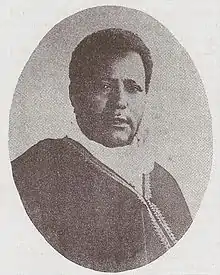 | |
| Born | 1851 |
| Died | 12 December 1926 (aged 75) |
| Parent(s) |
|
Early life
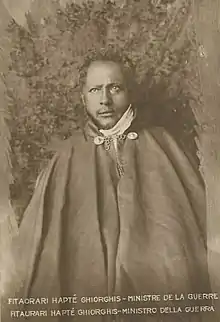
Habte Giyorgis was of Oromo and Gurage descent. He was trained in the art of warfare and later promoted to a high rank in the empire's army under Emperor Menelik II. He was a young prisoner of war, along with Dajazmach Balcha Safo, and was found in South West Shewa. He was later taken to Ankober, Menelik's Shewan capital, before Addis Ababa. As a young man he joined the forces of Menelik, then-King of Shewa, during one of Menelik's campaigns to reinstate Ethiopia's southern lands that had been disunited since the 16th century.
Military career
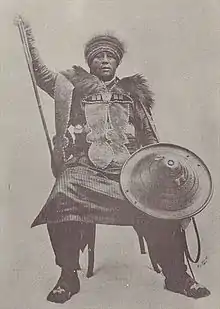
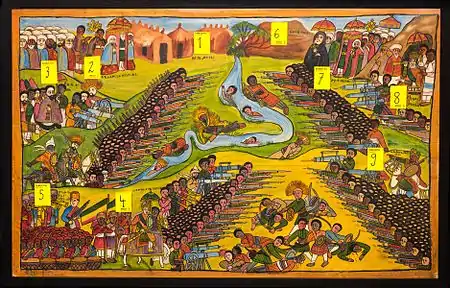
Habte Giyorgis played a leading role in several important battles of Ethiopian history. He participated in many battles, including the Battle of Adwa. In October 1896 Habte Giyorgis was appointed as chief of the army after Fitawrari Gabayahu Gurmu (Abba Gora) was killed during the Battle of Adwa.[2] After his appointment Commander of the Imperial Army, Menelik made Habte Giyorgis Shum, equivalent as governor, of Borena adding "Mecha and Jibat as a reward".[2]
Political potentiate
However, he grew to become a skilled military leader and statesman. He was also a central figure in the coup which removed Taytu from power during the period of Menelik II's incapacitation as well as the 1916 coup which deposed Lij Iyasu and put Empress Zewditu in power.
From 1909 to 1926, Habte Giyorgis was Chief Minister (equivalent to the late title of Prime Minister) of the Council of Ministers to the Emperor of Ethiopia. He was an important figure in the Ethiopian Empire often cited for his great skills as military commander and judiciary.
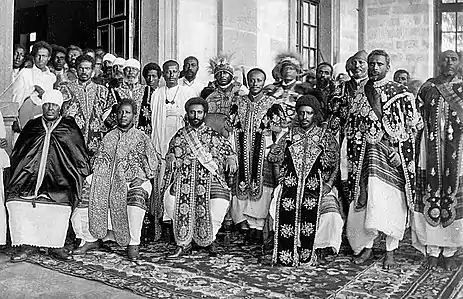
Legacy
A street in Addis Ababa are named after him. He is still today renowned for his wisdom and his military skills.
References
- "Injifannoo Adwaa: Mallattoo tokkummaa ummata Itiyoophiyaati". obnoromia.com (in Oromo).
- Demie, Mebrete (2 August 2020). "Metamorphosis in Conquest of Borana Oromo (c. 1897-1907)". Journal of Indigenous knowledge and development studies. 1 (2): 22. eISSN 2708-2830.
External links
| Ethiopian Empire (1173–1974) | .svg.png.webp) .svg.png.webp) .svg.png.webp) .svg.png.webp)  | |
|---|---|---|
| Provisional Military Government of Socialist Ethiopia (1974–1987) |
| |
| People's Democratic Republic of Ethiopia (1987–1991) | ||
| Transitional Government of Ethiopia (1991–1995) | ||
| Federal Democratic Republic of Ethiopia (since 1995) | ||
| ||
Authority control  | |
|---|---|
| General | |
| National libraries | |
| Other | |