Hair oil
Hair oil is oil applied to the hair as a cosmetic, conditioner, styling aid, restorative or tonic. Different hair oils have been used for many different purposes such as hair growth, health, dryness, scalp, or to fix damaged hair. There are various forms of hair oils that can be applied which include coconut, castor, or almond oil.[1][2][3]
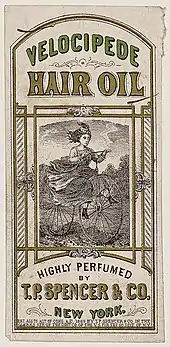
Use of Hair Oil
Humans produce natural hair oil called sebum from glands around each follicle. Other mammals produce similar oils such as lanolin. When hair oils are first applied onto the scalp, the effect of the oil on the lipid barriers varies depending on the type of oil. When oil is first applied, the oil forms a protective hydrophobic film that decreases transepidermal water loss as it reduces evaporation from water from the skin.[4] The reduction of water loss is important to the scalp because it helps reduce hygral fatigue such as swelling and dryness.[5] Furthermore, hair oils fill up any gaps between the cuticle cells which prevent the penetration of any damaging substances in the hair follicle.[5]
Types of Oils
Mineral and vegetable oils are used to make a variety of commercial and traditional hair oils. Coconut oil is a common ingredient and brands which use this include Macassar oil and Parachute. Other vegetable oils used on the hair include almond, argan, babassu, burdock, Castor, and tea seed. Going the more traditional route, natural oils are used more commonly as cosmetic products on the scalp. Each oil has its own use as each one provides different benefits to the scalp. Natural Oils come from natural resources that are very high in nutrients such as vitamin and fatty acids.[6]
Coconut Oil
Coconut oil has been found to be one of the most commonly used oils in hair products and just by itself. Coconut oil was found to have properties that reduce protein loss in hair when used before and after wash.[5] Coconut oil is known to have lauric acid, which is a type of fatty acid that allows it to penetrate within the hair follicles and therefore heal and repair hair that is damaged. Aside from this, coconut oil is also widely known for moisturizing the hair to avoid breakage. [4]
Argan Oil
Over the years, Argan oil has become a popular product used for hair treatment. Argan oil is relieved from Morocco and is known for the conditioning effect that leaves hair soft and relieves frizz. Just like coconut oil, argan oil has essential fatty acids that leave hair healthy. [7]
Avocado Oil
Avocado oil has many uses as it is very rich in nutrients. Avocado oil has a source of high vitamin E, which is an antioxidant that helps with hair loss and encourages hair growth.[7]
Onion Oil
Onion oil is used for ages to sustain the quality and beauty of hair and nourishing it. The components present in red onion can cure hair-associated dilemmas and the side effects are minimal. In the long run, noticeable results are visible on the tresses through the application of this wonderful vegetable. Onion oil is principally utilized for its medicinal properties. Besides enhancing the taste of the food it is recognized for its versatile medicinal qualities.[8]
Other oils
Other oils consist of other fruit and nuts oil such as almond oil, grape seed oil, jojoba oil, olive oil, and many more. These oils promote hair elasticity to avoid breakage while preparing dryness and other hair damage. [4]
Ways to Use Hair Oil
Generally, hair oils could be introduced in a hair-care routine in many different ways. Many cosmetic products have ingredients with natural hair oils that can be used such as shampoo, heat protectant, hair drops, or hair masks. Technique that can be used to maximize potential is to use overnight as a hair mask or by adding drops of oil into shampoo and conditioner. When we talk about a specific hair mask, we discuss conditioners and are more to them. Other ingredients nourish your hair and give good shine and help in recovering damaged hair.[9]
See also
References
- "Scientists validate more herbs for hair growth". The Guardian Nigeria News - Nigeria and World News. 2019-04-18. Retrieved 2021-11-27.
- Barve, Kalyani; Dighe, Apurva (2016), Barve, Kalyani; Dighe, Apurva (eds.), "Hair Oils", The Chemistry and Applications of Sustainable Natural Hair Products, SpringerBriefs in Molecular Science, Cham: Springer International Publishing, pp. 5–24, doi:10.1007/978-3-319-29419-3_2, ISBN 978-3-319-29419-3, retrieved 2021-11-27
- "The 20 Best Foods for Hair Growth". UPGUYS. Retrieved 2021-11-27.
- Mank, Valerii; Polonska, Tetyana (June 2016). "Use of natural oils as bioactive ingredients of cosmetic product's". Ukrainian Food Journal. 5 (2): 281–289. doi:10.24263/2304-974x-2016-5-2-7. ISSN 2304-974X.
- Gavazzoni Dias, Maria FernandaReis (2015). "Hair cosmetics: An overview". International Journal of Trichology. 7 (1): 2–15. doi:10.4103/0974-7753.153450. ISSN 0974-7753. PMC 4387693. PMID 25878443.
- Hajini, G.H.; Kandhari, K.C.; Mohapatra, L.N.; Bhutani, L.K. (1970-11-01). "Effect of hair oils and fatty acids on the growth of dermatophytes and their In vitro penetration of human scalp hair". Sabouraudia. 8 (3): 174–176. doi:10.1080/00362177085190851. ISSN 0036-2174.
- Dreher, Mark L.; Davenport, Adrienne J. (January 2013). "Hass Avocado Composition and Potential Health Effects". Critical Reviews in Food Science and Nutrition. 53 (7): 738–750. doi:10.1080/10408398.2011.556759. ISSN 1040-8398. PMC 3664913. PMID 23638933.
- "Onion Oil and Shampoo - 10 commonly asked questions". Beautilens. 2021-06-02. Retrieved 2021-07-02.
- "How To Apply Hair Mask || How to Prepare It". Beautilens. 2021-06-02. Retrieved 2021-07-22.