Hamo Thornycroft
Sir William Hamo Thornycroft RA (9 March 1850 – 18 December 1925) was an English sculptor, responsible for some of London's best-known statues, including the statue of Oliver Cromwell outside the Palace of Westminster.[1][2] He was a keen student of classical sculpture and was one of the youngest artists to be elected to the Royal Academy, in 1882, the same year the bronze cast of Teucer was purchased for the British nation under the auspices of the Chantrey Bequest.
Hamo Thornycroft | |
|---|---|
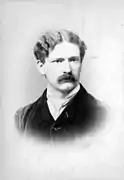
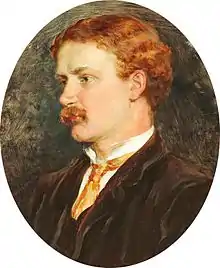 William Hamo Thornycroft, 1884 by Theodore Blake Wirgman | |
| Born | 9 March 1850 London, England |
| Died | 18 December 1925 (aged 75) Oxford, England |
| Occupation | Artist |
| Known for | Sculpture |
He was a leading figure in the movement known as the New Sculpture, which provided a transition between the neoclassical styles of the 19th century and later modernist developments.
Biography

Hamo Thornycroft was born in London into the Thornycroft family of sculptors. Both of his parents, Thomas and Mary, were distinguished sculptors. As a young child, Hamo was sent to live with an uncle on a farm in Cheshire until, aged nine, he began studying at the Modern Free Grammar School in Macclesfield before, in 1863, returning to London as a pupil at the University College School.[3] He subsequently, from 1869, studied at the Royal Academy, where his primary influence was the painter-sculptor Frederic Leighton. While a student, Thornycroft assisted his father, Thomas, on the monumental statue of Boadicea and Her Daughters beside Westminster Bridge in London.[3] At the Royal Academy Schools, Hamo Thornycroft won two medals and obtained his first paid commission for a work, a bust of a Dr. Sharpey.[3] In 1871, Thornycroft visited Italy and Paris and assisted his father in creating a large fountain, destroyed in World War II, for Park Lane in London, modelling several figures of poets in marble and bronze.[3] During the first half of the 1870s he exhibited works on a regular basis at the Royal Academy, showing Fame, the Sharpey bust, a bust of Mrs Mordaunt and a model for an equestrian statue of Lord Mayo.[3] In 1876 Thornycroft won the Gold Medal of the Royal Academy, with the statue Warrior Bearing a Wounded Youth.[4]
In 1894 the critic Edmund Gosse, coined the term "The New Sculpture" and formulated its early principles from his friendship with Thornycroft. Thornycroft created a series of statues in the ideal genre in the late 1870s and early 1880s that sought to reanimate the format of the classical statue.[5] These included Lot's Wife (1878) and Artemis and her Hound (1880 plaster, 1882 marble).[3] In 1880 he was elected an Associate of the Royal Academy,[4] and produced the Homeric bowman Teucer (1881 plaster, 1882 bronze), and the Mower (1884 plaster, 1894 bronze), arguably the first life-size freestanding statue of a contemporary labourer in 19th-century sculpture.[6] A companion piece to the Mower, the Sower was exhibited in 1886 at the Royal Academy.[3]
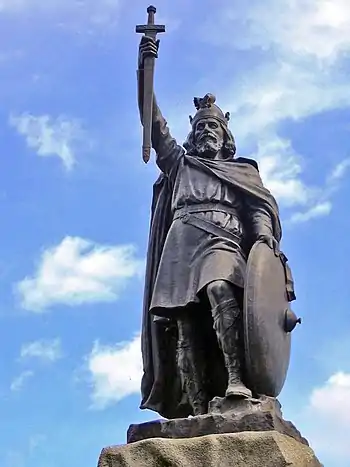
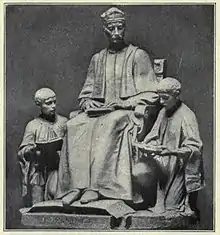
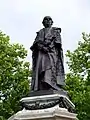
After 1884, Thornycroft's reputation was secure and he received commissions for a number of major monuments, most notably the innovative General Gordon in Trafalgar Square. He produced other significant statues including an effigy of The Bishop of Carlisle (1895; Carlisle Cathedral),[7] Oliver Cromwell (Westminster), Dean Colet (a bronze group, early Italianate in feeling, outside St Paul's School, Hammersmith), King Alfred (Winchester), the Gladstone Monument (in the Strand, London) and Dr Mandell Creighton, Bishop of London (bronze, erected in St Paul's Cathedral). Other significant memorials were built in several cities of the then British Empire.[4][8]
Thornycroft continued to be a central member of the sculptural establishment and the Royal Academy into the 20th century. He was awarded the medal of honour at the 1900 Paris Exhibition,[4] and was knighted in 1917.[8] He became increasingly resistant to new developments in sculpture, although his work of the early 1880s helped to catalyse sculpture in the United Kingdom towards those new directions. In sum, he provided an important transition between the neoclassical and academic styles of the 19th century and its fin-de-siècle and modernist departures.
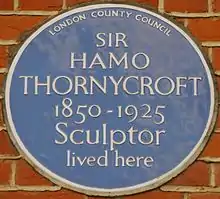
A blue plaque commemorates Thornycroft at 2b Melbury Road, Kensington,[9] his studio designed by his lifelong friend the architect John Belcher, c. 1892.[10][11]
Family
In addition to his parents, Thornycroft's grandfather John Francis was also a distinguished sculptor. His brother, Sir John Isaac Thornycroft, became a successful naval engineer; their sister, Theresa, was the mother of the poet Siegfried Sassoon; Theresa and sisters Alyce and Helen Thornycroft were artists.
In 1884, Hamo married Agatha Cox, who was fourteen years his junior. At a dinner in 1889, Agatha was introduced to Thomas Hardy, who later described her as "the most beautiful woman in England" and admitted that she was one of the models for the title character in his novel Tess of the D'Urbervilles.[12] Agatha and her husband were interested in the concept of "artistic dress", and a dress worn by her (presumed to be her wedding dress) is held in the costume collection of the Victoria & Albert Museum, donated by their daughter, Mary Elfrida Thornycroft, who was also his biographer.[3][13]
Writings
- "Lecture to the Sculpture Students of the Royal Academy of Art, 1885" reprinted in the Journal of the Walpole Society, vol. 69 (2007): 211–26.
Architectural work
The Institute of Chartered Accountants in England and Wales (ICAEW) Council commissioned Thornycroft to produce a detailed sculpted frieze for their headquarters at Chartered Accountants Hall for a cost of £3,000.[14]
Thornycroft's frieze, carved between 1889 and 1893, includes a series of figures representing Arts, Sciences, Crafts, Education, Commerce, Manufacture, Agriculture, Mining, Railways, Shipping, India, the Colonies, and Building.[15] The figure of the architect is based on the Hall's architect, John Belcher and the sculptor on Thornycroft himself. The figure of the solicitor is H. Markby of Markby, Stewart & Co., who acted for ICAEW in its early years.[16]
Selected public works
1880 to 1889
| Image | Title / subject | Location and coordinates |
Date | Type | Material | Dimensions | Designation | Wikidata | Notes |
|---|---|---|---|---|---|---|---|---|---|
 |
Stepping Stones | Kibble Palace, Glasgow Botanic Gardens | 1878 | Sculpture | Marble | ||||
 More images |
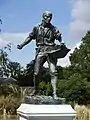
A Sower | Kew Gardens, London | 1886 | Statue on pedestal | Bronze and Portland stone | Grade II | Q27082922 | [17] | |
.JPG.webp) More images |
General Gordon | Victoria Embankment Gardens, London | 1887–88 | Statue on pedestal with plaques | Bronze and Portland stone | 3.1m (statue only) | Grade II | Q26319159 | Relocated from Trafalgar Square[18][19][20][21] |
1890 to 1899
| Image | Title / subject | Location and coordinates |
Date | Type | Material | Dimensions | Designation | Wikidata | Notes |
|---|---|---|---|---|---|---|---|---|---|
 |
John Bright | Broadfield Park, Rochdale | 1891 | Statue on pedestal | Bronze and stone | Grade II | Q26651280 | [18][22] | |
 More images |
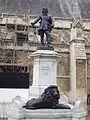
Statue of Oliver Cromwell | Outside of the Palace of Westminster, London | 1899 | Statue on pedestal with supporting figure | Bronze and Portland stone | Grade II | Q3497572 | [18][19][23] |
1900 to 1909
| Image | Title / subject | Location and coordinates |
Date | Type | Material | Dimensions | Designation | Wikidata | Notes |
|---|---|---|---|---|---|---|---|---|---|
 More images |
Alfred the Great | High Street, Winchester | 1901 | Statue on pedestal and base | Bronze and granite | Grade II | Q26461216 | [18][24][25] | |
 More images |
Dean John Colet and Two Pupils | St Paul's School, London | 1902 | Sculpture group on pedestal with canopy | Bronze and stone | Originally installed at the school's previous site in Hammersmith, relocated in 1968.[3][19] | |||
 More images |
William Ewart Gladstone | George Square, Glasgow | 1902 | Statue on pedestal with plaque | Bronze and granite | Category B | Q17792886 | [26] | |
 More images |
Memorial to William Ewart Gladstone | The Strand, London | 1905 | Statue on pedestal with supporting figures | Bronze and Portland stone | 11m tall | Grade II | Q27081590 | [18][19][27] |
 More images |
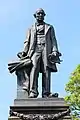
William Armstrong, 1st Baron Armstrong | Barras Bridge, Newcastle-upon-Tyne | 1905–6 | Statue with screen wall, steps and relief panels | Bronze and stone | Grade II | Q26586754 | [28][18] | |
 More images |
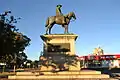
Cecil Rhodes | Kimberley, South Africa | 1907 | Equestrian statue on pedestal and steps | Bronze and stone | Q20972960 | [3][29] | ||
 More images |
Boer War Memorial | St Ann's Square, Manchester | 1908 | Sculpture group on pedestal with plaques | Bronze, granite and marble | Grade II | Q26546131 | [30][31] | |
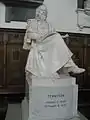 |
Alfred Lord Tennyson | Trinity College Chapel, Cambridge | 1909 | Seated statue on pedestal | Stone | [3][32] |
1910 to 1925
| Image | Title / subject | Location and coordinates |
Date | Type | Material | Dimensions | Designation | Wikidata | Notes |
|---|---|---|---|---|---|---|---|---|---|
 More images |
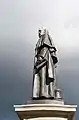
Sir Daniel Dixon, 1st Baronet | Belfast City Hall | 1910 | Statue on pedestal with plaques | Bronze and stone | Q72151439 | [3][33] | ||
 More images |
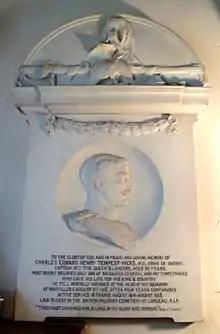
CEH Tempest-Hicks | St Mary the Virgin, Monken Hadley | c. 1922 | Memorial tablet | Marble | Q106783020 | [3][34] | ||
| Statue of Haron Baronian | Library garden, Knutsford | Unveiled 1922 | Statue on pedestal | Bronze and stone | Statue relocated twice, since 2018 part of the Great War Centenary memorial in Knutsford.[35][36][37][38] | ||||
.jpg.webp) More images |
War memorial | George Street, Luton | 1922 | Statue on cenotaph | Bronze and Portland stone | Approx. 19m tall | Grade II | Q26408428 | Architect, Sir Reginald Blomfield[39][40] |
 More images |
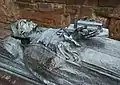
Bishop Huyshe Yeatman-Biggs | Coventry Cathedral | 1925 | Chest tomb and effigy | Bronze and stone | [18] |
Other works
- Lord Mayo, 1876, Kolkata, India, bronze equestrian statue
- Thomas Clarkson, 1877, St Mary's church, Playford, Suffolk, memorial relief in marble
- Thomas Gray, 1885, Chapel of Pembroke College, Cambridge, marble bust and bronze relief
- Sir John Goss, 1886, St Paul's Cathedral, marble panel within a larger monument by John Belcher
- Henry Bradshaw, 1887, Fitzwilliam Museum, Cambridge, marble bust
- General Gordon, 1889, Melbourne, Australia, bronze statue on pedestal
- Sir Steuart Bayley, 1894, Kolkata, marble statue
- George Leveson-Gower, exhibited 1895, unveiled 1896, Central Lobby, Houses of Parliament, marble statue[3]
- Bishop Harvey Goodwin, 1895, Carlisle Cathedral, bronze effigy with figures[7]
- Queen Victoria, 1899, Durban, South Africa, marble statue on stone pedestal with bronze figures.[41]
- Boer War memorial, 1905, Durban, bronze figure of Peace descending on pedestal with figures and reliefs
- Bishop Mandell Creighton, 1905, St Paul's Cathedral, London, bronze statue[3]
- Queen Victoria, 1906, Karachi, Pakistan, marble statue and pedestal with bronze figures and relief panels, removed 1962.[42]
- Bishop Mandell Creighton, 1909, Lambeth Palace, London, bronze bust
- George V as the Prince of Wales, 1911, Kolkata, marble statue
- Lord Curzon, 1912, Kolkata, bronze statue on Portland stone pedestal with figures and reliefs, partly dismantled
- Thomas Hardy, 1915, National Portrait Gallery, London, bust[3]
- Edward VII, 1916, Karachi, marble statue on pedestal with bronze groups, dismantled.[3]
Gallery
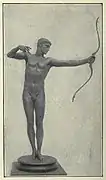 The bronze statue of Homeric bowman Teucer (1882)[4]
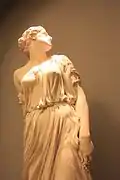 Lot's Wife by Hamo Thornycroft, Victoria & Albert Museum, 1878.[4] Previously located in Leighton House.[44]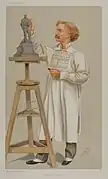
References
- "The Cromwell Statue at Westminster - Icons of England". 14 March 2009. Archived from the original on 14 March 2009. Retrieved 17 November 2021.
- Jan Marsh (2016). "Later Victorian Portraits Catalogue". National Portrait Gallery. Retrieved 15 September 2016.
- Elfrida Manning (1982). Marble & Bronze: The Art and Life of Hamo Thornycroft. London: Trefoil Books. ISBN 978-0-89860-072-8.
- Marion Harry Alexander Spielmann (1911). . In Chisholm, Hugh (ed.). Encyclopædia Britannica. 26 (11th ed.). Cambridge University Press. p. 881.
- David Getsy (2004). Body Doubles: Sculpture in Britain, 1877–1905. New Haven and London: Yale University Press.
- David Getsy (2002). "The Difficult Labor of Hamo Thornycroft's 'Mower', 1884". Sculpture Journal. 7: 53–76.
- Jacqueline Banerjee (18 July 2014). "Monument to Bishop Harvey Goodwin by Sir W. Hamo Thornycroft, Carlisle Cathedral". The Victorian Web. Retrieved 23 February 2021.
-
 Chisholm, Hugh, ed. (1922). "Thornycroft, Sir William Hamo". Encyclopædia Britannica. 32 (12th ed.). London & New York: The Encyclopædia Britannica Company. p. 722.
 - "THORNYCROFT, SIR HAMO (1850-1925)". English Heritage. Retrieved 1 July 2012.
- "Sir Hamo Thornycroft's studio, 2a Melbury Road, Holland Park, London". RIBApix. Architectural Press Archive / RIBA Collections. 1892. Retrieved 12 September 2016.
- "The Holland estate: Since 1874, in Survey of London: Volume 37, Northern Kensington". British History Online. F H W Sheppard (London). 1973. pp. 126–150. Retrieved 15 September 2016.
- Max Egremont (22 May 2014). Siegfried Sassoon: A Biography. Pan Macmillan. p. 635. ISBN 978-1-4472-3478-4.
- Robyne Erica Calvert (2012). "Fashioning the artist: artistic dress in Victorian Britain 1848-1900" (PDF). University of Glasgow PhD thesis. Retrieved 21 October 2017.
- "Friezes (ornamental bands)". Art & Architecture. The Courtauld Institute of Art. Retrieved 10 October 2018.
- Liz Pile. "Chartered Accountants' Hall - Analysis - A building of distinction". Accountancy Daily. Croner-i. Retrieved 10 October 2018.
- Harold Howitt (1966). The History of the Institute of Chartered Accountants in England and Wales 1880-1965 and of its founder Accountancy Bodies 1870-1880: The Growth of a Profession and its Influence on Legislation and Public Affairs. London: Heinemann. p. 206.
- Historic England. "The Sower (1262481)". National Heritage List for England. Retrieved 17 November 2021.
- Jo Darke (1991). The Monument Guide to England and Wales. Macdonald Illustrated. ISBN 0-356-17609-6.
- John Blackwood (1989). London's Immortals. The Complete Outdoor Commemorative Statues. Savoy Press. ISBN 0951429604.
- Historic England. "Statue of General Gordon (1066175)". National Heritage List for England. Retrieved 17 November 2021.
- "War Memorials Register: Maj Gen CG Gordon". Imperial War Museum. Retrieved 17 November 2021.
- Historic England. "Statue of John Bright (1370017)". National Heritage List for England. Retrieved 17 November 2021.
- Historic England. "Statue of Oliver Cromwell in front of Westminster Hall (1226285)". National Heritage List for England. Retrieved 17 November 2021.
- "Alfred the Great (849-899)". The Victorian Web. 20 August 2009. Retrieved 15 September 2016.
- Historic England. "Statue of Alfred the Great (1167789)". National Heritage List for England. Retrieved 17 November 2021.
- Historic Environment Scotland. "George Square, William Ewart Gladstone Statue (Category B Listed Building) (LB32695)". Retrieved 17 November 2021.
- Historic England. "Statue of WE Gladstone on island in road (1237098)". National Heritage List for England. Retrieved 18 November 2021.
- Historic England. "Armstrong Memorial (1299341)". National Heritage List for England. Retrieved 17 November 2021.
- "Cecil John Rhodes on Horse - bronze statue". Solomon Edwardian Guest House. Retrieved 28 February 2016.
- Historic England. "War Memorial (Boer War) (1254462)". National Heritage List for England. Retrieved 17 November 2021.
- "War Memorials Register: Manchester Regiment South African War - The Last Shot". Imperial War Museum. Retrieved 17 November 2021.
- "Alfred, Lord Tennyson". TrinityCollegeChapel. Trinity College Cambridge. Retrieved 15 September 2016.
- "Memorials and Statues". Belfast City Council. Retrieved 17 November 2021.
- "War Memorials Register: CEH Tempest-Hicks - St Mary the Virgin". Imperial War Museum. Retrieved 18 November 2021.
- "Centennial War Memorial unveiled in Knutsford Library gardens". 8 October 2018. Retrieved 18 November 2021.
- "War Memorials Register: H Baronian". Imperial War Museum. Retrieved 18 November 2021.
- "War Memorials Register: Knutsford War Memorial Hospital". Imperial War Museum. Retrieved 18 November 2021.
- "War Memorials Register: Knutsford Great War Centenary". Imperial War Museum. Retrieved 18 November 2021.
- "War Memorials Register: Borough of Luton War Memorial". Imperial War Museum. Retrieved 18 November 2021.
- Historic England. "War Memorial (1114644)". National Heritage List for England. Retrieved 17 November 2021.
- "Statue of Queen Victoria 1899". Yale Centre for British Art. Retrieved 19 November 2021.
- "Statue of Queen Victoria 1906". Yale Centre for British Art. Retrieved 19 November 2021.
- "Hamo Thornycroft". National Portrait Gallery. National Portrait Gallery, London. 2016. Retrieved 15 September 2016.
albumen cabinet card, 1880s
- "Statue of Lot's Wife". The Courthauld Gallery. Conway Library, Courtauld Institute of Art: The Courtauld Institute of Art, London. Retrieved 15 September 2016.
Location England, London, Leighton House
- "Sir (William) Hamo Thornycroft ('Men of the Day. No. 533.')". National Portrait Gallery. National Portrait Gallery, London. 2016. Retrieved 15 September 2016.
published in Vanity Fair 20 February 1892
Further reading
- Dakers, Caroline (1999). The Holland Park Circle: Artists and Victorian Society. Yale University Press. ISBN 978-0-300-08164-0.
- "W. H. Thornycroft, A.R.A." Victorian Artists at Home. Emory University. 2021. Retrieved 8 February 2021.
- Beattie, Susan. The New Sculpture. New Haven: Yale University Press, 1983.
- Friedman, Terry, ed. The Alliance of Sculpture and Architecture. Leeds: Henry Moore Institute, 1993.
- Getsy, David, "The Problem of Realism in Hamo Thornycroft's 1885 Royal Academy Lecture," The Walpole Society 69 (2007): 211–25.
- Gosse, Edmund. "Our Living Artists: Hamo Thornycroft, A.R.A." Magazine of Art, 1881, pp. 328–32.
- Read, Benedict. Victorian Sculpture. New Haven: Yale University Press, 1982.
- White, Adam. Hamo Thornycroft and the Martyr General. Leeds: Henry Moore Institute, 1991.
External links
 |
Wikimedia Commons has media related to Hamo Thornycroft. |
- 91 artworks by or after Hamo Thornycroft at the Art UK site
- Papers of the Thornycroft Family, in the Archive of Sculptors Papers at the Henry Moore Institute, Leeds
- Thornycroft works in the Tate Collection, London
- The Victorian Web, featuring links to images of works
- "Archival material relating to Hamo Thornycroft". UK National Archives.

- Portraits of Hamo Thornycroft at the National Portrait Gallery, London
Authority control | |
|---|---|
| General | |
| National libraries | |
| Art galleries and museums | |
| Art research institutes | |
| Other | |