Haplogroup O-M176
Haplogroup O-M176 (aka O-SRY465) or O1b2 is a human Y-chromosome DNA haplogroup. It is best known for its part in the settlement of Korea and Japan. It is a descendant of Haplogroup O-P31, and it has been estimated to share a most recent common ancestor with its nearest outgroup, Haplogroup O-K18, approximately 28,300 [95% CI 26,100 <-> 30,600] years before present.[1]
| Haplogroup O-M176 | |
|---|---|
| Possible time of origin | 28,300 [95% CI 26,100 <-> 30,600] years before present[1] |
| Coalescence age | 25,800 [95% CI 23,300 <-> 28,400] years before present (YFull[1][2]) |
| Possible place of origin | Manchuria or a nearby part of northern East Asia[3][4] |
| Ancestor | O-P31 |
| Defining mutations | M176/SRY465, P49, 022454 |
| Highest frequencies | Japanese, Koreans, Ryukyuans, Manchus
|
Distribution
Haplogroup O-M176 is found mainly in the northernmost parts of East Asia, from the Uriankhai and Zakhchin peoples of western Mongolia (Katoh et al. 2005) to the Japanese of Japan, though it also has been detected sporadically in the Buryats (Jin et al. 2003). It's been detected with moderate frequencies in Udegeys (Jin 2010) of southern Siberia, rarely among populations of Southeast Asia including Indonesia (Hammer et al. 2006 and Jin et al. 2003), the Philippines (Jin et al. 2003), Thailand (Jin et al. 2003), and Vietnam (Hammer et al. 2006 and Jin et al. 2003), and Micronesians (Hammer et al. 2006). This haplogroup is found with its highest frequency and diversity values among modern populations of Japan and Korea and is rare in most populations in China. Among Han Chinese, it has been detected in some samples of Han Chinese from Beijing (1/51, Jin et al. 2003 and Kim et al. 2011 harvnb error: multiple targets (2×): CITEREFKimKimShinJin2011 (help)),[3] Xi'an (1/34, Kim et al. 2011 harvnb error: multiple targets (2×): CITEREFKimKimShinJin2011 (help)),[3] one Han Chinese in Henan,[14] Han Chinese in Taiwan (2/352 = 0.57%, including one of 34 Hakka people and one of 258 miscellaneous Han volunteers),[15] Han Chinese from East China sampled from the infertility clinic at the Affiliated Hospitals of Nanjing Medical University at Jiangsu (6/1147 = 0.52%, Lu 2009), Wuhan (1/160),[16] and South China outside of Jiangsu, Anhui, Zhejiang, and Shanghai (1/65).[17] Among ethnic minorities in China, haplogroup O-M176 has been detected with high frequency in samples of Koreans in China (Xue et al. 2006 and Katoh et al. 2005) and with generally much lower frequency among Manchus (Xue et al. 2006, Katoh et al. 2005, and Karafet et al. 2001), Hezhe people,[9] Daurs,[9] Evenks,[8] Sibes (Xue et al. 2006), Kham Tibetans,[18] and Hui.[19] In a study of various populations of Hunan, O1b2-M176 was found in 0.55% (5/903) of all samples; specifically, this haplogroup was observed in 3.0% (1/33) of a sample of Iu Mien from Hunan, 1.9% (2/103) of a sample of Gàn Chinese from Hunan, 1.4% (1/71) of a sample of Kam from Hunan, and 1.1% (1/95) of a sample of Xong Miao from Hunan.[20] In a study published in July 2020, Y-DNA belonging to haplogroup O1b2-M176 was observed in 1.31% (4/305) of a sample of Han Chinese from Zibo, Shandong and in 1.06% (6/565) of a sample of Han Chinese from Zhaotong, Yunnan.[21]
Mitsuru Sakitani suggests that haplogroup O1b2, which is common in today Koreans, Japanese and Manchu, are one of the carriers of Liao civilization or Yangtze civilization. As the Liao civilization and the Yangtze civilization declined several tribes crossed westward and northerly, to the Korean Peninsula and the Japanese archipelago.[22][23][24] Another study calls the haplogroup O1b1 as the major Austroasiatic paternal lineage and the haplogroup O1b2 (of Koreans and Japanese) as the "para-Austroasiatic" paternal lineage.[25]
Paragroup O-M176*
Y-DNA that belongs to O-M176(xK10, F3356) has been found in an individual from Hiroshima,[2] an individual from Fukushima,[2] an individual from Beijing,[2] and 1% (7/706) of a sample of males collected in Seoul and Daejeon.[26]
O-M176(x47z) has been found in approximately 3.5%[27] to 9.9%[28] of Japanese males. However, most of those individuals probably belong to subclades of O-K10(x47z).
O-K10
The majority of extant members of O-M176 belong to the subclade O-K10 (or O-F3356). O-K10 subsumes the prolific subclades O-47z, which occurs with especially high frequency in Japan, and O-L682, which occurs with especially high frequency in Korea, in addition to a relatively rare subclade, O-K3, which has been found among Han Chinese in Hunan,[2] Jiangxi,[2] and Henan.[29] O-L682 and O-K3 are linked by 18 SNPs that define the O-K4 clade, and thus their members are more closely related to one another by paternal lineage than any of them is related to any member of O-47z.
An example of Y-DNA that belongs to O-K10 but neither O-47z nor O-K4 has been found in an individual in Tokyo, Japan. This individual's Y-DNA is estimated to share a most recent common ancestor with O-47z and O-K4 roughly around the same time as the most recent common ancestor of those latter two clades, about 7,200 [95% CI 6,200 <-> 8,200] ybp.[1]
O-F3356(x47z, L682) has been found in 2% (14/706) of a sample of Koreans collected in Seoul and Daejeon, South Korea.[26] However, the status of these individuals' Y-DNA in regard to K4, K3, and phylogenetically equivalent SNPs has not been published.
O-47z
| Haplogroup O-47z | |
|---|---|
| Possible time of origin | 7,870 [95% CI 5,720–12,630] years ago (Hammer et al. 2006) 7,100 [95% CI 6,100 <-> 8,300] ybp[1] |
| Possible place of origin | Japanese Archipelago(Hammer et al. 2006) or Korean Peninsula(see Jin et al. 2003) |
| Ancestor | O-M176 |
| Defining mutations | 47z |
| Highest frequencies | Japanese, Ryukyuans, Koreans, Manchus
|
O-47z or O-CTS11986 is a subclade of O-K10. It is found with high frequency among the Japanese and Ryukyuan populations of Japan, and with lower frequency among Koreans.
Haplogroup O-47z has been detected in approximately 24% of males who speak a Japonic language, while it has not been found at all among Ainu males whose Y-DNA has been tested in two genetic studies (Tajima 2004, n=16; Hammer et al. 2006, n=4). Based on the STR haplotype diversity within Haplogroup O-47z, it has been estimated in a study published in 2006 that this haplogroup has expanded from a single founder who has lived approximately 3,810 (95% CI 1,640 <–> 7,960) years before present in a model according to which continuous, pure exponential population growth is assumed.[8] In a paper published in 2016, the time to most recent common ancestor of a set of fifteen members of the O-47z clade, all from the JPT (Japanese in Tokyo, Japan) sample of the 1000 Genomes Project, was estimated to be 4,500 years using a relatively slow mutation rate (μ = 0.76 x 10⁻⁹ per bp per year as according to Qiaomei Fu et al. 2014) or 3,900 years using a relatively fast mutation rate (μ = 0.888 x 10⁻⁹ per bp per year as according to A. Helgason et al. 2015).[27] Haplogroup O-47z also has been found among samples of modern Koreans, though with low frequency in comparison to both the frequency of O-47z in samples of Japanese and the frequency of O-M176(x47z) in samples of Koreans.[30]
O-K4
O-K4 is a subclade of O-K10. It includes at least two subclades, O-L682 and O-K3, which have been estimated to share a most recent common ancestor approximately 6,100 [95% CI 5,000 <-> 7,200] years before present.[2]
O-K3
| Haplogroup O-F940 | |
|---|---|
| Possible time of origin | 3,500 [2,000-13,000] |
| Possible place of origin | Manchuria or Korean Peninsula |
| Ancestor | O-F2868 |
| Defining mutations | CTS12145, F1912, F2206, F2703, F940, K3 |
| Highest frequencies | Manchurian, Manchu Mongolian, Manchu Han
|
The O-K3 (or O-F940) lineage is a subclade of O-K4 that has been observed to date in three individuals from Hunan,[2] one individual from Jiangxi,[2] and one individual from Henan.[29] The TMRCA of the three individuals from Hunan plus the one individual from Jiangxi has been estimated to be 1,250 (95% CI 750 <-> 1950) ybp.[2]
O-L682
| Haplogroup O-L682 | |
|---|---|
| Possible time of origin | 6,300 [95% CI 4,700 <-> 8,000] ybp[1] |
| Possible place of origin | Korean Peninsula or Manchuria |
| Ancestor | O-M176, O-F3356 |
| Defining mutations | L682 |
| Highest frequencies | Koreans, Hezhen, Udege, Japanese, Ryukyuans, Manchus
|
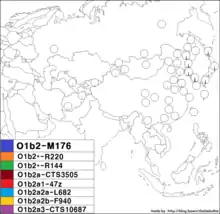
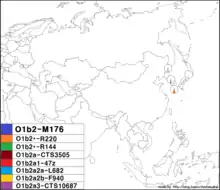
The O-L682 subclade of O-K4 is believed to be related to Native Korean population. One study has found O-L682 Y-DNA in 19% (134/706) of Koreans sampled in Seoul and Daejeon.[26] O-L682 also has been found in Japanese in Tokyo, Okayama, Kōchi, and the US, Chinese in Shanxi, Shandong, and Beijing,[2] and Nanai people in China. Its descendants appear to have begun rapidly increasing in number at approximately the same time as those of its distant cousin O-47z, perhaps 4,000 years ago.[2]
Phylogenetics
Phylogenetic history
Prior to 2002, there were in academic literature at least seven naming systems for the Y-Chromosome phylogenetic tree. This led to considerable confusion. In 2002, the major research groups came together and formed the Y-Chromosome Consortium (YCC). They published a joint paper that created a single new tree that all agreed to use. Later, a group of citizen scientists with an interest in population genetics and genetic genealogy formed a working group to create an amateur tree aiming at being above all timely. The table below brings together all of these works at the point of the landmark 2002 YCC Tree. This allows a researcher reviewing older published literature to quickly move between nomenclatures.
| YCC 2002/2008 (Shorthand) | (α) | (β) | (γ) | (δ) | (ε) | (ζ) | (η) | YCC 2002 (Longhand) | YCC 2005 (Longhand) | YCC 2008 (Longhand) | YCC 2010r (Longhand) | ISOGG 2006 | ISOGG 2007 | ISOGG 2008 | ISOGG 2009 | ISOGG 2010 | ISOGG 2011 | ISOGG 2012 |
|---|---|---|---|---|---|---|---|---|---|---|---|---|---|---|---|---|---|---|
| O-M175 | 26 | VII | 1U | 28 | Eu16 | H9 | I | O* | O | O | O | O | O | O | O | O | O | O |
| O-M119 | 26 | VII | 1U | 32 | Eu16 | H9 | H | O1* | O1a | O1a | O1a | O1a | O1a | O1a | O1a | O1a | O1a | O1a |
| O-M101 | 26 | VII | 1U | 32 | Eu16 | H9 | H | O1a | O1a1 | O1a1a | O1a1a | O1a1 | O1a1 | O1a1a | O1a1a | O1a1a | O1a1a | O1a1a |
| O-M50 | 26 | VII | 1U | 32 | Eu16 | H10 | H | O1b | O1a2 | O1a2 | O1a2 | O1a2 | O1a2 | O1a2 | O1a2 | O1a2 | O1a2 | O1a2 |
| O-P31 | 26 | VII | 1U | 33 | Eu16 | H5 | I | O2* | O2 | O2 | O2 | O2 | O2 | O2 | O2 | O2 | O2 | O2 |
| O-M95 | 26 | VII | 1U | 34 | Eu16 | H11 | G | O2a* | O2a | O2a | O2a | O2a | O2a | O2a | O2a | O2a | O2a1 | O2a1 |
| O-M88 | 26 | VII | 1U | 34 | Eu16 | H12 | G | O2a1 | O2a1 | O2a1 | O2a1 | O2a1 | O2a1 | O2a1 | O2a1 | O2a1 | O2a1a | O2a1a |
| O-SRY465 | 20 | VII | 1U | 35 | Eu16 | H5 | I | O2b* | O2b | O2b | O2b | O2b | O2b | O2b | O2b | O2b | O2b | O2b |
| O-47z | 5 | VII | 1U | 26 | Eu16 | H5 | I | O2b1 | O2b1a | O2b1 | O2b1 | O2b1a | O2b1a | O2b1 | O2b1 | O2b1 | O2b1 | O2b1 |
| O-M122 | 26 | VII | 1U | 29 | Eu16 | H6 | L | O3* | O3 | O3 | O3 | O3 | O3 | O3 | O3 | O3 | O3 | O3 |
| O-M121 | 26 | VII | 1U | 29 | Eu16 | H6 | L | O3a | O3a | O3a1 | O3a1 | O3a1 | O3a1 | O3a1 | O3a1 | O3a1 | O3a1a | O3a1a |
| O-M164 | 26 | VII | 1U | 29 | Eu16 | H6 | L | O3b | O3b | O3a2 | O3a2 | O3a2 | O3a2 | O3a2 | O3a2 | O3a2 | O3a1b | O3a1b |
| O-M159 | 13 | VII | 1U | 31 | Eu16 | H6 | L | O3c | O3c | O3a3a | O3a3a | O3a3 | O3a3 | O3a3a | O3a3a | O3a3a | O3a3a | O3a3a |
| O-M7 | 26 | VII | 1U | 29 | Eu16 | H7 | L | O3d* | O3c | O3a3b | O3a3b | O3a4 | O3a4 | O3a3b | O3a3b | O3a3b | O3a2b | O3a2b |
| O-M113 | 26 | VII | 1U | 29 | Eu16 | H7 | L | O3d1 | O3c1 | O3a3b1 | O3a3b1 | - | O3a4a | O3a3b1 | O3a3b1 | O3a3b1 | O3a2b1 | O3a2b1 |
| O-M134 | 26 | VII | 1U | 30 | Eu16 | H8 | L | O3e* | O3d | O3a3c | O3a3c | O3a5 | O3a5 | O3a3c | O3a3c | O3a3c | O3a2c1 | O3a2c1 |
| O-M117 | 26 | VII | 1U | 30 | Eu16 | H8 | L | O3e1* | O3d1 | O3a3c1 | O3a3c1 | O3a5a | O3a5a | O3a3c1 | O3a3c1 | O3a3c1 | O3a2c1a | O3a2c1a |
| O-M162 | 26 | VII | 1U | 30 | Eu16 | H8 | L | O3e1a | O3d1a | O3a3c1a | O3a3c1a | O3a5a1 | O3a5a1 | O3a3c1a | O3a3c1a | O3a3c1a | O3a2c1a1 | O3a2c1a1 |
Original research publications
The following research teams per their publications were represented in the creation of the YCC Tree.
Phylogenetic trees
This phylogenetic tree of haplogroup O subclades is based on the YCC 2008 tree (Karafet 2008) and subsequent published research.
- O1b2 (IMS-JST022454, L272.2, M176/Page63/SRY465, M302, P49, F1942/Page92)
- O1b2a (F1942/Page92)
- O1b2a1 (CTS9259)
- O1b2a1a (F3356)
- O1b2a1a1 (47z, CTS713, CTS11986)
- O1b2a1a2 (F2868, F3110, K4)
- O1b2a1a2a (L682)
- O1b2a1a2b (F940, F1912, F3390)
- O1b2a1a3 (CTS10687, F1813, F1800)
- O1b2a1b (CTS562)
- O1b2a1a (F3356)
- O1b2a2 (Page90)
- O1b2a1 (CTS9259)
- O1b2a (F1942/Page92)
Table of frequencies of O-M176
| Population | Frequency | Sample Size | SNPs | Source |
|---|---|---|---|---|
| Korean (Gangwon) | 0.397 | 63 | M176(x47z)=20 47z=5 | Kim et al. 2011 harvnb error: multiple targets (2×): CITEREFKimKimShinJin2011 (help) |
| Korean (National Biobank of Korea) | 0.377 | 300 | M176(x47z)=88 47z=25 | Park 2013 |
| South Korea | 0.373 | 75 | M176/P49(x47z)=25 47z=3 | Hammer et al. 2006 |
| Japanese (Shizuoka) | 0.344 | 61 | 47z=13 M176/P49(x47z)=8 | Hammer et al. 2006 |
| Korean (Daejeon) | 0.338 | 133 | M176(x47z)=30 47z=15 | Park 2012 |
| Japanese | 0.335 | 263 | 47z=66 M176/JST022454(x47z)=22 | Nonaka, Minaguchi & Takezaki 2007 |
| Korean (Jeju) | 0.322 | 87 | M176(x47z)=20 47z=8 | Kim et al. 2011 harvnb error: multiple targets (2×): CITEREFKimKimShinJin2011 (help) |
| Japanese (Kyushu) | 0.321 | 53 | 47z=15 M176/P49(x47z)=2 | Hammer et al. 2006 |
| Korean (Seoul) | 0.316 | 573 | M176(x47z)=125 47z=56 | Park 2012 |
| Korean (Jeolla) | 0.311 | 90 | M176(x47z)=21 47z=7 | Kim et al. 2011 harvnb error: multiple targets (2×): CITEREFKimKimShinJin2011 (help) |
| Japanese (Aomori) | 0.308 | 26 | 47z=7 M176/P49(x47z)=1 | Hammer et al. 2006 |
| Korean (Chungcheong) | 0.306 | 72 | M176(x47z)=15 47z=7 | Kim et al. 2011 harvnb error: multiple targets (2×): CITEREFKimKimShinJin2011 (help) |
| Japanese (Tokushima) | 0.300 | 70 | 47z=17 M176/P49(x47z)=4 | Hammer et al. 2006 |
| Korean (Gyeongsang) | 0.298 | 84 | M176(x47z)=15 47z=10 | Kim et al. 2011 harvnb error: multiple targets (2×): CITEREFKimKimShinJin2011 (help) |
| Japanese | 0.293 | 157 | 47z=38 M176(x47z)=8 | Kim et al. 2011 harvnb error: multiple targets (2×): CITEREFKimKimShinJin2011 (help) |
| Korean (Seoul/Gyeonggi) | 0.282 | 110 | M176(x47z)=23 47z=8 | Kim et al. 2011 harvnb error: multiple targets (2×): CITEREFKimKimShinJin2011 (help) |
| Korean (PRC) | 0.280 | 25 | M176(x47z)=5 47z=2 | Xue et al. 2006 |
| Korean (Korea) | 0.279 | 43 | M176(x47z)=6 47z=6 | Xue et al. 2006 |
| Japanese | 0.277 | 47 | 47z=11 M176(x47z)=2 | Xue et al. 2006 |
| Manchurians | 0.271 | 48 | 47z=9 M176(x47z)=4 | Jin, Kim & Kim 2009 |
| Korean (Seoul & Daejeon) | 0.269 | 216 | M176(x47z)=37 47z=21 | Kim et al. 2007 |
| Japanese | 0.262 | 107 | 47z=21 M176(x47z)=7 | Jin, Kim & Kim 2009 |
| Okinawa | 0.222 | 45 | 47z=5 M176/P49(x47z)=5 | Hammer et al. 2006 |
| Korean | 0.201 | 154 | M176(x47z)=22 47z=9 | Jin, Kim & Kim 2009 |
| Udeges | 0.095 | 21 | M176(x47z)=2 | Jin 2010 |
| Han (Beijing) | 0.020 | 51 | M176(x47z)=1 | Kim et al. 2011 harvnb error: multiple targets (2×): CITEREFKimKimShinJin2011 (help) |
| Manchu | 0.057 | 35 | M176(x47z)=2 | Xue et al. 2006 |
| Uriankhai (Mongolia) | 0.050 | 60 | M176=3 | Katoh et al. 2005 |
| Mongol (NE Mongolia) | 0.050 | 20 | M176=1 | DiCristofaro 2013 |
| Hezhe (PRC) | 0.044 | 45 | M176(x47z)=2 | Xue et al. 2006 |
| Manchu | 0.038 | 52 | M176/P49(x47z)=2 | Hammer et al. 2006 |
| Zakhchin (Mongolia) | 0.033 | 60 | M176=2 | Katoh et al. 2005 |
| Manchurian | 0.033 | 30 | M176(x47z)=1 | Kim et al. 2011 harvnb error: multiple targets (2×): CITEREFKimKimShinJin2011 (help) |
| Hakka (Taiwan) | 0.029 | 34 | M176=1 | Trejaut et al. 2014 |
| Buryat | 0.028 | 36 | M176(x47z)=1 | Kim et al. 2011 harvnb error: multiple targets (2×): CITEREFKimKimShinJin2011 (help) |
| Nanai (Samar from Khabarovsk) | ≤0.027 | 37 | O-P31=1 | Bogunov et al. 2015 |
| Daur | 0.026 | 39 | M176(x47z)=1 | Xue et al. 2006 |
| Evenk (PRC) | 0.024 | 41 | M176/P49(x47z)=1 | Hammer et al. 2006 |
| Xibe | 0.024 | 41 | M176(x47z)=1 | Xue et al. 2006 |
| Buryat | 0.020 | 50 | M176(x47z)=1 | Jin, Kim & Kim 2009 |
| Mongols (Mongolia) | 0.006 | 160 | M176=1 | DiCristofaro 2013 |
| Han (Taiwan) | 0.004 | 258 | M176=1 | Trejaut et al. 2014 |
| Zhuang | 0.000 | 20 | M176/P49=0 | Hammer et al. 2006 |
| Oroqen | 0.000 | 22 | M176/P49=0 | Hammer et al. 2006 |
| Hanoi, Vietnam | 0.000 | 24 | M176=0 | Trejaut et al. 2014 |
| Kalimantan | 0.000 | 25 | M176=0 | Trejaut et al. 2014 |
| Evenk (PRC) | 0.000 | 26 | M176=0 | Xue et al. 2006 |
| Sumatra | 0.000 | 26 | M176=0 | Trejaut et al. 2014 |
| Akha (Thailand) | 0.000 | 27 | M176=0 | Trejaut et al. 2014 |
| Alor | 0.000 | 28 | M176=0 | Karafet 2010 |
| Han (Lanzhou) | 0.000 | 30 | M176=0 | Xue et al. 2006 |
| Even | 0.000 | 31 | M176/P49=0 | Hammer et al. 2006 |
| Oroqen | 0.000 | 31 | M176=0 | Xue et al. 2006 |
| Uyghur (Ürümqi) | 0.000 | 31 | M176=0 | Xue et al. 2006 |
| Han (Yili) | 0.000 | 32 | M176=0 | Xue et al. 2006 |
| Malay | 0.000 | 32 | M176/P49=0 | Hammer et al. 2006 |
| Australian aborigines | 0.000 | 33 | M176/P49=0 | Hammer et al. 2006 |
| Qiang | 0.000 | 33 | M176=0 | Xue et al. 2006 |
| Han (Chengdu) | 0.000 | 34 | M176=0 | Xue et al. 2006 |
| Hani (PRC) | 0.000 | 34 | M176=0 | Xue et al. 2006 |
| Li | 0.000 | 34 | M176=0 | Xue et al. 2006 |
| She | 0.000 | 34 | M176=0 | Xue et al. 2006 |
| Buyi | 0.000 | 35 | M176=0 | Xue et al. 2006 |
| Han (Harbin) | 0.000 | 35 | M176=0 | Xue et al. 2006 |
| Han (Meixian) | 0.000 | 35 | M176=0 | Xue et al. 2006 |
| Hui (PRC) | 0.000 | 35 | M176=0 | Xue et al. 2006 |
| Tibetan | 0.000 | 35 | M176=0 | Xue et al. 2006 |
| Yao (Bama) | 0.000 | 35 | M176=0 | Xue et al. 2006 |
| Yao (Liannan) | 0.000 | 35 | M176=0 | Xue et al. 2006 |
| Batak Toba (Sumatra) | 0.000 | 38 | M176=0 | Karafet 2010 |
| Uyghur (Yili) | 0.000 | 39 | M176=0 | Xue et al. 2006 |
| East Indonesia | 0.000 | 40 | M176=0 | Trejaut et al. 2014 |
| Han (Guangdong) | 0.000 | 40 | M176/P49=0 | Hammer et al. 2006 |
| Yi (Butuo, Sichuan) | 0.000 | 43 | M176/P49=0 | Hammer et al. 2006 |
| Northern Han | 0.000 | 44 | M176/P49=0 | Hammer et al. 2006 |
| Khalkh | 0.000 | 45 | M176=0 | Kim et al. 2011 harvnb error: multiple targets (2×): CITEREFKimKimShinJin2011 (help) |
| Mongol (Inner Mongolia) | 0.000 | 45 | M176=0 | Xue et al. 2006 |
| Papua New Guinea | 0.000 | 46 | M176/P49=0 | Hammer et al. 2006 |
| Khalkh | 0.000 | 48 | M176=0 | Jin, Kim & Kim 2009 |
| Philippines | 0.000 | 48 | M176/P49=0 | Hammer et al. 2006 |
| Taiwanese aborigines | 0.000 | 48 | M176/P49=0 | Hammer et al. 2006 |
| Tujia | 0.000 | 49 | M176/P49=0 | Hammer et al. 2006 |
| She | 0.000 | 51 | M176/P49=0 | Hammer et al. 2006 |
| Melanesia | 0.000 | 53 | M176/P49=0 | Hammer et al. 2006 |
| Mandar (Sulawesi) | 0.000 | 54 | M176=0 | Karafet 2010 |
| Han (Fujian) | 0.000 | 55 | M176=0 | Trejaut et al. 2014 |
| Indonesia (East) | 0.000 | 55 | M176/P49=0 | Hammer et al. 2006 |
| Miao | 0.000 | 58 | M176/P49=0 | Hammer et al. 2006 |
| Han (Yunnan) | 0.000 | 60 | M176=0 | Kim et al. 2011 harvnb error: multiple targets (2×): CITEREFKimKimShinJin2011 (help) |
| Minnan (Taiwan) | 0.000 | 60 | M176=0 | Trejaut et al. 2014 |
| Nias | 0.000 | 60 | M176=0 | Karafet 2010 |
| Polynesia | 0.000 | 60 | M176/P49=0 | Hammer et al. 2006 |
| Yao | 0.000 | 60 | M176/P49=0 | Hammer et al. 2006 |
| Java | 0.000 | 61 | M176=0 | Karafet 2010 |
| Filipino | 0.000 | 64 | M176=0 | Kim et al. 2011 harvnb error: multiple targets (2×): CITEREFKimKimShinJin2011 (help) |
| Mongol (Outer Mongolia) | 0.000 | 65 | M176=0 | Xue et al. 2006 |
| Uyghur | 0.000 | 67 | M176/P49=0 | Hammer et al. 2006 |
| Mentawai | 0.000 | 74 | M176=0 | Karafet 2010 |
| Thailand | 0.000 | 75 | M176=0 | Trejaut et al. 2014 |
| Buryat | 0.000 | 81 | M176/P49=0 | Hammer et al. 2006 |
| Han (Taiwan) | 0.000 | 84 | M176/P49=0 | Hammer et al. 2006 |
| Borneo | 0.000 | 86 | M176=0 | Karafet 2010 |
| Sri Lanka | 0.000 | 91 | M176/P49=0 | Hammer et al. 2006 |
| Lembata | 0.000 | 92 | M176=0 | Karafet 2010 |
| Evenk (Russia) | 0.000 | 95 | M176/P49=0 | Hammer et al. 2006 |
| Altai | 0.000 | 98 | M176/P49=0 | Hammer et al. 2006 |
| Tibet | 0.000 | 105 | M176/P49=0 | Hammer et al. 2006 |
| Java | 0.000 | 141 | M176=0 | Trejaut et al. 2014 |
| Philippines | 0.000 | 146 | M176=0 | Trejaut et al. 2014 |
| Mongolia | 0.000 | 149 | M176/P49=0 | Hammer et al. 2006 |
| Sumba | 0.000 | 350 | M176=0 | Karafet 2010 |
| Taiwan mountain tribes | 0.000 | 355 | M176=0 | Trejaut et al. 2014 |
| Taiwan plains tribes | 0.000 | 370 | M176=0 | Trejaut et al. 2014 |
| Flores | 0.000 | 394 | M176=0 | Karafet 2010 |
| India | 0.000 | 405 | M176/P49=0 | Hammer et al. 2006 |
| Bali | 0.000 | 641 | M176=0 | Karafet 2010 |
See also
Genetics
Y-DNA O subclades
Y-DNA backbone tree
References
Footnotes
- 256/800=32.0% O-M176 in a pool of all Japanese samples of (Xue et al. 2006), (Katoh et al. 2005), (Jin, Kim & Kim 2009), (Nonaka, Minaguchi & Takezaki 2007), (Poznik et al. 2016), and all non-Ainu and non-Okinawan Japanese samples of (Hammer et al. 2006).
- 202/677=29.8% O-M176 in a pool of all ethnic South Korean samples of (Hammer et al. 2006), (Xue et al. 2006), (Katoh et al. 2005), (Kim et al. 2007), and (Park 2013)
- 30/132=22.7% O-M176 in a pool of all Okinawan data from (Hammer et al. 2006) and (Nonaka, Minaguchi & Takezaki 2007)
- 30/123=24.3% O-M176 in a pool of all ethnic North Korea samples of (Jeong2018)
- 150/628=23.9% O-47z in a pool of all non-Ainu and non-Okinawan Japanese samples of (Jin et al. 2003), (Hammer et al. 2006), (Xue et al. 2006), and (Nonaka, Minaguchi & Takezaki 2007)
- 22/132=16.7% O-47z in a pool of all Okinawan samples of Hammer et al. 2006 and Nonaka, Minaguchi & Takezaki 2007
- 41/519=7.9% O-47z in a pool of all ethnic Korean samples of (Jin et al. 2003), (Hammer et al. 2006), (Xue et al. 2006), and (Kim et al. 2007)
- 9/135=6.7% O-47z in a pool of all "Manchu" or "Manchurian" samples of (Hammer et al. 2006), (Xue et al. 2006), and (Jin, Kim & Kim 2009)
- 41/519=7.9% O-L682 in a pool of all ethnic Korean samples of (Yoo 2014), (Katoh et al. 2005), and (Kim et al. 2011) harv error: multiple targets (2×): CITEREFKimKimShinJin2011 (help)
- 22/132=16.7% O-47z in a pool of all Okinawan samples of Hammer et al. 2006 and Nonaka, Minaguchi & Takezaki 2007
- 150/628=23.9% O-47z in a pool of all non-Ainu and non-Okinawan Japanese samples of (Jin et al. 2003), (Hammer et al. 2006), (Xue et al. 2006), and (Nonaka, Minaguchi & Takezaki 2007)
- 9/135=6.7% O-47z in a pool of all "Manchu" or "Manchurian" samples of (Hammer et al. 2006), (Xue et al. 2006), and (Jin, Kim & Kim 2009)
Citations
- YFull Haplogroup YTree v6.01 at 04 January 2018
- YFull Haplogroup YTree v5.04 at 16 May 2017
- Kim et al. 2011. sfn error: multiple targets (2×): CITEREFKimKimShinJin2011 (help)
- Balaresque, Patricia; Poulet, Nicolas; Cussat-Blanc, Sylvain; et al. (2015). "Y-chromosome descent clusters and male differential reproductive success: young lineage expansions dominate Asian pastoral nomadic populations". European Journal of Human Genetics. 23 (10): 1413–1422. doi:10.1038/ejhg.2014.285. PMC 4430317. PMID 25585703.
- Katoh et al. 2005.
- "Kyeongsang Haplogroup (Korean DNA) : 네이버 블로그".
- Karafet et al. 2001.
- Hammer et al. 2006.
- Xue et al. 2006.
- Zhang, Xianpeng; He, Guanglin; Li, Wenhui; Wang, Yunfeng; Li, Xin; Chen, Ying; Qu, Quanying; Wang, Ying; Xi, Huanjiu; Wang, Chuan-Chao; Wen, Youfeng (30 September 2021). "Genomic Insight Into the Population Admixture History of Tungusic-Speaking Manchu People in Northeast China". Frontiers in Genetics. 12: 754492. doi:10.3389/fgene.2021.754492. PMC 8515022. PMID 34659368.
- Bogunov et al. 2015.
- Jin, Kim & Kim 2009.
- Харьков, Владимир Николаевич (2012). Структура и филогеография генофонда коренного населения Сибири по маркерам Y-хромосомы [The structure and phylogeography of the gene pool of the indigenous population of Siberia by Y-chromosome markers] (PDF) (Thesis) (in Russian).
- Yan, Shi; Wang, Chuan-Chao; Zheng, Hong-Xiang; Wang, Wei; Qin, Zhen-Dong; Wei, Lan-Hai; Wang, Yi; Pan, Xue-Dong; Fu, Wen-Qing; He, Yun-Gang; Xiong, Li-Jun; Jin, Wen-Fei; Li, Shi-Lin; An, Yu; Li, Hui; Jin, Li (2014). "Y Chromosomes of 40% Chinese Descend from Three Neolithic Super-Grandfathers". PLOS ONE. 9 (8): e105691. arXiv:1310.3897. Bibcode:2014PLoSO...9j5691Y. doi:10.1371/journal.pone.0105691. PMC 4149484. PMID 25170956.
- Trejaut et al. 2014.
- Huang, DX; Yang, QE; Yin, H; Zhai, XD; Yang, RZ (10 July 2006). "汉族群体23个Y染色体双等位基因标记遗传多态性研究" [Genetic polymorphism of 23 Y chromosome biallelic markers in Wuhan Han population]. 遗传 (in Chinese). 28 (7): 791–798. PMID 16825164.
- Yan, Shi; Chuan-Chao, Wang; Hui, Li; Li, Shi-Lin; Jin, Li; Schurr, Theodore G; Santos, Fabricio R; Quintana-Murci, Lluis; Bertranpetit, Jaume; Comas, David; Tyler-Smith, Chris; Zalloua, Pierre A; Balanovska, Elena; Balanovsky, Oleg; John Mitchell, R; Jin, Li; Soodyall, Himla; Pitchappan, Ramasamy; Cooper, Alan; Matisoo-Smith, Lisa; Royyuru, Ajay K; Platt, Daniel E; Parida, Laxmi; Blue-Smith, Jason; Soria Hernanz, David F; Spencer Wells, R (2011). "An updated tree of Y-chromosome Haplogroup O and revised phylogenetic positions of mutations P164 and PK4". European Journal of Human Genetics. 19 (9): 1013–1015. doi:10.1038/ejhg.2011.64. PMC 3179364. PMID 21505448.
- Wang, Chuan-Chao; Wang, Ling-Xiang; Shrestha, Rukesh; Zhang, Manfei; Huang, Xiu-Yuan; Hu, Kang; Jin, Li; Li, Hui (4 August 2014). "Genetic Structure of Qiangic Populations Residing in the Western Sichuan Corridor". PLOS ONE. 9 (8): e103772. Bibcode:2014PLoSO...9j3772W. doi:10.1371/journal.pone.0103772. PMC 4121179. PMID 25090432.
- 陆艳 (2011). 中国西部人群的遗传混合 [Genetic Mixture of People in Western China] (Thesis) (in Chinese).
- Xia, Zi-Yang; Yan, Shi; Wang, Chuan-Chao; Zheng, Hong-Xiang; Zhang, Fan; Liu, Yu-Chi; Yu, Ge; Yu, Bin-Xia; Shu, Li-Li; Jin, Li (9 August 2019). "Inland-coastal bifurcation of southern East Asians revealed by Hmong-Mien genomic history" (PDF). doi:10.1101/730903. S2CID 202028061. Cite journal requires
|journal=(help) - Yin, Caiyong; Su, Kaiyuan; He, Ziwei; Zhai, Dian; Guo, Kejian; Chen, Xueyun; Jin, Li; Li, Shilin (3 July 2020). "Genetic Reconstruction and Forensic Analysis of Chinese Shandong and Yunnan Han Populations by Co-Analyzing Y Chromosomal STRs and SNPs". Genes. 11 (7): 743. doi:10.3390/genes11070743. PMC 7397191. PMID 32635262.
- 崎谷 満 (2009). DNA・考古・言語の学際研究が示す新・日本列島史 日本人集団・日本語の成立史 [New Japanese archipelago history shown by interdisciplinary research on DNA, archeology, and language Japanese group, history of establishment of Japanese] (in Japanese). 勉誠出版. ISBN 978-4-585-05394-1. OCLC 429025925.
- https://ameblo.jp/ufjtmb26/entry-12696619851.html
- http://www.cam.hi-ho.ne.jp/sakura-komichi/kodaishi/hn2602/5.htm遼河周辺から満洲あたりから見られる日本人の起源
- Robbeets, Martine; Savelyev, Alexander (2017). Language Dispersal Beyond Farming. John Benjamins Publishing Company. ISBN 978-90-272-6464-0.
- Yeun Kwon, So; Young Lee, Hwan; Young Lee, Eun; Ick Yang, Woo; Shin, Kyoung-Jin (2015). "Confirmation of Y haplogroup tree topologies with newly suggested Y-SNPs for the C2, O2b and O3a subhaplogroups". Forensic Science International: Genetics. 19: 42–46. doi:10.1016/j.fsigen.2015.06.003. PMID 26103100.
- Poznik et al. 2016.
- Sato, Youichi; Shinka, Toshikatsu; Ewis, Ashraf A.; Yamauchi, Aiko; Iwamoto, Teruaki; Nakahori, Yutaka (2014). "Overview of genetic variation in the Y chromosome of modern Japanese males". Anthropological Science. 122 (3): 131–136. doi:10.1537/ase.140709.
- Yan, Shi; Wang, Chuan-Chao; Zheng, Hong-Xiang; Wang, Wei; Qin, Zhen-Dong; Wei, Lan-Hai; Wang, Yi; Pan, Xue-Dong; Fu, Wen-Qing; He, Yun-Gang; Xiong, Li-Jun; Jin, Wen-Fei; Li, Shi-Lin; An, Yu; Li, Hui; Jin, Li (29 August 2014). "Y Chromosomes of 40% Chinese Descend from Three Neolithic Super-Grandfathers". PLOS ONE. 9 (8): e105691. arXiv:1310.3897. Bibcode:2014PLoSO...9j5691Y. doi:10.1371/journal.pone.0105691. PMC 4149484. PMID 25170956.
- Kim, Soon-Hee; Kim, Ki-Cheol; Shin, Dong-Jik; Jin, Han-Jun; Kwak, Kyoung-Don; Han, Myun-Soo; Song, Joon-Myong; Kim, Won; Kim, Wook (2011-04-04). "High frequencies of Y-chromosome haplogroup O2b-SRY465 lineages in Korea: a genetic perspective on the peopling of Korea". Investigative Genetics. 2 (1): 10. doi:10.1186/2041-2223-2-10. ISSN 2041-2223. PMC 3087676. PMID 21463511.
Sources
- Bogunov, Y.V.; Maltseva, O.V.; Bogunova, A.A.; Balanovskaya, E.V. (June 2015). "The Nanai Clan Samar: The structure of gene pool based on Y-chromosome markers". Archaeology, Ethnology and Anthropology of Eurasia. 43 (2): 146–152. doi:10.1016/j.aeae.2015.09.015.
- Jin, Han-Jun; Kwak, Kyoung-Don; Hammer, Michael F.; Nakahori, Yutaka; Shinka, Toshikatsu; Lee, Ju-Won; Jin, Feng; Jia, Xuming; Tyler-Smith, Chris; Kim, Wook (1 December 2003). "Y-chromosomal DNA haplogroups and their implications for the dual origins of the Koreans". Human Genetics. 114 (1): 27–35. doi:10.1007/s00439-003-1019-0. PMID 14505036. S2CID 1396796.
- Hammer, Michael F.; Karafet, Tatiana M.; Park, Hwayong; Omoto, Keiichi; Harihara, Shinji; Stoneking, Mark; Horai, Satoshi (January 2006). "Dual origins of the Japanese: common ground for hunter-gatherer and farmer Y chromosomes". Journal of Human Genetics. 51 (1): 47–58. doi:10.1007/s10038-005-0322-0. PMID 16328082.
- Jin, Han-Jun; Tyler-Smith, Chris; Kim, Wook (2009). Batzer, Mark A (ed.). "The Peopling of Korea Revealed by Analyses of Mitochondrial DNA and Y-Chromosomal Markers". PLOS ONE. 4 (1): e4210. Bibcode:2009PLoSO...4.4210J. doi:10.1371/journal.pone.0004210. PMC 2615218. PMID 19148289.
- Jin, Han-Jun; Kim, Ki-Cheol; Kim, Wook (2009). "Genetic diversity of two haploid markers in the Udegey population from southeastern Siberia". American Journal of Physical Anthropology. 142 (2): 303–313. doi:10.1002/ajpa.21232. PMID 19953529.
- Karafet, Tatiana; Xu, Liping; Du, Ruofu; Wang, William; Feng, Shi; Wells, R.S.; Redd, Alan J.; Zegura, Stephen L.; Hammer, Michael F. (September 2001). "Paternal Population History of East Asia: Sources, Patterns, and Microevolutionary Processes". The American Journal of Human Genetics. 69 (3): 615–628. doi:10.1086/323299. PMC 1235490. PMID 11481588.
- Katoh, Toru; Munkhbat, Batmunkh; Tounai, Kenichi; Mano, Shuhei; Ando, Harue; Oyungerel, Ganjuur; Chae, Gue-Tae; Han, Huun; Jia, Guan-Jun; Tokunaga, Katsushi; Munkhtuvshin, Namid; Tamiya, Gen; Inoko, Hidetoshi (February 2005). "Genetic features of Mongolian ethnic groups revealed by Y-chromosomal analysis". Gene. 346: 63–70. doi:10.1016/j.gene.2004.10.023. PMID 15716011.
- Kim, Soon-Hee; Kim, Ki-Cheol; Shin, Dong-Jik; Jin, Han-Jun; Kwak, Kyoung-Don; Han, Myun-Soo; Song, Joon-Myong; Kim, Won; Kim, Wook (2011). "High frequencies of Y-chromosome haplogroup O2b-SRY465 lineages in Korea: a genetic perspective on the peopling of Korea". Investigative Genetics. 2 (1): 10. doi:10.1186/2041-2223-2-10. PMC 3087676. PMID 21463511.
- Kim, Wook; Yoo, Tag-Keun; Kim, Sung-Joo; Shin, Dong-Jik; Tyler-Smith, Chris; Jin, Han-Jun; Kwak, Kyoung-Don; Kim, Eun-Tak; Bae, Yoon-Sun (24 January 2007). "Lack of Association between Y-Chromosomal Haplogroups and Prostate Cancer in the Korean Population". PLOS ONE. 2 (1): e172. Bibcode:2007PLoSO...2..172K. doi:10.1371/journal.pone.0000172. PMC 1766463. PMID 17245448.
- Lu, C.; Zhang, J.; Li, Y.; Xia, Y.; Zhang, F.; Wu, B.; Wu, W.; Ji, G.; et al. (2009). "The b2/b3 subdeletion shows higher risk of spermatogenic failure and higher frequency of complete AZFc deletion than the gr/gr subdeletion in a Chinese population". Human Molecular Genetics. 18 (6): 1122–30. doi:10.1093/hmg/ddn427. PMID 19088127.
- Nonaka, I.; Minaguchi, K.; Takezaki, N. (2 February 2007). "Y-chromosomal Binary Haplogroups in the Japanese Population and their Relationship to 16 Y-STR Polymorphisms: Y-chromosomal Binary and STR Polymorphisms". Annals of Human Genetics. 71 (4): 480–495. doi:10.1111/j.1469-1809.2006.00343.x. hdl:10130/491. PMID 17274803. S2CID 1041367.
- Poznik, G David; Xue, Yali; Mendez, Fernando L; Willems, Thomas F; Massaia, Andrea; Wilson Sayres, Melissa A; Ayub, Qasim; McCarthy, Shane A; Narechania, Apurva; Kashin, Seva; Chen, Yuan; Banerjee, Ruby; Rodriguez-Flores, Juan L; Cerezo, Maria; Shao, Haojing; Gymrek, Melissa; Malhotra, Ankit; Louzada, Sandra; Desalle, Rob; Ritchie, Graham R S; Cerveira, Eliza; Fitzgerald, Tomas W; Garrison, Erik; Marcketta, Anthony; Mittelman, David; Romanovitch, Mallory; Zhang, Chengsheng; Zheng-Bradley, Xiangqun; Abecasis, Gonçalo R; McCarroll, Steven A; Flicek, Paul; Underhill, Peter A; Coin, Lachlan; Zerbino, Daniel R; Yang, Fengtang; Lee, Charles; Clarke, Laura; Auton, Adam; Erlich, Yaniv; Handsaker, Robert E; Bustamante, Carlos D; Tyler-Smith, Chris; Tyler-Smith, C (June 2016). "Punctuated bursts in human male demography inferred from 1,244 worldwide Y-chromosome sequences". Nature Genetics. 48 (6): 593–599. doi:10.1038/ng.3559. PMC 4884158. PMID 27111036.
- Tajima, Atsushi; Hayami, Masanori; Tokunaga, Katsushi; Juji, Takeo; Matsuo, Masafumi; Marzuki, Sangkot; Omoto, Keiichi; Horai, Satoshi (2004). "Genetic origins of the Ainu inferred from combined DNA analyses of maternal and paternal lineages". Journal of Human Genetics. 49 (4): 187–93. doi:10.1007/s10038-004-0131-x. PMID 14997363.
- Xue, Yali; Zerjal, Tatiana; Bao, Weidong; Zhu, Suling; Shu, Qunfang; Xu, Jiujin; Du, Ruofu; Fu, Songbin; Li, Pu; Hurles, Matthew E; Yang, Huanming; Tyler-Smith, Chris (1 April 2006). "Male Demography in East Asia: A North–South Contrast in Human Population Expansion Times". Genetics. 172 (4): 2431–2439. doi:10.1534/genetics.105.054270. PMC 1456369. PMID 16489223.
- Trejaut, Jean A; Poloni, Estella S; Yen, Ju-Chen; Lai, Ying-Hui; Loo, Jun-Hun; Lee, Chien-Liang; He, Chun-Lin; Lin, Marie (2014). "Taiwan Y-chromosomal DNA variation and its relationship with Island Southeast Asia". BMC Genetics. 15 (1): 77. doi:10.1186/1471-2156-15-77. PMC 4083334. PMID 24965575.
- Li, Hui; Huang, Ying; Mustavich, Laura F.; Zhang, Fan; Tan, Jing-Ze; Wang, Ling-E; Qian, Ji; Gao, Meng-He; Jin, Li (November 2007). "Y chromosomes of prehistoric people along the Yangtze River". Human Genetics. 122 (3–4): 383–388. doi:10.1007/s00439-007-0407-2. PMID 17657509. S2CID 2533393.