Happy Merchant
The Happy Merchant (also called "Jew-bwa-ha-ha.gif") is a common name for an image that depicts a stereotyped Jewish man with exaggerated features. The Happy Merchant is common on imageboards such as 4chan when it is frequently used in an anti-Semitic context.
| Happy Merchant | |
|---|---|
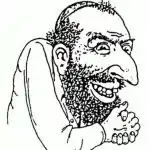 Caricature illustration of a Jewish man with beard and yarmulke | |
| First appearance | Artwork by A. Wyatt Mann. |
History
The image was first created by a cartoonist called A. Wyatt Mann (a pseudonym that sounds like "A white man"). In 2015, Mann was revealed by BuzzFeed to actually be Nick Bougas. The image was part of a cartoon that also included a racist drawing of a black man and said: "A world without Jews and Blacks would be like a world without Rats and Cockroaches." The cartoon was first released in print, but appeared online in February 2001.[1]
The image of the Jew in the cartoon was cropped out and began to spread on various internet communities, where users began to make variations of it.[1]
Description
The image is intended as a derogatory depiction of Jewish people, and employs many stereotypes. These include:
Use
The image is common on internet communities such as 4chan, other "chan" websites, and on other message boards.[3] In 2017, Al Jazeera tweeted an image that included the Happy Merchant on its official English-language Twitter account. The tweet was promoting a story about climate change, and insinuated that Jews were behind climate change. Al Jazeera later deleted the tweet.[4]
A study published by Savvas Zannettou et al. on online anti-Semitism recorded the prevalence of the Happy Merchant and its variations on 4chan's /pol/ board and Gab. The study found that usage of the Happy Merchant on /pol/ remained largely consistent (with a peak during the US airstrike on Syria in April 2017), while usage of the meme on Gab increased after the Charlottesville rally in August 2017.[5] It was also determined that /pol/ influences the spread of Happy Merchant to other web platforms such as Twitter and Reddit.[6]
The same study also found that the Happy Merchant has been incorporated into other common memes on the site, including Pepe the Frog.[7]
References
- "The Surprisingly Mainstream History Of The Internet's Favorite Anti-Semitic Image". BuzzFeed News. p. 11. Retrieved 2021-07-30.
- Zannettou, Savvas (24 Nov 2019). "A Quantitative Approach to Understanding Online Antisemitism" (PDF). ArXiv. p. 2. Retrieved 30 July 2021.
- "The Happy Merchant". Anti-Defamation League. Retrieved 2021-07-30.
- Kestenbaum, Sam (31 May 2017). "Al Jazeera Tweets, Then Deletes, Anti-Semitic 'Greedy Jew' Meme". The Forward. Retrieved 2021-07-30.
- Zannettou, Savvas (24 Nov 2019). "A Quantitative Approach to Understanding Online Antisemitism" (PDF). ArXiv. p. 9. Retrieved 30 July 2021.
- Zannettou, Savvas (24 Nov 2019). "A Quantitative Approach to Understanding Online Antisemitism" (PDF). ArXiv. p. 11. Retrieved 30 July 2021.
- Sannettou, Savvas (24 Nov 2019). "A Quantitative Approach to Understanding Online Antisemitism" (PDF). ArXiv. p. 10. Retrieved 30 July 2021.