Yeshivat Har Etzion
Yeshivat Har Etzion (YHE; Hebrew: ישיבת הר עציון), commonly known in English as "The Gush" and in Hebrew as "Yeshivat HaGush", is a hesder yeshiva located in Alon Shvut, an Israeli settlement in Gush Etzion in the West Bank, near Jerusalem. With a student body of roughly 480, it is one of the largest hesder yeshivot in Israel and the West Bank.[1]
ישיבת הר עציון | |
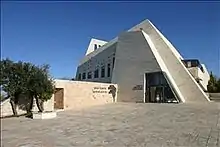 Yeshivat Har Etzion's main Bet Midrash building | |
| Established | 1968 |
|---|---|
| Affiliation | Jewish |
| Students | 480 |
| Location | , |
| Website | haretzion |
Most of the students are Israelis in the hesder program, which integrates intensive yeshiva study with at least 15 months of active service in the Israel Defense Forces. Post-high school overseas students are also accepted after undergoing a selective application and interview process. Many return after university to study for the rabbinate in the yeshiva's Semicha Program (Semicha given by the Israeli Rabbanut) and affiliated Herzog College. Over 550 alumni from overseas have made aliyah and a high percentage are involved in Jewish education. Others have gone on to prominent academic careers in science, law, medicine, engineering and mathematics.
Yeshivat Darkaynu, a yeshiva program is housed on the YHE campus.[2]
History
In 1968, shortly after the Six-Day War, a movement was founded to resettle the Gush Etzion region. Yehuda Amital, a prominent rabbi and Jewish educator was asked to head the yeshiva. Rabbi Aharon Lichtenstein moved from the United States soon after it was established to join Amital as Rosh Yeshiva. First established in Kfar Etzion, it moved to Alon Shvut, where it developed into a major institution.[3] The current yeshiva building was finished in 1977.[4]
On January 4, 2006, Rabbis Yaaqov Medan and Baruch Gigi joined Amital and Lichtenstein as roshei yeshiva in anticipation of Amital's upcoming retirement. Amital's involvement in the yeshiva effectively ended due to illness in the later months of 2009, and he died in July 2010. Lichtenstein died in April 2015, and his son, Mosheh Lichtenstein, replaced him as Rosh Yeshiva.
Educational and religious philosophy
According to the mission statement of the yeshiva, it advocates a combination of Torah study and a love of the Jewish people and the Land of Israel.[5] Its embrace of spirituality and religious striving is tempered with a message of moderation and openness. YHE encourages serious study, creative thought, intellectual rigor, fellowship with all Jews regardless of level of observance or political outlook, and a universal, humanistic outlook. While the intense study of Gemara - analytic Talmud - is the central focus of the learning, other areas especially Tanach (Bible), Machshevet Yisrael (Jewish Thought / Hashkafa), and Halakha LeMaaseh (practical Jewish law) are integral as well.[6]
YHE is known in Israel and abroad for its rigor and standards in Talmud.[7] The study of Gemara at YHE "trains talmidim to analyze, explore and evaluate differing opinions in the hope that they will grow to be discerning individuals [and] sophisticated thinkers..."[6] In particular, the Yeshiva emphasizes the Brisk analytic style of Talmud study; see Yeshiva § Talmud study.
The yeshiva is also well known for its pioneering and continuing role in the study of Tanach. [8] Led by Rabbi Yaakov Medan and Rabbi Dr. Yoel Bin-Nun, Har Etzion offers formal shiurim structured similar to Talmud study, where the text, and its overall structure, is then analyzed in light of the various commentaries and Midrashim. This approach to Tanakh study is sometimes referred as the "Bible Revolution." In the past, Rabbi Mordechai Breuer, the founder of the Shitat Habechinot ("the aspect approach"), also taught at the yeshiva. See Yeshiva § Torah and Bible study.
Libraries
The Yeshiva operates two libraries. The Torah Library, overseen by Aharon Bejell, has over 90,000 volumes, as well as CDs, microfilms, a collection of rare Judaica and an antique book facility, including Rav Yisachar Tamar’s personal Sefarim collection and a four-hundred year-old collection from the Etz Chayim community of Amsterdam known as “The Amsterdam Room.” Yeshivat Har Etzion’s Torah library is the largest of any Yeshiva in Israel.[9] The state-of-the-art Pedagogic Resource Center of the Herzog College supplements the central Torah library, providing audio-visual material for teachers of Judaic studies in Israel and worldwide.
Virtual Beit Midrash
YHE established the Israel Koschitzky Virtual Beit Midrash, which provides yeshiva-style courses and shiurim (lectures) in Torah and Judaism to students of all ages outside the Yeshiva walls, in an effort to open to the greatest extent possible a window into the Beit Midrash. Over 18,000 subscribers in every continent throughout the world subscribe to weekly shiurim, in English, Hebrew and Russian covering subjects such as Tanakh, Gemara, Halakha, Jewish philosophy and various other Jewish topics.[10]
KMTT
KMTT is a daily Torah study Podcast, from Yeshivat Har Etzion which is sent out every day of the week.[11]
Notable faculty
- Yehuda Amital (deceased) – Founding Rosh Yeshiva,[12] founder of the Meimad party, former member of the Israeli cabinet, creator of the Hesder Yeshiva concept
- Amnon Bazak – Ram
- Yoel Bin-Nun – co-founder of Yeshivat Har Etzion and Gush Emunim, emphasized a deep understanding of Tanach and its connection to the Land of Israel, featured in Yossi Klein Halevi’s Like Dreamers (2013)
- Mordechai Breuer (deceased) – one of the world's leading experts on Tanakh
- Baruch Gigi – Rosh Yeshiva[12]
- Dovid S. Gottlieb – Rav
- Menachem Leibtag – well known Tanach scholar
- Shlomo Levy – Ram, Rosh Kollel
- Yitzchak Levy – Mashgiach Ruchani
- Aharon Lichtenstein (deceased) – Rosh Yeshiva,[12] Rosh Kollel of Yeshiva University's Gruss Kollel, son-in-law of Joseph B. Soloveitchik
- Mosheh Lichtenstein – Rosh Yeshiva[12]
- Yaakov Medan – Rosh Yeshiva[12]
- Hanan Porat – Israeli Orthodox rabbi, educator, political activist and politician, co-founder of Yeshivat Har Etzion and Gush Emunim, featured in Yossi Klein Halevi’s Like Dreamers (2013)
- Yosef Tzvi Rimon – Ram, Rosh Kollel
Notable alumni
- Zechariah Baumel – American-Israeli soldier of the IDF who, in the aftermath of the First Lebanon War, was declared missing for many years
- Amnon Bazak – Ram at Yeshivat Har Etzion, lecturer of Tanach at Herzog College, editor and author
- Shalom Berger – Scholar and educational activist
- Ari Berman – Fifth President of Yeshiva University
- Eliyahu Blumenzweig – Founder, Rosh Yeshivat Yerucham
- Yuval Cherlow – Rosh Yeshivat Orot Shaul
- Michael Eisenberg – Highly successful venture capitalist and author
- Yehuda Etzion – Israeli right-wing activist
- Daniel Fridman – S'gan (Deputy) Rosh Yeshiva of TABC and the Rabbi of the Jewish Center of Teaneck
- Baruch Gigi – Rosh Yeshiva of Yeshivat Har Etzion, communal Rabbi of the Sephardi Synagogue in Alon Shvut
- Yehuda Gilad – Rosh Yeshivat Maale Gilboa
- Yehudah Glick – Israeli political activist and politician
- Jason Greenblatt – Assistant to the President and Special Representative for International Negotiations under President Donald Trump
- Aviad Hacohen – Israeli attorney and professor of law
- Re'em Ha'Cohen – Rosh Yeshivat Hesder Otniel
- Moshe Halbertal – Israeli philosopher, professor and writer, a noted expert on Maimonides and co-author of the Israeli Army Code of Ethics
- Nathaniel Helfgot – President of the International Rabbinic Fellowship
- Howard Jachter – American Orthodox rabbi, Dayan, educator, author and communal leader, expert on the laws of Jewish divorce
- Dov Kalmanovich – Israeli politician, first Israeli victim in the First Palestinian Intifada
- Moshe Koppel – American-Israeli computer scientist, Talmud scholar and political activist
- Binyamin Lau – Rav of Kehillat Ramban
- Menachem Leibtag – well known Tanach scholar
- Shamai Leibowitz – American lawyer, blogger who worked for the FBI and was convicted of leaking classified FBI information
- Shlomo Levy – Ram, Rosh Kollel at Yeshivat Har Etzion, President of the Yeshivat Hesder Gavoa Kiryat Gat, author, of the authors of the Israeli Rabbanut exam questions
- Yitzhak Levy – Mashgiach at Yeshivat Har Etzion for 25 years
- Mosheh Lichtenstein – Rosh Yeshiva and Rosh Kollel at Yeshivat Har Etzion, author
- Yaakov Medan – Rosh Yeshiva of Yeshivat Har Etzion, author
- Avraham Michaeli – Member of Knesset in the Shas party
- Ephraim Mirvis – Chief Rabbi of the UK and Commonwealth
- Chaim Navon – Israeli Rabbi, scholar, author and publicist
- Yosef Zvi Rimon – Israeli Rabbi and Posek, Rabbi of the Gush Etzion Regional Council, Ram, Rosh Kollel at Yeshivat Har Etzion
- Jonathan Rosenblatt – American Modern Orthodox rabbi, teacher, lecturer and counselor
- Itamar Rosensweig – Rabbi and maggid shiur at Yeshiva University and a dayan (rabbinic judge) at the Beth Din of America, son of Rabbi Michael Rosensweig
- Michael Rosensweig – Rosh Yeshiva at the Rabbi Isaac Elchanan Theological Seminary of Yeshiva University and the Rosh Kollel of the Beren Kollel Elyon
- Yehuda Sarna – Chief Rabbi of the Jewish Community of the United Arab Emirates
- Zvi Schreiber – British-Israeli serial entrepreneur, executive and author
- Elliot Schrier – community leader and teacher, current Mara d'asra of Congregation Bnai Yeshurun in Teaneck, New Jersey
- Sharon Shalom – Ethiopian-Israeli community Rabbi, lecturer and writer
- Scott J. Shapiro – Professor of Philosophy and Law at Yale Law School
- Eli Baruch Shulman – Rosh Yeshiva at the Rabbi Isaac Elchanan Theological Seminary of Yeshiva University, Rabbi Henry H. Guterman chair in Talmud, author and editor
- Noam Sohlberg – Israeli jurist who serves as a judge on the Supreme Court of Israel
- Ben-Tzion Spitz – Chief Rabbi of Uruguay, writer and Nuclear Engineer
- Shaul Stampfer – American historian, academic and author
- Zev Weitman – Rabbi of Tnuva, Rabbi of Alon Shvut, expert in Kashrut
See also
References
- "Yeshiva University". yu.edu.
- "Home". Darkaynu. Retrieved 2020-02-12.
- "Lonely man of faith", Larry Derfner, Jerusalem Post, December 22, 1995
- Gush, In The (April 5, 2017). "in The Gush: הספרייה התורנית של ישיבת הר עציון - הנצחת זכרון הנופלים".
- Administrator. "Mission Statement". haretzion.org.
- Prospective Students FAQ, haretzion.org
- See "Har Etzion" Listing under Yeshiva University's Men's Schools - S. Daniel Abraham Israel Program
- See description at, "Torah MiEtzion", Bereshit volume, Koren Publishers Jerusalem
- "Yeshivat Har Etzion: Har Etzion Library". Retrieved 18 November 2021.
- "vbm haretzion". etzion.org.il.
- "KMTT - The Torah Podcast". kimitzion.org.
- "Roshei Yeshiva". Archived from the original on March 20, 2012.
External links
 |
Wikimedia Commons has media related to Yeshivat Har Etzion. |
