Stellagama
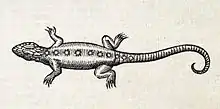
Stellagama is a monotypic genus of agamid lizard, containing the single species Stellagama stellio,[3][1] also known as the starred agama or the roughtail rock agama.
| Stellagama stellio | |
|---|---|
_2.jpg.webp) | |
| Dana Biosphere Reserve, Jordan | |
Scientific classification  | |
| Kingdom: | Animalia |
| Phylum: | Chordata |
| Class: | Reptilia |
| Order: | Squamata |
| Suborder: | Iguania |
| Family: | Agamidae |
| Genus: | Stellagama Baig, Wagner, Ananjeva & Böhme, 2012 |
| Species: | S. stellio |
| Binomial name | |
| Stellagama stellio | |
| Synonyms[2] | |
| |

Common names
Common names for S. stellio include dikenli keler, hardim, hardun, kourkoutas (Cypriot Greek), kourkoutavlos, painted dragon, roughtail rock agama, short-toed rock agama, sling-tailed agama, star lizard, starred agama, and stellion.
Geographic range
Stellagama stellio can be found in Greece, Israel, Cyprus, Lebanon, western Asia and northern Egypt; it has also been introduced to Malta.[1]
Description
Stellagama stellio may attain a total length (including tail) of 35 cm (14 in) or slightly longer.[4]
Behaviour and habitat
Like many agamids, S. stellio can change its color to express its mood. It basks on stone walls, rocks, and trees. It is usually found in rocky habitats, and is quite shy, being very ready to dive into cracks to hide from potential predators.
Etymology
The common name "stellion" comes from Latin stellio, stēlio (stelliōn-, stēliōn-), from stella, star.[5] It may have referred to any spotted lizard.
Uses
For the indigenous people of Europe, and perhaps the Middle East, traditionally the excrement of the stellio was a popular medicine for the eyes, also used as a cosmetic, known as cordylea, crocodilea or stercus lacerti (i.e. 'lizard shit'), the faeces being imported to European pharmacies from the Levant - a rarer and more potent form was acquired from monitor lizards in olden days (stercus magni lacerti). The dung was used to improve one's eyesight, as well as take away any itches and cure cataracts (webbe).[5][6] Muslims killed them, for it was believed that the lizards were mocking their faith, by lowering their heads in imitation of prayer.[6]
Subspecies
There are several subspecies, and S. stellio is likely a species complex.[1] More research will be done, and this species may yet be split into several species.[3]
The following seven subspecies, including the nominotypical subspecies, are recognized as being valid.[2]
- Stellagama stellio brachydactyla (Haas, 1951)
- Stellagama stellio cypriaca (Daan, 1967)
- Stellagama stellio daani (Beutler & Frör, 1980)
- Stellagama stellio picea (Parker, 1935)
- Stellagama stellio salehi Y. Werner in Lachmann et al., 2006
- Stellagama stellio stellio (Linnaeus, 1758)
- Stellagama stellio vulgaris (Sonnini & Latreille, 1802)
Nota bene: A trinomial authority in parentheses indicates that the subspecies was originally described in a genus other than Stellagama.
.jpg.webp)
.jpg.webp)
References
- Amr ZSS et al. (2012). Stellagama stellio. IUCN Red List of Threatened Species. Version 2012.2.
- Species Stellagama stellio at The Reptile Database www.reptile-database.org.
- Baig KJ et al. (2012). "A morphology-based taxonomic revision of Laudakia Gray, 1845 (Squamata: Agamidae)". Vertebrate Zoology 62 (2): 213-260. (Stellagama, new genus, p. 222).
- "Stellagama (=Laudakia) stellio daani (Spiny Lizard, Starred Agama or Hardun / Dikenli Keler)".
- Lanfranke of Milayne (13th century) (1529–1530). A most excellent and learned vvoorke of chirurgerie, called Chirurgia parua Lanfranci Lanfranke of Mylayne his briefe: reduced from dyuers translations to our vulgar or vsuall frase, and now first published in the Englyshe prynte by Iohn Halle chirurgien. Who hath thervnto necessarily annexed. A table, as wel of the names of diseases and simples with their vertues, as also of all other termes of the arte opened. ... And in the ende a compendious worke of anatomie ... An historiall expostulation also against the beastly abusers, both of chyrurgerie and phisicke in our tyme: with a goodly doctrine, and instruction, necessary to be marked and folowed of all true chirurgie[n]s. All these faithfully gathered, and diligently set forth, by the sayde Iohn Halle. Translated by Hall, John. John Hall. p. 56.CS1 maint: date format (link)
- Cuvier, Georges (1836–1849). Le Règne Animal (in French). 3 (3rd ed.). Paris: Fortin, Masson et cie. p. 49. doi:10.5962/bhl.title.39612.CS1 maint: date format (link)
Further reading
- Arnold EN, Burton JA (1978). A Field Guide to the Reptiles and Amphibians of Britain and Europe. (Illustrated by D. W. Ovenden). London: Collins. 272 pp. + Plates 1-40. (Agama stellio, pp. 110-111 + Plate 16 + Map 54 + map on p. 113).
- Boulenger GA (1885). Catalogue of the Lizards in the British Museum (Natural History). Second Edition. Volume I. ... Agamidæ. London: Trustees of the British Museum (Natural History). (Taylor and Francis, printers). xii +436 pp. + Plates I-XXXII. (Agama stellio, pp. 368-369).
- Linnaeus (1758). Systema naturæ per regna tria naturæ, secundum classes, ordines, genera, species, cum characteribus, diferentiis, synonymis, locis. Tomus I. Editio Decima, Reformata. Stockholm: L. Salvius. 824 pp. (Lacerta stellio, new species, p. 202). (in Latin).
External links
 |
Wikispecies has information related to Stellagama stellio. |
 |
Wikimedia Commons has media related to Stellagama stellio. |