Hassaan Al-Gazaar Al-Chinani
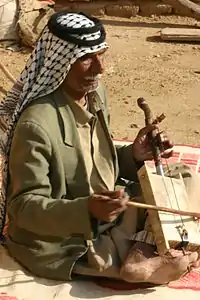
Hassaan Al-Gazaar Chenani (Arabic: حسان الگزار چناني), is an instrumentalist of "Rababa", who is known as "Hassaan Al-Gazaar", was a singer of from the Ahwaz area. He was a resident of Khowayes (Maytham Al-Tammar), a village in Khuzistan. Chenani was discovered and introduced to music society of Iran by Hooshangjavid, a music researcher of areas of Iran.[1]
Hassaan Al-Gazaar Chenani | |
|---|---|
 | |
| Background information | |
| Birth name | Hassaan Al-Gazaar Chenani |
| Origin | Ahwaz |
| Genres | Classic folk |
| Occupation(s) | Singer, Songwriter, Composer, Instrumentalist |
Expertise and reputation
Chenani was reputed mostly because of his expertise in vocal music and playing with his handmade Rababa instrument, that was made up a wire and a simple instrument. Al-Gazaar was recognized and took into the consideration of many elite music of Iran, in Twenty-Fifth Annual Music"Fajr" Festival.
Following his death, the media introduced him as epic singer of Khuzestan.[2] In addition to Alwanie style, he was completely a professional in many different styles, like "helilawi", "shatrawi", "mohammadawi", "magsosi", "chobie" etc… . It is said that "Hassaan Al-Gazaar Chenani" was the supreme players of "Rababa", who had an important role in keeping Alwanie tune, alive.[3] Of course Hassaan Al-Gazaar, believed that this tune did not belong to Alwan, but belongs to an ethnic, by the name of "Amooris" in Khuzestan, and he (Alwan) kept this tune alive.[4]
His life
| Part of a series on |
| Arabic culture |
|---|
 |
He lived in Khowayes village until the end of his life. Hassaan turned to singing and musicianship from the age of 12, that is called "shaeri" (versification) in local speaking. He performed music in the praise of the Islam prophet and his family.[2] The art of versification, is hereditary, in his family. His grandfather was nicknamed "Jabbar-Al-Adib", because of his poetry talent, his father "Salman" was a dexterous poet and singer. Al-Gazaar learned the art of crafting the "Rababa" and singing from his father.[5][6][7][8] [9]
It is quoted from Hassaan, that when he had traveled to Baghdad for visiting his brothers there, his visit had coincided with the anniversary of the crowning of King Faisal in Iraq, he took part in the ceremony, which was attended by the most famous Arab singers, to show his art. In this event, the organizers, gave him a car, but he gave it to his brothers in Iraq, and on his horseback he returned to Susa. He said due to the interest in his native land, he returned. "Chenani" trained next to the "Ekransheroobe", who changed the singing style in Khuzistan. He knew the rows and the verses completely. Also in the Sixth Iranian Regional Music Festival, he was honored and celebrated by twenty-seven singers and nine outstanding instrumentalists of different regions of Iran.[4]
End of his life
Two days after his artistically implementation in the Twenty-Fifth Annual Music Fajr Festival, on the way of return to his birthplace, Hassaan Al-Gazaar Chenani, died, because of heart failure.
At March 9th's Saturday evening, Chenani, played the last song of his life, at the art academy of Tehran, in Twenty-Fifth Annual Music Fajr Festival. Deputy of artistic affairs, of Minister of Culture and Islamic Guidance of the time, in a message, send his condolences to the death of this regional music artist. Also the Secretary of the Twenty-Fifth International Music Fajr Festival, In a separate message sends his condolences to the people of Khuzistan.[10]
The instrument that Al-Gazaar was using, was his handmade Rababa, that was made up by a single hair from the horse's tail. Al-Gazaar performed his latest songs in Sunday (February 28, 2010) after the performance of Ehsan Khajehamiri, Rumi and Gholam Margiri group, Gholamreza Alme Jooghi in Tehran Art Academy.[11] At the closing ceremony of the Twenty-Fifth Fajr Music Festival, After a speech by Minister of Culture of the time, In a part of the celebration, there was a reminding for departed members of music community of Iran, in the year 2010, by playing a clip of Hassaan Al-Gazaar Chenani, Andre Arezoomanian, Gholamreza Hamzei, Reza Saghaee, Mohammad Noori, Farid Salmanian, Elin Baghcheban, Gholam-Ali Naizar, Ali Abchoori, Mohammad-Hassan Tafakori, Saeed Gholipoor and Hossein Fotoohi.[12] [13]
[14] The message of passing the way of Hassaan Al-Gazaar, published in newspapers and national radios of Iran.[15][16]
References
- روزنامه ایران، شماره ۵۳۴۱ به تاریخ ۲۷/۱/۹۲، صفحه ۱۹ (موسیقی)
- خبرگزاری فارس، حوزه هنر و اندیشه
- "Archived copy". Archived from the original on 2013-11-11. Retrieved 2013-07-18.CS1 maint: archived copy as title (link)
- ایسنا خوزستان، محمود مشهودی
- "Archived copy". Archived from the original on 2013-11-11. Retrieved 2013-07-18.CS1 maint: archived copy as title (link)
- روزنامه آفتاب یزد، شماره ۲۸۶۳ به تاریخ ۱۲/۱۲/۸۸، صفحه ۱۰ (فرهنگی)
- http://www.magiran.com/npview.asp?ID=2051508
- رادیو ایران صدا
- "روزنامه مردمسالاری". Archived from the original on 2016-09-18. Retrieved 2013-07-18.
- آفتاب
- روزنامه ایران
- "روزنامه آفرینش". Archived from the original on 2013-11-11. Retrieved 2013-07-18.
- روزنامه ایران، شماره ۴۴۴۶ به تاریخ ۹/۱۲/۸۸، صفحه ۲۷ (فرهنگ و هنر)
- روزنامه ایران، چهارشنبه, ۱۲ اسفند ۱۳۸۸، مرگ موسیقیدان نواحی، استقبال از کنسرت بنیامین
- روزنامه همشهری، ویژه نامه خوزستان، چهرهها، چهارشنبه ۱۶ فروردین ۱۳۹۱
- مجلهتخصصی ملودیمگز