Head on a spike
Placing a severed head on a spike (or pike or pole) is a custom used sometimes in human history and in culture. The symbolic value may change over time. It may give a warning to spectators. The head may be a human head or an animal head.
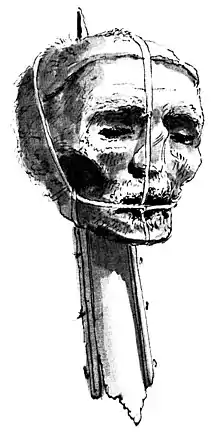
Oliver Cromwell's head was placed on a spike and erected in the 17th century. A drawing from the late 18th century.
Noted examples
- William Wallace (c. 1270–1305)
- Simon Fraser (d. 1306)
- Jack Cade (c. 1420–1450)
- Richard of York (1411–1460)
- Thomas More (1478–1535)
- Thomas Cromwell (c. 1485–1540)
- Oliver Cromwell (1599–1658)
- Jacques de Flesselles (1730–1789)
- Bernard-René Jourdan de Launay (1740–1789)
- Staker Wallace (1733–1798)
- John Murphy (1753–1798)
- Vela Peeva (1922–1944)
Gallery
 A sketch of a head impaled on a pike, included in a letter to Ronald Fuller dated 1924
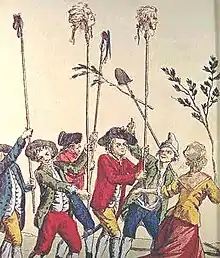 Drawing of the French Revolution: "Aristocratic Heads on Pikes"
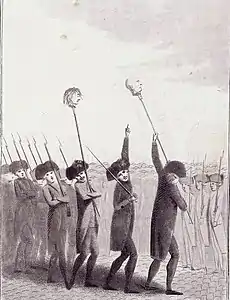 Engraving c.1789 of French militia hoisting the heads of Jacques de Flesselles and the marquis de Launay on pikes
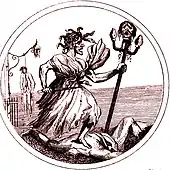 Historical caricature on the Reign of Terror
See also
- Decapitation
- Mouting points and synonyms:
- Battlefield Cross, a symbolic replacement of a cross made up of the soldier's rifle stuck into the ground with helmet on top
- London Bridge
- Impalement, in which the object is alive at the time of penetration
This article is issued from Wikipedia. The text is licensed under Creative Commons - Attribution - Sharealike. Additional terms may apply for the media files.