Hedwig Dülberg
Hedwig Dulberg-Arnheim (née Hedwig Slutzky-Arnheim; 7 January 1894 – 1944)[1] was a German nude artist, embroiderer and wood carver.[2][3][4][5]
Hedwig Dülberg-Arnheim | |
|---|---|
.jpg.webp) Portrait of Hedwig Arnheim by Rudolf Dührkoop (1918) | |
| Born | Hedwig Slutzky-Arnheim 7 January 1894 |
| Died | 1944 (aged 49–50) |
| Cause of death | Suffocation |
| Occupation | Artist |
| Spouse(s) | Ewald Dülberg
(m. 1915; div. 1921)Naum Slutzky
(m. 1923; div. 1930) |
| Parent(s) |
|
| Relatives |
|
Life
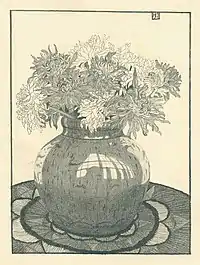
Hedwig Arnheim was born on 7 January 1894 in Hamburg, Germany. She was the eldest child of the doctor Felix Arnheim and his wife Lisbeth, née Samuel. With her brother Hans (born 1895) and the two sisters Eva Karoline Friederike (24 March 1902) and Ruth Anna Frieda (16 April 1912), she grew up in the Protestant faith.[6] Hedwig was described as a beautiful woman, versatile and endowed with a rich imagination, ambitious and demanding.[7] After finishing school, she went to the Britain for a while at the age of 18. Artistically gifted, she had been a student at the University of Fine Arts of Hamburg before 1914, where she studied applied arts and design with the German designer, Friedrich Adler. In 1915, Hedwig married the teacher, painter and wood carver Ewald Dülberg. Their daughter Esther Maria was born in 1918. However, their marriage ended up in divorce in 1921.[8]
Hedwig Arnheim went to the Weimar Bauhaus with her daughter, attended courses there with Johannes Itten and apprenticed to Gunta Stölzl. In 1923 she married the lighting and jewelry artist Naum Slutzky and broke off her training. The couple lived in Berlin, and in Vienna for a short time and returned to Hamburg on October 1924 for economic reasons, where they lived in Hedwig's parents' house.[5] As a freelance artist, Hedwig earned her living as a craftsperson and interior designer, later with tailoring. She divorced Naum Slutzky in 1930.
Until she emigrated to France on 15 February 1936, she continued to live in her father's apartment. She emigrated to the south of France, where she settled in Nice. Due to a denunciation on 20 September 1943, she was interned with a group of 345 Jewish prisoners on 23 September 1943 in the Drancy assembly camp. On 7 October 1943, she was deported to Auschwitz in convoy No. 60, where she presumably died inside a gas chamber by suffocation.[7]
Reference
- Bruhns, Maike (2007). Geflohen aus Deutschland: Hamburger Künstler im Exil 1933–1945. Edition Temmen. pp. 76–81. ISBN 978-3861088905.
- Stein, Edith (1993). Self Portrait in Letters 1916-1942. ICS Publications. pp. 204, 266, 271, 290. ISBN 978-0935216202.
- Anton Schnack: German Expressionism Darmstadt 1920. In: Deutsche Kunst und Decoration 46 (1920), pp. 206–221, here: p. 221 (online); Wilhelm Michel: First exhibition of the "Darmstadt Secession". In: German Art and Decoration 45 (1919/20), pp. 131–142, p. 141.
- Stein, Harry (2009). Franz Ehrlich: Ein Bauhäusler in Widerstand und Konzentrationslager. pp. 145, 158. ISBN 978-3935598156.
- Women Artists and Designers in Europe Since 1800: An Annotated Bibliography. G. K. Hall & Co. 1998. ISBN 0816105960.
- Ada Anders, Christina (2014). "Vorläufig muß ich leben bleiben". Alfred Ahner – Aus den Briefen und Tagebüchern des Weimarer Künstlers (1890–1973) (in German). Georg Olms Verlag. pp. 176, 372. ISBN 978-3487085517.
- "Stolpersteine in Hamburg | Namen, Orte und Biografien suchen". www.stolpersteine-hamburg.de. Retrieved 6 May 2021.
- Bruhns, Maike (2001). Kunst in der Krise, Volume 2. Dölling und Galitz. pp. 110, 360, 364. ISBN 3933374944.
