Henry John King
Henry John King (1855–1934) was an Australian composer.
Henry John King | |
|---|---|
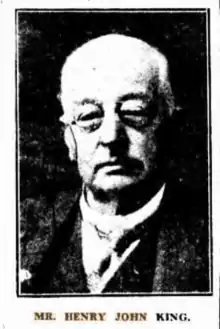 Henry John King 1933 | |
| Background information | |
| Born | 1 January 1855 Tasmania, Australia |
| Died | 27 June 1934 |
| Genres | Romantic, Classical, Spiritual |
| Occupation(s) | Composer, Musician, Conductor, Organist, Music Teacher |
| Instruments | Organ, Choir, Piano, Violin |
| Years active | 1880-1930 |
King was born in Emerald Hill[1] to English settlers of Tasmania. His father of the same name was a respected musician.[2]
He married Mary Ann Hutchens and two years later obtained a scandalous divorce from her.[3] They had children named Harold Ernest Justiman King and Ilma Valerie Madeline King.[4]
King was chosen to adjudicate choir competitions in Gympie [5] and Bathurst [6]
He composed a cantata selected for the 1888 International Centennial Exhibition in Melbourne.[7][8]
Organist at St Mark's Cathedral, Melbourne [9]
King was choirmaster and organist at The Southport School in Surfer's Paradise for nine years, retiring in March 1933.[10][11]
Devout Protestant academically eloquent on the humanities [12]
He was buried at Southport with second wife Elizabeth née Halford (1874–1949),[13] with whom he had a daughter, Norah Yvonne Sylvia King (1902–1976).
Works
- Alternatives [14]
- Centennial Cantata
- Te Deum Laudamus and Jubilate Deo : set to music in the key of D [15]
- Little Bird
- The children's Eucharist : the Office for the Holy Communion : set in the key of F
- The Office for the Holy Communion set to music in the key of D / by Henry John King
- Benedictus
- Wilt thou be mine for ever love / lyrics by Russell Blackman
- Four works for piano and violin
- Album of four song on funereal themes
References
- Victorian Birth Registration 3552
- https://oa.anu.edu.au/obituary/king-henry-john-24985
- "A SENSATIONAL DIYORCE CASE". Geelong Advertiser (12, 423). Victoria, Australia. 7 September 1887. p. 3. Retrieved 6 November 2021 – via National Library of Australia.
- Southport Cemetry index Grave 472
- "GYMPIE EISTEDDFOD". Queensland Times. LVI (9522). Queensland, Australia. 22 April 1916. p. 8 (DAILY.). Retrieved 6 November 2021 – via National Library of Australia.
- "Bathurst Musical and Literary Competitions". Australian Town And Country Journal. LXXV (1972). New South Wales, Australia. 20 November 1907. p. 25. Retrieved 6 November 2021 – via National Library of Australia.
- "Obituary". The Courier-mail (260). Queensland, Australia. 28 June 1934. p. 18. Retrieved 9 November 2021 – via National Library of Australia.
- "Music". The Australasian. CXXXVI (4, 436). Victoria, Australia. 13 January 1934. p. 16. Retrieved 9 November 2021 – via National Library of Australia.
- "MUSICAL NOTES AND CHIT-CHAT". The Tasmanian. XVII (5). Tasmania, Australia. 2 February 1889. p. 8. Retrieved 6 November 2021 – via National Library of Australia.
- "Mr. Henry John King". The Brisbane Courier (23, 472). Queensland, Australia. 24 April 1933. p. 11. Retrieved 6 November 2021 – via National Library of Australia.
- "Henry John King". The Telegraph. Queensland, Australia. 27 June 1934. p. 7 (City Final Last Minute News). Retrieved 9 November 2021 – via National Library of Australia.
- "MUSIC AND MUSICIANS". The Brisbane Courier (16, 907). Queensland, Australia. 20 March 1912. p. 19 (Courier Home Circle.). Retrieved 6 November 2021 – via National Library of Australia.
- https://www.findagrave.com/memorial/195395743/henry-john-king
- ""ALTERNATIVES"". Illustrated Australian News And Musical Times (420). Victoria, Australia. 1 May 1890. p. 12 (NEW ZEALAND EDITION.). Retrieved 6 November 2021 – via National Library of Australia.
- http://nla.gov.au/nla.obj-172214169