Henry Lidgbird Ball
Rear-Admiral Henry Lidgbird Ball (1756–1818) was a Royal Navy officer, best known as the commander of the First Fleet's HMS Supply, for the exploration of environs around Port Jackson and Broken Bay, helping establish the Norfolk Island penal settlement, and for discovering and naming Lord Howe Island.
Henry Lidgbird Ball | |
|---|---|
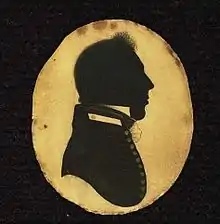 Silhouette of Henry Lidgbird Ball | |
| Born | 7 December 1756[lower-alpha 1] Woodchurch, Cheshire, England |
| Died | 22 October 1818 (aged 61) Mitcham, Surrey, England |
| Service/ | Royal Navy |
| Rank | Rear-Admiral of the Blue |
| Commands held | HMS Gibraltar 1808–1810 HMS Zealand 1805–1807 HMS Daedalus 1797–1801 HMS Ariadne 1796–1797 HMS Flora 1794–1795 HMS Supply 1787–1792 HMS Seaflower 1783–1786 |
| Spouse(s) | Charlotte Foster
(m. 1802; died 1803)Anne Georgiana Henrietta Johnston
(m. 1810) |
| Children | Anne Maria Partridge Ball (1789–) |
Early life
Henry Lidgbird Ball was born in 1756 at Birkenhead, Cheshire, England, to George Ball and his wife, Lucy Stringer. Henry was baptised on 7 December 1756 in Holy Cross Church, Woodchurch, Cheshire.[1]
Ball joined the Royal Navy when quite young, serving on various ships: HMS Venus, HMS Ramillies, HMS Raven, and HMS Lark.[2] On 23 April 1778 he was commissioned a Lieutenant and from March 1783 until April 1786 commanded the cutter HMS Seaflower on the northern coast of Ireland.[3]
Colonial service
In 1787, Lieutenant Ball was placed in command of the armed tender HMS Supply as part of the naval escort for the ships of the First Fleet. Supply's armament had been increased in 1786 with the addition of four twelve-pounder carronades; the crew was augmented to 55. Additionally, a detachment of 16 marines from the New South Wales Marine Corps, under command of Lieutenant William Dawes, was embarked. The Supply had orders to create a penal colony in Botany Bay, New South Wales.[1][3]
With Ball as captain, Supply sailed from Spithead, Portsmouth, on 13 May 1787 with the fleet commanded by Commodore Arthur Phillip. On 3 June 1787, the fleet anchored at Santa Cruz de Tenerife, Spain.[4] On 10 June they began their voyage across the Atlantic to Rio de Janeiro, Brazil, taking advantage of favourable trade winds and ocean currents.[4] The fleet reached Rio on 5 August and remained for a month while resuppling.[4] The fleet departed Rio de Janeiro on 4 September to run before the westerlies, reaching Table Bay in South Africa on 13 October, the last port of call before Botany Bay. On 25 November, Phillip transferred from HMS Sirius to the faster Supply, and with the fleet's faster ships raced ahead to prepare for arrival of the rest of his command. However, this "flying squadron" reached Botany Bay only hours before the slower members, so no preparatory work was done. Supply reached Botany Bay on 18 January 1788; the three fastest transports in the advance group arrived on 19 January; slower ships, including Sirius, arrived on 20 January.[4][1][3]
On 14 February Ball on Supply sailed with Lieutenant Philip Gidley King, who was to establish a subordinate settlement on Norfolk Island. Ball learned the navigational and physical difficulties in approaching the island which were to affect future settlement there, but got ashore on 6 March.[1] On the return voyage he explored a small island sighted previously, which he named Lord Howe's Island after Richard Howe, 1st Earl Howe; he also named Mount Lidgbird and Ball's Pyramid after himself.[5]
During the next two years he took part in parties of exploration around Port Jackson, was in the group who captured Arabanoo on 31 December 1788, made another voyage to Lord Howe Island in an unsuccessful search for turtles to supplement the meagre diet at Sydney, and made multiple voyages to Norfolk Island. He also drew a sketch of Lord Howe Island that Phillip sent to England.[1]
On 5 March 1790 the Sirius and Supply left Sydney Cove to transport 300 convicts and marines to Norfolk Island, arriving on 13 March. Bad weather precluded landing personnel and provisions near the settlement, so the marines and some convicts were landed at Cascade Bay on the north-east coast. Here they had to jump individually from a boat to a rock; the jump was possible only when the tide was half out.[6] On 19 March the weather cleared and Ball and Captain John Hunter of Sirius started to unload the remaining convicts and provisions.[7] Ball noticed the current was pushing the ships towards the sunken rocks and signalled to Hunter before manoeuvring Supply away from the danger. Even though the Sirius was farther from the rocks than Supply, Captain Hunter was unable to save his ship from foundering. Supply, with assistance of the men on shore, was able to rescue every person from the sinking Sirius.[6][7]
In April 1790, after the loss of Sirius and with food running low, Governor Phillip sent Ball in the Supply to Batavia, Dutch East Indies, for provisions. He returned in October, having chartered the Waaksamheyd, which arrived two months later with more comestibles.[3] In January 1791 Ball was ordered to bring Hunter and the crew of the Sirius back to Sydney from Norfolk Island. Ball then became ill with a malady that had originated in a fever suffered at Batavia. In March he sought leave to return to England both to recover his health and to attend to family affairs. Sailing in November 1791, he arrived at Plymouth in April 1792, carrying the first kangaroo to be shipped to England.[1]
In 1808 he applied unsuccessfully for the governorship of New South Wales.[1]
Further Naval Career
Ball was promoted to Commander on 28 April 1792 for his achievements in New South Wales.[3] He returned to duty in December 1794 with his appointment to HMS Flora, and conveyed the new British ambassador, Lord Bute, to Spain before returning from the Mediterranean in June 1795 when he was posted captain on 9 July.[3] In September he was appointed to command HMS Ariadne, serving for the next eighteen months in the North Sea and The Downs.[3]
In March 1797 Ball was appointed to HMS Daedalus, serving initially in home waters, before being transferred to the East Indies station. Off the West African coast in early 1798, Deadalus with HMS Hornet, was involved in the capture of seven vessels.[8] Ball was off the Cape Colony when he encountered the French frigate Prudente and, in the action of 9 February 1799, after an eighty-minute battle, the badly battered French ship surrendered. The Daedalus lost two men killed and 12 wounded in the engagement; Prudente suffered 27 killed and 22 wounded.[3]
Ball commanded three more vessels: HMS Zealand 1806–1807, HMS Gibraltar 1808–1810, and Christian VII 1812–1813. In 1812 he went onto half-pay in semi-retirement.[1]
In the summer, 1809 he was called as a witness at the Court-martial of James, Lord Gambier which assessed whether Admiral Lord Gambier had failed to support Captain Lord Cochrane at the Battle of Basque Roads in April 1809. Gambier was controversially cleared of all charges.[9] On 4 June 1814 Ball was promoted to flag rank as Rear-Admiral of the Blue.[10]
Personal life
During his time in Colony of New South Wales, Ball had a relationship with Sarah Partridge (also known as Mary Stokes),[11] a convict who had been transported by the First Fleet in the Lady Penrhyn.[12] They had a daughter, Anne Maria Partridge Ball, born 1789 at Norfolk Island. She was christened on 22 August 1789 at Sydney.[12] No mention of Sarah or her daughter was made in Ball's will, but Ball's sister Mary made "my niece 'Ann Maria'" her heir in 1820.[13]
On 17 June 1802 Ball married Charlotte Foster in London; she died a year later. He married again on 19 July 1810, at Kingston upon Thames, to Anne Georgianna Henrietta Johnston,[1] who was 31 years his junior, she survived him and died in 1864.[12]
Death and legacy
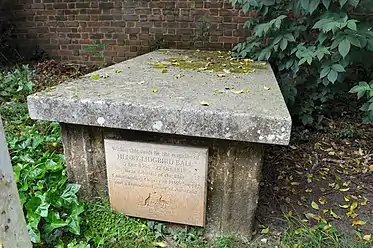
He died on 22 October 1818 at Mitcham[1] (then in Surrey and now in Greater London), England. He was buried in the churchyard at St Peter's Church, Petersham, in the family vault of his wife, Anne Georgianna Henrietta Johnston.[12]
A plaque commemorating Ball was added to the Johnston tomb on 20 October 2013 at a service attended by the Australian High Commissioner to the United Kingdom.[12]
Ball's Pyramid and Mount Lidgbird on Lord Howe Island, Ball Bay, Norfolk Island, and possibly Balls Head on Sydney Harbour are all named after him.[2]
Ball appears as a character in Evelyn Cheesman's 1950 novel Landfall the Unknown: Lord Howe Island 1788.
Notes
- Date of christening, not birth
References
- Parsons, Vivienne (1966). Ball, Henry Lidgbird (1756–1818). Australian Dictionary of Biography. National Centre of Biography, Australian National University.
- Dunmore, John (1991), Who's Who in Pacific Navigation, University of Hawai'i Press, pp. 7–48, doi:10.2307/j.ctvp7d58v.7, retrieved 15 October 2021
- Hiscocks, Richard (2018). "Henry Lidgbird Ball". morethannelson.com. Retrieved 2 October 2021.
- "The First Fleet". Project Gutenberg. Retrieved 2 October 2021.
- Hutton 1986, p. 1.
- Groom, Linda (2012). A Steady Hand: Governor Hunter & His First Fleet Sketchbook. National Library Australia. p. 47. ISBN 9780642277077.
- Barnes, Robert Winstanley (2009). An Unlikely Leader: The Life and Times of Captain John Hunter. Sydney University Press. p. 126. ISBN 9781920899196.
- "No. 14096". The London Gazette. 6 March 1798. p. 205.
- Gurney, W. B. (1809). Minutes of a court-martial ... on the trial of James Lord Gambier. Mottey, Harrison & Miller.
- Harrison, Simon (2010–2018). "Henry Lidgbird Ball (1756–1818)". threedecks.org. S. Harrison. Retrieved 15 February 2019.
- "ANN MOORE, SARAH PARTRIDGE, MARY STOKES, Theft > shoplifting, 14th January 1784". Old Bailey Proceedings Online. Retrieved 3 March 2014.
- Boyes, Valerie; Wintersinger, Natascha (2014). Encountering the Unchartered and Back – three explorers: Ball, Vancouver and Burton. Museum of Richmond. pp. 9–10.
- "Partridge, Ann Maria (1789–?)". National Centre of Biography, Australian National University. Retrieved 3 October 2021.
Further reading
- Parsons, Vivienne (1966). "Ball, Henry Lidgbird (1756–1818)". Australian Dictionary of Biography. Melbourne University Press. ISSN 1833-7538 – via National Centre of Biography, Australian National University.
- Hutton, Ian (1986). Lord Howe island: Discovering Australia's world heritage. Canberra: Conservation Press. ISBN 090819840X.
