Henry William Brewer
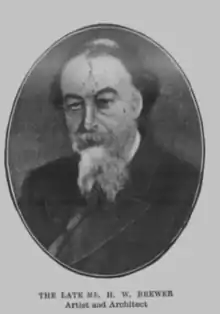
Henry William Brewer (1836–1903) was a British illustrator, notable for his detailed city panoramas, held to be one of the most outstanding architectural draughtsmen of his day.[1]

Family & early life
Brewer was born in Oxford on 7th August 1836. His father was the historian John Sherren Brewer, and his uncle, E. Cobham Brewer, the compiler of Brewer's Dictionary of Phrase & Fable.[2]
Brewer received his early education at the school in Norwich founded by his grandfather, John Sherren Brewer, Senior. His school fellows included Sydney Ringer, Professor Robert Lubbock Bensly, the architect Edward Boardman and Brewer’s cousin, John Odin Howard Taylor. The school’s drawing master and art teacher was the architectural painter David Hodgson (artist), from whom the young Henry Brewer received private lessons in oil painting and drawing, developing his love of mediaeval and other architecture.[3] Brewer later continued his art studies under William Warren and the prominent painter George Clarkson Stanfield. He was also a pupil at King's College, London, where his father was Professor of Literature.[4]
Brewer married Frances Mary Mottley (1842-1927) in Germany on 7th July 1862. His older children were born in Bavaria.[5] His sons Henry Charles Brewer and James Alphege Brewer achieved notoriety as artists and engravers. His eldest son, John Francis Brewer, became an organist and writer.[2]
Professional life
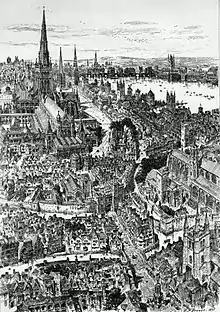
Brewer trained as an architectural draughtsman. He developed an individual style which was often ingenious and marked by delicacy and extreme care.[6] He became especially well known for his panoramic bird's eye views of British towns and cities, and for historical reconstructions.[7]
Brewer also taught illustration. The Pall Mall Gazette article records in 1871 that "the programme for the new term at the Working Men's College, 45, Great Ormond-street, has just been issued. In art there are six classes, the life class being visited by Mr. Lowes Cato Dickinson and Mr. Cave Thomas, with a special course in perspective by Mr. Henry W. Brewer."[8]
He was a frequent exhibitor the Royal Academy, the British Institution and the Suffolk Street Gallery from 1858 to 1893.[9] Among his important commissions was one given by Queen Victoria, for whom he executed number of water colour paintings of the Mausoleum at Frogmore, the Queen taking great interest in and watching him at his work.[10] He also produced a series of views of London, showing the city in the time of Henry VIII, later published as “Old London illustrated”.[11]
Galleries
- 150 Henry William Brewer pictures are held by the Victoria & Albert Museum.[12]
- 26 Henry William Brewer paintings are held by the Royal Collection Trust.[13]
Writings
Brewer became an expert on medieval architecture, and wrote authoritatively and extensively on the subject of buildings for a number of periodicals. His articles generally appeared under the initials 'HWB', and were often richly illustrated by his architectural drawings. His work appeared in both The Graphic and The Builder for around 25 years prior to his death.[14][15]
He also wrote for The Girls Own Paper between 1889 and 1901, where subjects included Interesting Monuments of Distinguished Women (1889),[16] The Castle of Cleve and the 'Magic Swan' (1890),[17] The Largest Churches in Europe (1891),[18] Archeology for Girls (1895),[19] Typical Church Towers of English Counties (1895),[20] Old english Cottage Homes (1899),[21] and Site Base Support and Superstructure – Ancient and Modern Methods of Building (1901).[22] Brewer's son, the author John Francis Brewer, also wrote for the Girls' Own Paper.[23]
References
- "Brewer, Henry William". Allgemeines Künstlerlexikon Online. Retrieved 16 October 2021.
- Dunham, Benjamin (2021). Etched in Memory: The Elevated Art of J. Alphege Brewer. Peacock Press. p. 9. ISBN 978-1914934131.
- "The Late Mr H W Brewer". The Norfolk News. 24 October 1903.
- "The Late Mr H W Brewer". The Norfolk News. 24 October 1903.
- "Henry William Brewer". British Map Engravers – A Supplement. British Map Engravers. Retrieved 6 December 2021.
- "Henry William Brewer". The Graphic. 17 October 1903.
- "Henry William Brewer". British Map Engravers – A Supplement. British Map Engravers. Retrieved 6 December 2021.
- "Great Ormond Street Working Men's Club". The Pall Mall Gazette. 14 September 1871.
- "Brewer, Henry William". Benezit Dictionary of Artists. Benezit Dictionary of Artists. 2011. doi:10.1093/benz/9780199773787.article.B00026373. ISBN 978-0-19-977378-7. Retrieved 16 October 2021.
- "The Late Mr H W Brewer". The Norfolk News. 24 October 1903.
- "Henry William Brewer". British Map Engravers – A Supplement. British Map Engravers. Retrieved 6 December 2021.
- "Henry William Brewer". Victoria & Albert Museum. Victoria & Albert Museum. Retrieved 15 December 2021.
- "Henry William Brewer". The Royal Collection. The Royal Collection Trust. Retrieved 15 December 2021.
- "Henry William Brewer". British Map Engravers – A Supplement. British Map Engravers. Retrieved 6 December 2021.
- "The Late Mr H W Brewer". The Norfolk News. 24 October 1903.
- Brewer, Henry William (1889). "Interesting Monuments of Distinguished Women" (PDF). The Girls' Own Paper. Retrieved 15 December 2021.
- Brewer, Henry William (June 1890). "The Castle of Cleve and the 'Magic Swan'" (PDF). The Girls' Own Paper. XL (547). Retrieved 15 December 2021.
- Brewer, Henry William (1891). "The Largest Churches in Europe" (PDF). The Girls' Own Paper. Retrieved 15 December 2021.
- Brewer, Henry William (1895). "Archeology for Girls" (PDF). The Girls' Own Paper. Retrieved 7 November 2021.
- Brewer, Henry William (October 1897). "Typical Church Towers of English Counties" (PDF). The Girls' Own Paper. 99. Retrieved 15 December 2021.
- Brewer, Henry William (1899). "Old English Cottage Homes" (PDF). The Girls' Own Paper. Retrieved 15 December 2021.
- Brewer, Henry William (1901). "Site Base Support and Superstructure – Ancient and Modern Methods of Building" (PDF). The Girls' Own Paper. Retrieved 15 December 2021.
- Brewer, John Francis (1888). "A Holiday in Norway" (PDF). The Girls' Own Paper. Retrieved 15 December 2021.