Hermann Stern
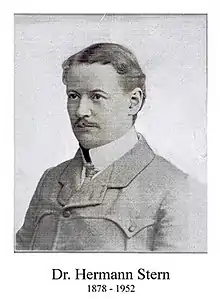
Hermann Stern (24 May 1878 – 24 August 1952) was an Austrian lawyer, local politician, and economic pioneer.[1]
Dr. Hermann Stern | |
|---|---|
 | |
| Born | 24 May 1878 |
| Died | 24 August 1952 |
| Nationality | Austrian |
Early life and education
He was the seventh of ten children of Johann Joachim Stern, a Jew who converted to Catholicism, and Gertraud née Lechthaler.[2]
In 1902, he received his doctorate in law from the University of Innsbruck and passed his bar examination in 1906. He was initially secretary of the "Association of Catholic Agricultural Workers" in Innsbruck. In 1910, he moved to Reutte as a lawyer.[3]
In 1911, he married Anna Knittel, a daughter of the school inspector Josef Knittel, from which marriage five children were born.[4] After World War I, he began extensive public work in addition to his legal practice.
Career
In 1918, Stern placed himself at the head of a democracy movement in the district of Reutte, which aimed to build the state not from the top but from the bottom up. In 1919, he moved into the municipal council of Reutte, where he held various positions until 1927, as vice mayor. Within the municipal council, he was responsible for the successful expansion of the municipally owned Reutte electricity plant and, in the social field, for the establishment of a hospital.[5]
As an economic pioneer, he pursued the course of using the available resources, such as; water, wood and electricity, for an economic upswing. In 1922, he persuaded Dr. Paul Schwarzkopf to found the Plansee metal works. To exploit the natural mineral resources, he founded an oil plant, and to promote the natural abundance of wood, he founded several wood processing companies.[6]
His main economic project was the construction of a cable car to the Zugspitze, the highest mountain in Germany, from the Austrian side.[7] The completion of this project in 1926 brought him the height of his popularity, but also ushered in his personal tragedy, as the project suffered a financial downfall due to economic conditions - in particular, the German Reich's thousand-mark freeze imposed by Hitler.
Exile and death
For his services to the construction of the Zugspitzbahn, he was made an honorary citizen of the community of Ehrwald in 1926. This honorary citizenship was revoked in 1940 because of his Jewish ancestry. The German racial laws stamped him a half-Jew in 1938. This was followed by the confiscation of his office premises and a 15-month imprisonment. In order to keep him out of Tyrol forever, Gauleiter Franz Hofer had him expelled to Nuremberg.[8] Stern went blind, returned in 1945 as a seriously ill man and tried in vain to rehabilitate himself. He died in Innsbruck on 24 August 1952.[9]
Honour
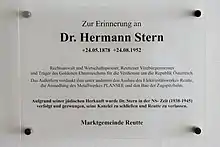
In 1947 he was re-registered as a lawyer. His deprivation was expressly revoked by the municipality of Ehrwald in 1998 and in 2017, the market town of Reutte installed a commemorative plaque in Dr. Stern's former house, referring to his achievements.[7][10]
References
- "Dr. Hermann Stern - Rechtsanwalt, Geschäftsmann und Visionär - verren.at". www.verren.at. Retrieved 2021-11-20.
- "Hermann Maria Stern 1878-1952 - Ancestry®". www.ancestry.ca. Retrieved 2021-11-19.
- "Einladung zur GÖCH-Generalversammlung 2018". Nachrichten aus der Chemie. 66 (9): 913–913. doi:10.1002/nadc.20184083408. ISSN 1439-9598.
- "Einladung zur Generalversammlung 2018 - Museum Reutte" (PDF).
- "vier Jahrzehnte Schwebezustand! - Tiroler Zugspitzbahn" (PDF).
- "7 Arbeitsteilung und technischer Fortschritt als Verstärker des gesellschaftlichen Energieaustauschs und -gewinns, aber auch sozialer Ungleichheit", Die Gesellschaft der Menschen, Peter Lang, retrieved 2021-11-19
- "90 Jahre Tiroler Zugspitzbahn". de.isr.at (in German). Retrieved 2021-11-20.
- Außerfern und der Holocaust (in German). Dr. Richard Lipp. pp. 173–188.
- "Gedӓchtnislandschaft Tirol" (PDF) (in German).
- Mittermayr, Helmut (2018-11-23). "Großer jüdischer Reuttener bekam eine späte Würdigung". Tiroler Tageszeitung Online (in German). Retrieved 2021-11-20.