High House Gardens, Congham
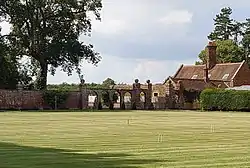
High House Gardens in Congham is a Victorian walled garden which was built in about 1856 by the famous architect Anthony Salvin. It was the garden for Congham High House which has been demolished although a section and the stables still remain. The house was the residence for almost a century of the Elwes family who were notable landowners and prominent members of society. Today the walled garden is an outdoor events venue for weddings, parties and other functions.[1]
Early residents
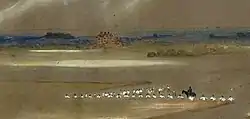
Robert Elwes (1819-1878) who built the house was a “country gentleman”, painter and author. He was the son of Henry Elwes of Colesbourne in Gloucestershire. His mother was Susan Hamond[2] who had brought the Congham land into the Elwes family when it was given by her father as a dowry[3] on her marriage in 1813. When Henry died in 1850 he left the Congham estate to Robert with other farms and land in several counties. Robert travelled widely in his youth. In 1848 he left England aboard The Eclipse to start a two year voyage around the world. During all his travels he painted, sketched and kept an account of his adventures which he published in 1854 in a book entitled, “ A Sketcher’s Tour Round the World”. It can be read at this reference.[4]
He explored Brazil and in Argentina and crossed the Pampas on horseback. He sailed to Honolulu, Tahiti and was shipwrecked off the coast of Tasmania in 1849. He was rescued by sealers and taken to Hobart. He sailed on to Australia and then went to Hong Kong, Canton, Shanghai, Singapore and the Red Sea. He travelled through the desert to Cairo in a horse drawn van and finally arrived back in London in 1850 shortly before his father’s death. When he married Mary Frances Lucas (1833-1866) the following year he was very wealthy because of his inheritance from his father.
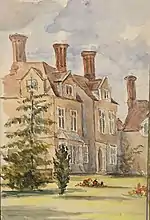
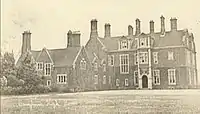
In about 1856 Robert commissioned the famous architect Anthony Salvin to build the Tudor style “High House” which was also referred to as “Congham House”[5] [6] A photo of the house is shown. The walled garden was behind the building. Robert and his daughter Violet were both competent artists and several paintings of the house were made. In about 1870 Robert painted “The Congham Reapers” which can be seen at this reference.[7] High House is in the middle background and is viewed from the south. It is enlarged and shown. The walled garden can be seen to the right of the house. Robert also painted the drawing room which can be seen at this reference.[8]
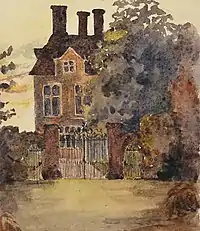
His daughter Violet Elwes made several watercolour paintings of “High House”. The one on the right was made in 1883 and shows the inside of the walled garden looking through the gates to the back of the house. Another is a clearer picture of the back of the house. The walled garden is not shown but would be to the right of the picture.
Robert was a member of the West Norfolk Hunt and frequently the Edward VIIPrince and Princess of Wales who were also members of this Club were his guests at High House. Robert and his wife were also frequently invited to functions by the Prince at Sandringham. There are many newspaper articles that mention these royal visits at the house. One of them stated:
"On Saturday their Royal Highnesses the Prince and Princess of Wales, the Duke of Edinburgh and Prince and Princess of Louis of Hesse accompanied by the Marchioness of Carmarthen etc drove over to High House (Congham House), the seat of Mr Robert Elwes where there was a large and fashionable assemblage including many who were present at the ball at Sandringham on Friday night".[9]
When Robert died in 1878 his eldest son Robert Hamond Elwes (1856-1881) inherited the house. However he was killed in the Boer War three years later in 1881 and the property was passed to his brother Arthur Henry Stuart Elwes (1858-1907).
Later residents
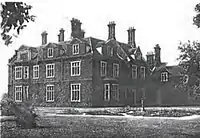
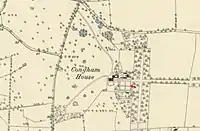
Arthur Henry Stuart Elwes (1858-1907) appears to have made additions to the front of the house as the map of 1884 shows the building as a rectangle. A photo of the altered house is shown. In 1884 Arthur married Millicent Chapman (1861-1939} who was the daughter of Peter Godfrey Chapman of Congham Lodge. The couple had three sons.
He was educated at the Royal Naval College, Southsea and served in the Navy until he inherited the Congham Estate.[10] He was a councillor on the Norfolk County Council and commanded D Squadron of the Kings Own Royal Regiment of Norfolk. When he died in 1907 his eldest son Robert inherited the house.
Robert Hamond Arthur Elwes (1887-1955) was a Lieutenant in the First World War. Shortly before he joined the military in 1914 he married Esterel Tillard (1893-1925) who was the daughter of Admiral Philip Francis Tillard and the couple had three daughters and one son. She died in 1925 and in the following year he married Philippa Gurney (1899-1977). The Census of 1939 records Robert and Philippa living at High House with a governess and four domestic servants.
Shortly after this Census was taken in 1939 a fire broke out in the house and gutted the building. According to newspaper reports it started at about 1.00 am in a downstairs room in the west of the house.[11] The family did not try to repair the building and for many years it was left in a ruinous state. In 1955 Robert died and in the following year the property was sold to the Clifton Brown family who still own it today.
External Links
References
- High House Gardens website. Online reference
- Burke, B “A Genealogical and Heraldic History of the United Kingdom, p. 514. Online reference
- Dersingham History website. Online reference
- Elwes, Robert, 1854 “A sketcher's tour round the world”. Online reference
- Allibone, Jill 1987 “Anthony Salvin: Pioneer of Gothic Revival Architecture, 1799-1881”, p. 69. Online reference
- Pevsner, N. and Wilson, B. 1999 “ “Norfolk 2: North and South West”, p. 270. Online reference
- Watercolour World website. Online reference
- Watercolour World website. Online reference
- Morning Post - Monday 13 November 1871, p. 5.
- The Times, 5 November, 1907, p. 7.
- Lynn News & County Press - Tuesday 21 November 1939, p. 3.